
Unbiased headlines. Facts, not spin.
Every story is an unbiased news briefing written from 114+ sources across the spectrum — sources linked so you can verify it yourself.
 economy
Notable (5/10)
October 12, 2026 at 10:26 AM
economy
Notable (5/10)
October 12, 2026 at 10:26 AM
Robert Hall and Michael Woodford Win 2026 Nobel Prize in Economics
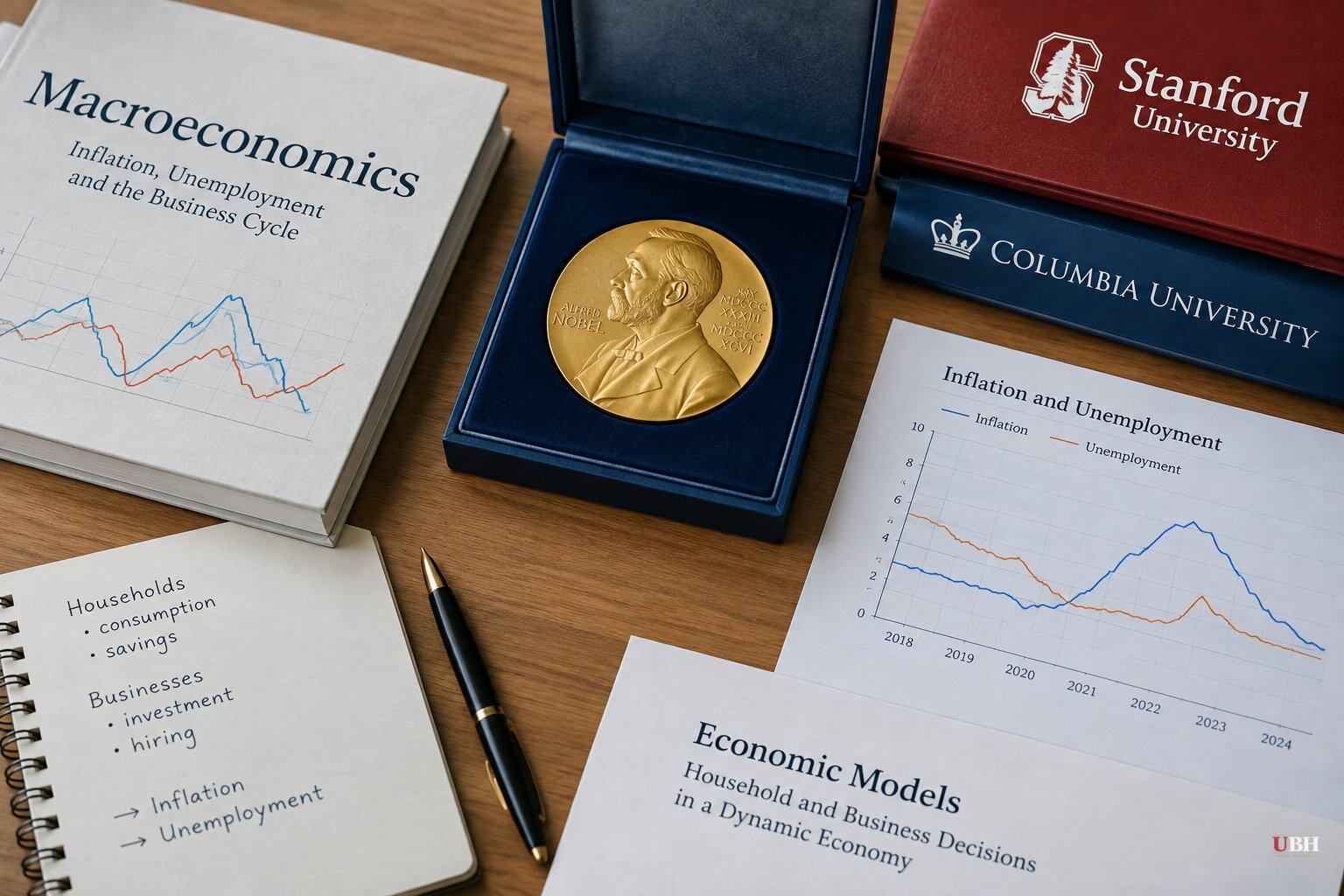
Two American economists won the 2026 Nobel memorial prize in economics today, Oct. 12. The Royal Swedish Academy of Sciences announced in Stockholm that Robert E. Hall of Stanford University and Michael Woodford of Columbia University were honored "for microeconomic foundations of macroeconomic stabilisation."
The prize is worth 12 million Swedish kronor, about $1.2 million, split between the two. It is the last of this year's Nobel announcements.
What the Academy says they did
The Academy said the pair developed macroeconomic models that "significantly improved our ability to implement effective stabilisation policy." In its words: "On the basis of these models, well-timed fiscal and monetary policy measures can reduce the economy's peaks and troughs."
John Hassler, chair of the Committee for the Prize in Economic Sciences, said the laureates' work "has provided us with a stable theoretical foundation for the models that are now used by central banks and governments around the world."
Hassler added: "With them, we are better equipped to deal with shocks in the economy, such as energy crises or sudden changes in how much households consume."
The research connects the choices made by households, workers and firms to the big aggregate numbers: inflation, unemployment, interest rates and growth. That link is what lets central banks and treasuries model how a policy move will ripple through an economy.
The two laureates
Hall, born in California in 1943, is an emeritus professor at Stanford and a senior fellow at the Hoover Institution. His research has covered employment, inflation, consumer spending and economic fluctuations. He also chaired the National Bureau of Economic Research's Business Cycle Dating Committee, the body that sets the official start and end dates of U.S. recessions and expansions.
Woodford, born in Massachusetts in 1955, is a professor of political economy at Columbia. He is one of the architects of modern forward guidance, the idea that a central bank can steer the economy by shaping public expectations about future policy and inflation, not just by moving the interest rate today.
Woodford spoke to the committee by phone from New York. "It's a tremendous honor, it's a surprise," he said. He had been among the names floated as a possible winner in pre-announcement predictions.
A prize with an asterisk
The economics prize is not one of the five awards in Alfred Nobel's 1895 will. Sweden's central bank, the Riksbank, created it in 1968 in his memory, and it was first awarded in 1969. Nobel purists stress that it is technically not a Nobel Prize. Detractors have dubbed it "a false Nobel."
It is nonetheless presented alongside the others on Dec. 10, the anniversary of Nobel's death in 1896.
How it fits the record
Most past laureates have come from the United States, and Hall and Woodford extend that run. Only three women have ever won the economics prize. The most recent was Claudia Goldin in 2023, for her work on how gender has affected pay and employment over time.
Last year's prize went to Joel Mokyr, Philippe Aghion and Peter Howitt for work on "creative destruction" and how new technology and production methods raise growth and living standards. Analysts at Clarivate's Institute for Scientific Information had pointed to monetary policy, the economics of information technology and evolutionary economic theory as likely areas for recognition.
This year's other awards went to Karl Deisseroth, Peter Hegemann and Georg Nagel in medicine, Francis Halzen in physics, Henri Kagan and Kenso Soai in chemistry, and Anne Carson in literature. South African jurist Navi Pillay received the Peace Prize on Friday, Oct. 9.
What comes next
The Academy's claim is a specific one: that well-timed fiscal and monetary action can flatten the economy's swings. Central banks and governments will keep testing that claim in real time, since they are the ones using these models.
Hall and Woodford will formally receive their medals and diplomas in Stockholm on Dec. 10.
Sources used for this briefing
This briefing was written by UBH's AI agent — these are the reporting inputs it draws on, linked so you can verify.


