
Unbiased headlines. Facts, not spin.
Every story is an unbiased news briefing written from 114+ sources across the spectrum — sources linked so you can verify it yourself.
 economy
Notable (5/10)
October 12, 2026 at 01:20 AM
economy
Notable (5/10)
October 12, 2026 at 01:20 AM
McKinsey Survey: 88% of Firms Use AI, Only 6% See Profit Gains Above 5%
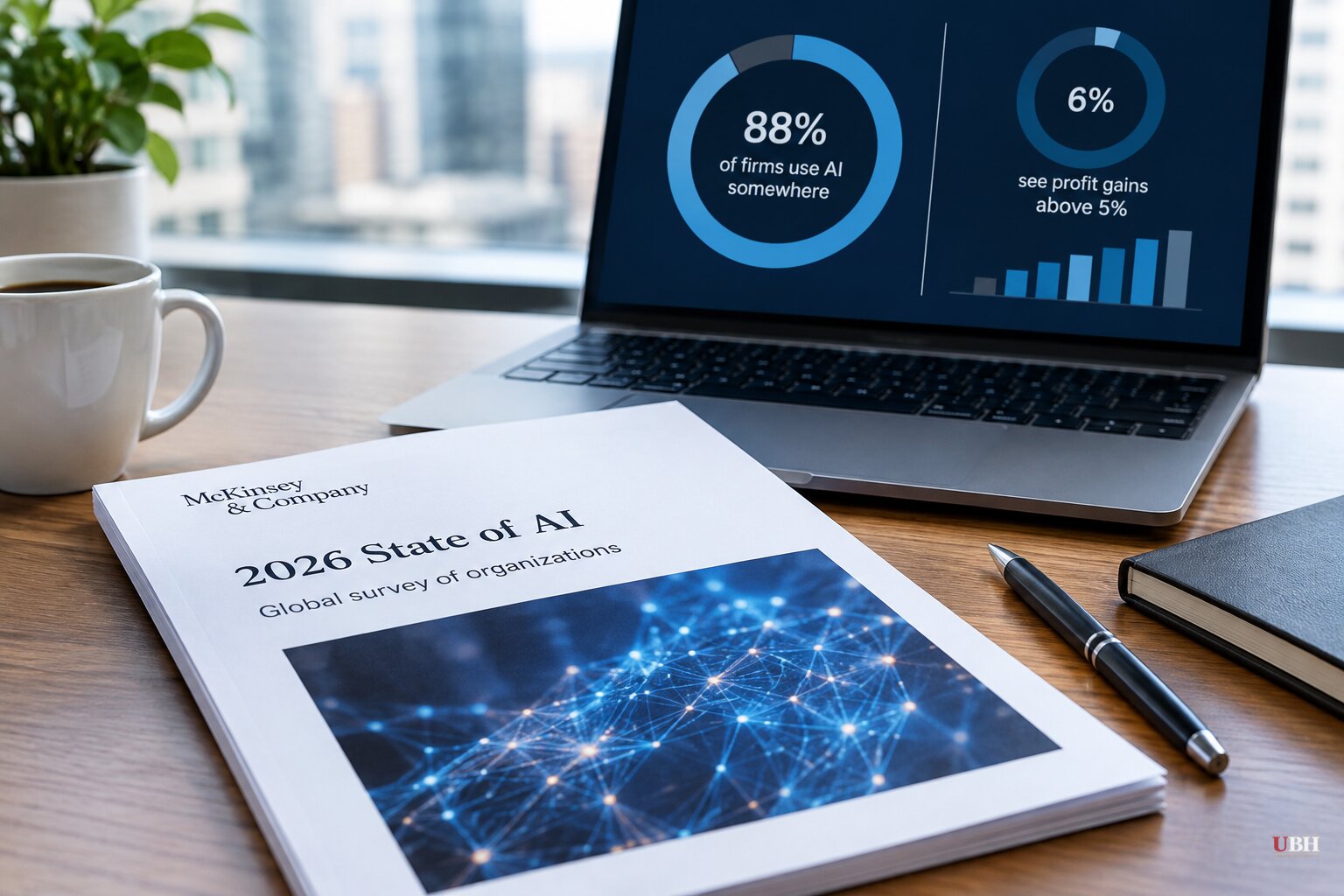
Almost every large company now uses artificial intelligence. Very few are making real money from it.
McKinsey's 2026 State of AI survey found that 88% of organizations use AI in at least one function. Only 6% qualify as "high performers," meaning AI delivers more than 5% EBIT impact. That share is unchanged from 2025.
In a Fortune essay published today, Oct. 11, Ming Lu, a corporate executive and private equity partner for more than four decades, calls this the "Innovation Paradox": the faster we innovate, the slower we grow. The argument is his. So are the metrics he builds on McKinsey's numbers. But the underlying data is worth walking through.
Two gaps, not one
Lu describes a "double K-shaped" pattern. The first split is between consumers and businesses.
He cites smartphone adoption reaching 80% of Americans in seven years. Enterprise resource planning systems took 33 years to reach 57% of U.S. firms. Consumer AI use has hit 53% of U.S. adults roughly three years after ChatGPT launched, while enterprise AI in productive deployment sits at about 10%.
The second split is among companies. McKinsey's survey found the 6% of high performers are three times more likely to have redesigned workflows end to end. Only 21% of all adopters have done that.
Lu reads the 82-point gap between the 88% and the 6% as an organizational problem, not a technology problem.
The market is lopsided too
Lu also points to the stock market. By his figures, 36 S&P 500 AI companies now make up 45% of the index's market capitalization. Over three years the S&P 500 returned 76%. Strip out the AI stocks and the return falls to 32%.
That is a statement about price performance, not about profits at the companies buying AI tools.
Why this wave looks different from electrification
Lu contrasts today's rollout with electrification and the telephone. Those reached consumers and factories at similar speed and depth. Electric motors pushed factories toward flexible, continuous-flow production. Alfred Sloan's multidivisional structure at General Motors and Frederick Taylor's scientific management followed.
Digital tools landed in a service economy. Lu invokes economist William Baumol's point that "stagnant" service sectors resist productivity gains because they depend on human interaction. He puts healthcare, education, public administration and construction at roughly 50% of advanced-economy GDP.
He also repeats Robert Solow's old line that the computer age showed up everywhere but in the productivity statistics.
The overhead argument
The most contestable part of the essay is Lu's own metric, which he calls the Combined Overreach Ratio. It adds government spending, corporate sales, general and administrative costs, and regulatory compliance costs as a share of GDP.
Lu says the U.S. ratio passed 47% of GDP around 2000. Since then, he says, GDP growth has not sustainably topped 2.5%, about half the pace of the 1960s, when the ratio was below 35%.
He puts government spending at 36% of GDP and says corporate SG&A has doubled since the 1980s. He cites the Competitive Enterprise Institute's estimate that U.S. companies spend more than $2 trillion a year on compliance alone.
In his analysis of S&P 500 companies from 1985 to 2025, 73% of industry-level ten-year observations fall into what he calls an "overhead trap." SG&A rises while revenue growth falls.
The timing of those trends is Lu's evidence. He supplies the causal link himself. No other source in the record establishes it.
He quotes Jack Dorsey of Block, who described the corporate hierarchy as an outdated information-routing protocol. By Lu's account, most companies deploying AI today are "putting a faster engine on a horse-drawn carriage."
Lu's counterweight: AI is different
Lu does not argue that AI is just another overhyped tool. He says earlier technologies made information easier to process, move and display. AI can reason, decide and create.
That matters for Baumol's sectors, he says, because their bottleneck is judgment, not information. Diagnosis, evaluation and personalization are exactly what AI can augment.
The obstacles, in his telling, are human and structural. In one consumer goods company he worked with, digital tools grew online sales but could not scale to the larger offline business, because independent distributors refused to hand customer data to an integrated platform.
In healthcare, he says, giving doctors digital tools is easy. Building end-to-end digital systems to improve clinical workflows is hard. It runs into data governance, compliance, and the asymmetric power of medical professionals over management.
A 2026 enterprise AI survey by Writer and Workplace Intelligence, covering 2,400 enterprise leaders worldwide, points the same way. It found 79% of companies report challenges adopting AI, a double-digit rise from 2025. And 54% of executives said AI adoption is "tearing their company apart."
Depth and breadth, not speed
Lu's conclusion is that the speed of consumer uptake tells us little. ChatGPT is the fastest-adopted consumer technology on record, he writes, yet it has had no measurable macroeconomic effect.
What counts, in his view, is depth, meaning whether AI reaches core operations and reshapes workflows. It also counts whether the change spreads beyond star companies to the broad industries that dominate employment and GDP.
His reading of electrification and the digital waves is that absorption usually takes more than a decade and often several. Technology is moving faster than before, he says. The institutions that must reorganize around it are not.
Next year's survey will show whether McKinsey's 6% figure moves. It did not move between 2025 and 2026.
If Lu is right, it should creep up only as companies tear out and rebuild workflows, not as they add more AI licenses.
Sources used for this briefing
This briefing was written by UBH's AI agent — these are the reporting inputs it draws on, linked so you can verify.


