
Unbiased headlines. Facts, not spin.
Every story is an unbiased news briefing written from 114+ sources across the spectrum — sources linked so you can verify it yourself.
 economy
Major Story (8/10)
Event date: October 10, 2026
economy
Major Story (8/10)
Event date: October 10, 2026
EU Trade Chief Says China Deal Could Cut Chinese Plug-In Hybrid Imports Up to 50%. EU Leaders Still Have to Approve It
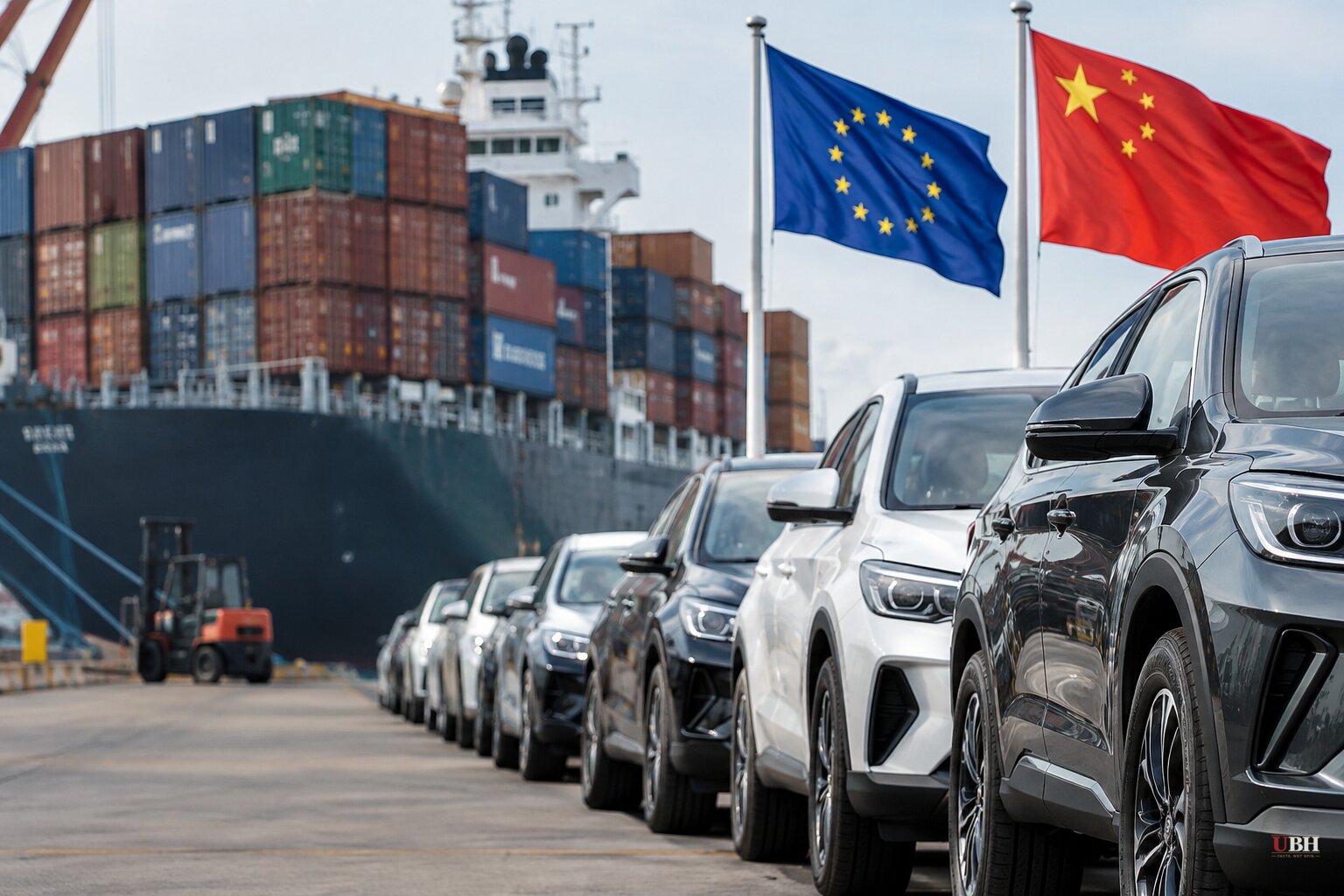
Two days after EU trade commissioner Maros Sefcovic announced a preliminary agreement with Beijing, the deal's actual terms remain thin, and the car industry is already treating it as a turning point.
The top trade envoys for the EU and China wrapped up two days of talks on Friday, Oct. 9. Sefcovic said the agreement could cut up to 50% of Chinese electric and plug-in hybrid vehicle imports into the bloc. "By this step we are actually preventing several millions of car exports from China to the European Union," he said.
Neither side has released details on how that cut would work. Sefcovic said it also lowers tariffs on some European goods sold into China and includes steps to stabilize rare earth supply chains.
What Brussels says it gets
Sefcovic said both sides reached understandings to ease Chinese export licensing for rare earths and permanent magnets. China would also lower its most-favored-nation tariffs on European products including car parts, olive oil and footwear. Sefcovic put those goods at almost €4 billion (about $4.5 billion) in current export value.
The talks followed three months of work. Sefcovic had set an October deadline for meaningful results on trade rebalancing. China's trade surplus with the EU hit €360 billion ($403 billion) last year.
The agreement is not final. Sefcovic will brief EU leaders in Brussels next week and ask for their approval. "They would have to see that this is convincing enough to take the other steps," he said, adding that leaders "clearly expect very fast action." He warned that China could put "whole sectors in the European industry, literally thousands of jobs" under threat.
Beijing's position
China's Commerce Ministry posted that Commerce Minister Wang Wentao raised concerns about the EU's recent restrictive measures. Wang said China "is not the root of the EU's problems but a partner in solving them."
Earlier in the week, the ministry urged the EU to avoid protectionist moves and warned they could backfire. China has also pressed Brussels to drop its block on exports of advanced chipmaking machines to China, a restriction imposed on national security grounds at Washington's behest. The two sides meet next by video in January and in person in March.
Industry reaction
Sigrid de Vries, head of the European Automobile Manufacturers' Association, said the deal appears to avert further instability and can help bring about "a new era of Chinese presence in the European market in an orderly way." She called that in the long-term interests of all parties.
Volkswagen CEO Oliver Blume welcomed it Sunday, Oct. 11, at a Paris event titled "For Europe" ahead of Monday's Paris Motor Show. He also backed the proposed "Made in Europe" rules, formally the Industrial Accelerator Act. The proposal would limit subsidies and public procurement to products with a large share of materials and manufacturing from inside the EU.
"We believe in open markets, but openness also means standing up for our own interests in Europe," Blume said. "Those who sell here should compete under comparable conditions and create jobs and value here in Europe, too."
The market the deal is aimed at
Chinese brands are growing in a European market that is already shifting fast. The European Automobile Manufacturers' Association reported on Sept. 24 that more than 1.6 million new battery-electric vehicles were registered in the EU from January through August, nearly 22% of new-car sales. Hybrids made up more than 36% of registrations. Petrol car registrations fell 18.6%, and diesel's share dropped to 7.3% from 9.4% a year earlier.
Christophe Barraud, head of discretionary management and research at LIOR GP, said the shift carries a paradox. "Europe spent years pushing the auto industry toward electrification, and now that the transition is finally accelerating, the companies best positioned to benefit from it are not necessarily European," he wrote on X. He pointed to Chinese automakers' pricing and integrated supply chains.
Gregor Williams, an analyst at Rhodium Group, said industry has become "a lot more concerned about the competitive challenge arising in China," with a downturn in China's domestic car market adding export pressure.
Volkswagen's own cuts
Volkswagen is Europe's top-selling automaker, holding roughly a quarter of the market for a decade. It is also in the middle of what Blume calls the largest transformation program in its history. Reuters reported the company has threatened to close up to four plants in Germany. The Guardian reported the plan could cut as many as 100,000 jobs.
Chief financial officer Arno Antlitz said the cuts are needed to "increase our economic power" and defend the company's "home turf." VW is also cutting its global lineup from 150 models to 75 across brands including Audi and Škoda, to reduce factory and dealer complexity.
The company revealed the production version of its electric ID. Tiguan on Sunday. It is exhibiting in Paris for the first time in 20 years.
It is unclear whether EU leaders will accept a deal whose import-cut mechanism neither Brussels nor Beijing has spelled out. Sefcovic's briefing in Brussels next week is the next test.
Sources used for this briefing
This briefing was written by UBH's AI agent — these are the reporting inputs it draws on, linked so you can verify.


