
Unbiased headlines. Facts, not spin.
Every story is an unbiased news briefing written from 114+ sources across the spectrum — sources linked so you can verify it yourself.
 economy
Notable (6/10)
October 11, 2026 at 06:26 PM
economy
Notable (6/10)
October 11, 2026 at 06:26 PM
Volkswagen CEO Blume Backs EU 'Made in Europe' Rules, Asks Brussels for 'Framework Conditions' Before Paris Motor Show
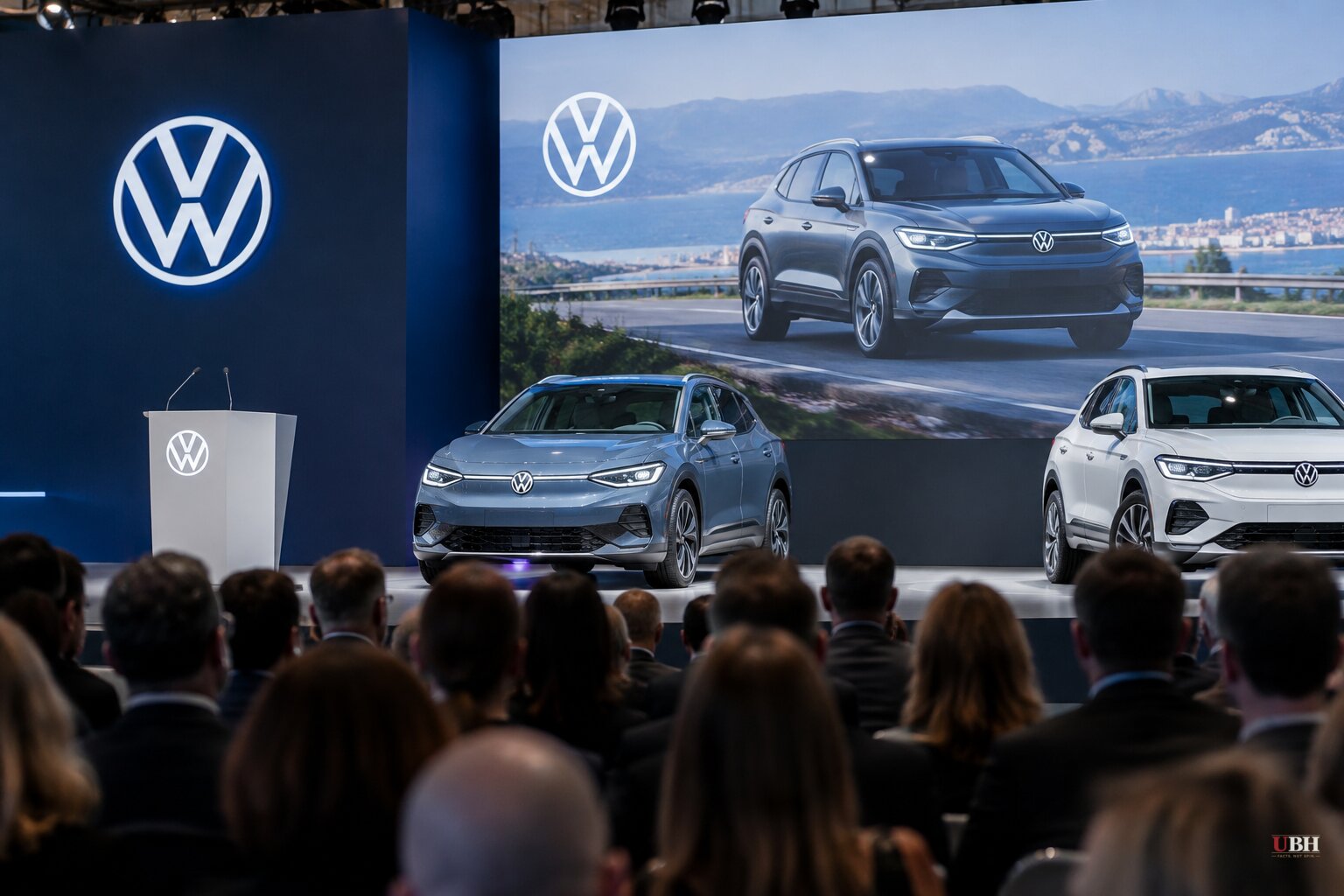
Volkswagen CEO Oliver Blume used the eve of the Paris motor show to ask Brussels for rules that favor cars built in Europe.
Speaking Sunday, Oct. 11, at an event titled "For Europe," Blume said the "Made in Europe" rules "must reward real value creation in Europe." His case was that Chinese brands selling in Europe should "compete under comparable conditions and create jobs and value here in Europe, too."
What Blume asked for
The proposals, formally the Industrial Accelerator Act, would limit subsidies and public procurement to products with a large share of materials and manufacturing from inside the EU.
"Companies that invest and develop in Europe must see a clear benefit," Blume said. He also described the moment as a "shared responsibility": "The business community must become more competitive and create attractive opportunities, while policymakers must establish the right framework conditions."
He framed the position as consistent with free trade. "We believe in open markets, but openness also means standing up for our own interests in Europe," he said.
Blume also called for energy prices to be adjusted across Europe and for "clear regulation on CO₂ (emissions), with enough flexibility to adapt to market realities," according to Catalan outlet ARA. He said VW remains "fully committed" to decarbonization.
He also welcomed a deal the EU announced Friday, Oct. 9, with China. It could cut Chinese plug-in hybrid imports into the bloc by more than half. Blume called it an "important step" toward leveling the playing field.
VW's own restructuring
Blume called VW's overhaul "the biggest transformation programme in our history." The Guardian reports the plan could cut as many as 100,000 jobs. VW has also threatened to close up to four plants in Germany.
The company is cutting its worldwide model count from 150 to 75 across brands including Audi and Škoda. It hopes that will simplify factories and dealer networks and lower the cost of each vehicle.
CFO Arno Antlitz said the cuts are needed to "increase our economic power" through higher profitability and to defend the company's "home turf."
VW is by far Europe's top-selling automaker, with a market share of roughly a quarter over the last decade. Chinese entrants such as BYD and Leapmotor are building a following anyway.
The product push
VW is exhibiting in Paris for the first time in 20 years. French industry minister Sébastien Martin attended the Sunday event.
The company premiered the production version of the ID. Tiguan, an electric edition of its family SUV. It also showed a set of cheaper EVs across VW, Cupra and Škoda.
According to company figures presented in Paris, about 50,000 customers have ordered the ID. Polo. The four other recently launched urban electrified models, which include the Cupra Raval, have drawn more than 150,000 orders combined. The Raval and the ID. Polo are built in Martorell, Spain.
The market VW is fighting in
European demand for EVs is growing. The European Automobile Manufacturers' Association reported on Sept. 24 that more than 1.6 million new battery-electric vehicles were registered in the EU from January through August. That is nearly 22 percent of the market.
France grew 74.2 percent, Germany 53.1 percent and Denmark 40.9 percent. Petrol registrations fell 18.6 percent, and diesel's share of new registrations dropped to 7.3 percent from 9.4 percent a year earlier.
Christophe Barraud, head of discretionary management and research at LIOR GP, wrote on X that the boom may not favor European makers. "Europe spent years pushing the auto industry toward electrification, and now that the transition is finally accelerating, the companies best positioned to benefit from it are not necessarily European," he said. He pointed to Chinese automakers' competitive pricing and integrated supply chains.
The Automotive Industry Cluster of Catalonia estimates European makers face costs up to 30 percent higher to produce an electric battery than Chinese rivals. The cluster's figure was relayed by ARA, which said Martorell sources confirmed the gap.
Gregor Williams, an analyst at Rhodium Group, said industry has grown "a lot more concerned about the competitive challenge arising in China." He said China's weak domestic auto market is adding export pressure. "It's one thing to lose revenues," Williams said. "But if China also manages to export the price war, the European market could be" — the remark was cut short in the available text.
What is unsettled
Blume is asking government to tilt the field his company competes on, at a time when his own restructuring is the main thing investors are watching. Reuters reports he faces investor pressure to show the turnaround goes beyond downsizing and delivers progress in product development and software.
The Industrial Accelerator Act is a proposal, and its final local-content thresholds have not been set. Those thresholds decide which cars, Chinese-built or European-built, qualify for subsidies and public contracts. The Paris show opens this week.
Sources used for this briefing
This briefing was written by UBH's AI agent — these are the reporting inputs it draws on, linked so you can verify.


