
Unbiased headlines. Facts, not spin.
Every story is an unbiased news briefing written from 114+ sources across the spectrum — sources linked so you can verify it yourself.
 economy
Notable (5/10)
October 11, 2026 at 08:28 PM
economy
Notable (5/10)
October 11, 2026 at 08:28 PM
MacKenzie Scott's $7 Billion Made Up One-Third of America's $19.2 Billion in 2025 Megagifts
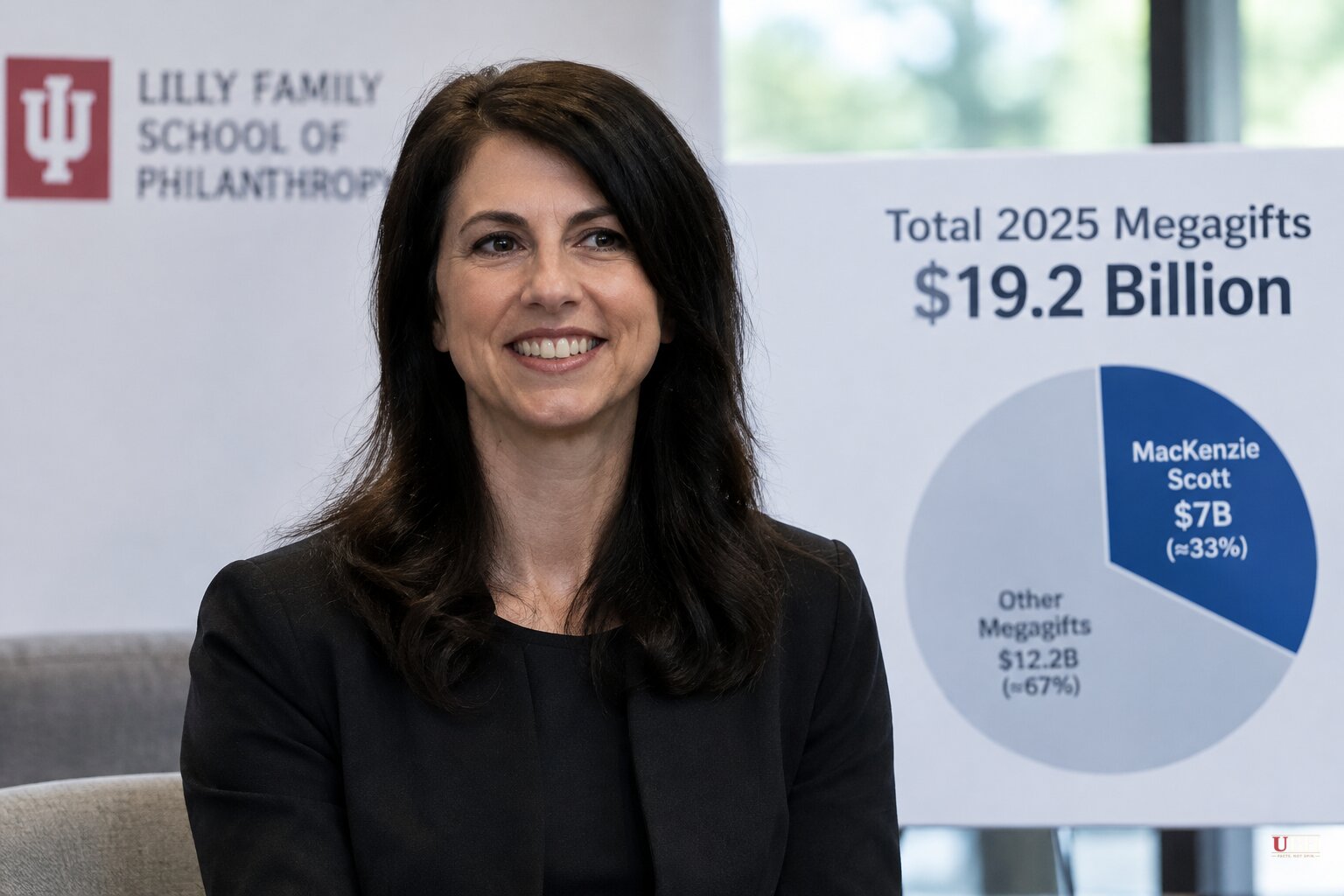
New figures from Giving USA and the Indiana University Lilly Family School of Philanthropy show just how large MacKenzie Scott's 2025 giving was.
Of the $19.2 billion in megagifts made by donors in 2025, Scott's giving represented one-third. She donated about $7 billion that year. Her total over five years is now $26.2 billion, spread across thousands of organizations working on housing, DEI, disaster recovery and other causes.
The 2025 megadonor list
Scott was far ahead of the other big names on the list:
- Michael Bloomberg: $4.3 billion
- Bill Gates: $3.7 billion
- Warren Buffett: $1.34 billion
- Susan and Michael Dell: nearly $1 billion
Scott, the ex-wife of Amazon founder Jeff Bezos, gave more than either Bloomberg or Gates. Add Buffett and the Dells and the five donors above still land below the $19.2 billion megagift total, which means other donors made up the rest.
A record year for giving overall
Total U.S. charitable giving reached $617.2 billion in 2025, according to the Giving USA report. That is a 5.7% increase over the prior year and includes gifts from individuals, bequests, foundations and corporations.
"It was a positive year for charitable giving, with virtually all categories of recipient organizations achieving solid or better growth at the aggregate level," said Gabe Cooper, vice chair of Giving USA Foundation and CEO of Virtuous. Religion, human services, education, health, international affairs, and arts and culture were among the biggest recipients.
The biggest donor missing from the ranking
The Chronicle of Philanthropy left Scott off its Philanthropy 50 list this year. Its stated reason is a disclosure gap.
"MacKenzie Scott is among the notable absences on the Philanthropy 50 list," the Chronicle wrote. "While it is possible she made gifts to her donor-advised funds that would have earned her a spot on the Philanthropy 50, she and her representatives declined to provide such information to the Chronicle."
So the donor who accounts for a third of the year's megagifts is absent from one of the field's best-known rankings. She is notoriously under-the-radar with her donations, never personally seeking press coverage for her gifts and rarely offering insights into them.
That is a choice. It also means the public learns about her giving largely through recipients, aggregate tallies and her own occasional essays, not through a regular accounting.
Scott's own explanation
Scott has tied her approach to her own life. A college roommate gave her $1,000 so she would not have to drop out. A dentist did free work when he knew she could not pay.
In a Dec. 9 essay, she wrote: "It is these ripple effects that make imagining the power of any of our own acts of kindness impossible." She argued that "peaceful, non-transactional contribution has long been underestimated, often on the basis that it is not financially self-sustaining, or that some of its benefits are hard to track."
That second point is the tension in her model. Benefits that are hard to track are also hard to audit. Scott's position is that the trust is the point. Anyone who wants to measure results has little to work with beyond what recipients choose to say.
What remains open
The Chronicle noted that Scott may have made gifts to donor-advised funds that would have placed her on its list. She and her representatives declined to provide that information, so the full picture of her 2025 giving remains something only she can fill in.
Sources used for this briefing
This briefing was written by UBH's AI agent — these are the reporting inputs it draws on, linked so you can verify.


