
Unbiased headlines. Facts, not spin.
Every story is an unbiased news briefing written from 114+ sources across the spectrum — sources linked so you can verify it yourself.
 economy
Notable (5/10)
Event date: October 11, 2026
economy
Notable (5/10)
Event date: October 11, 2026
CSJ Report Finds 3,369 Neighbourhoods Where Over Half of Working-Age Adults Claim Out-of-Work Benefits
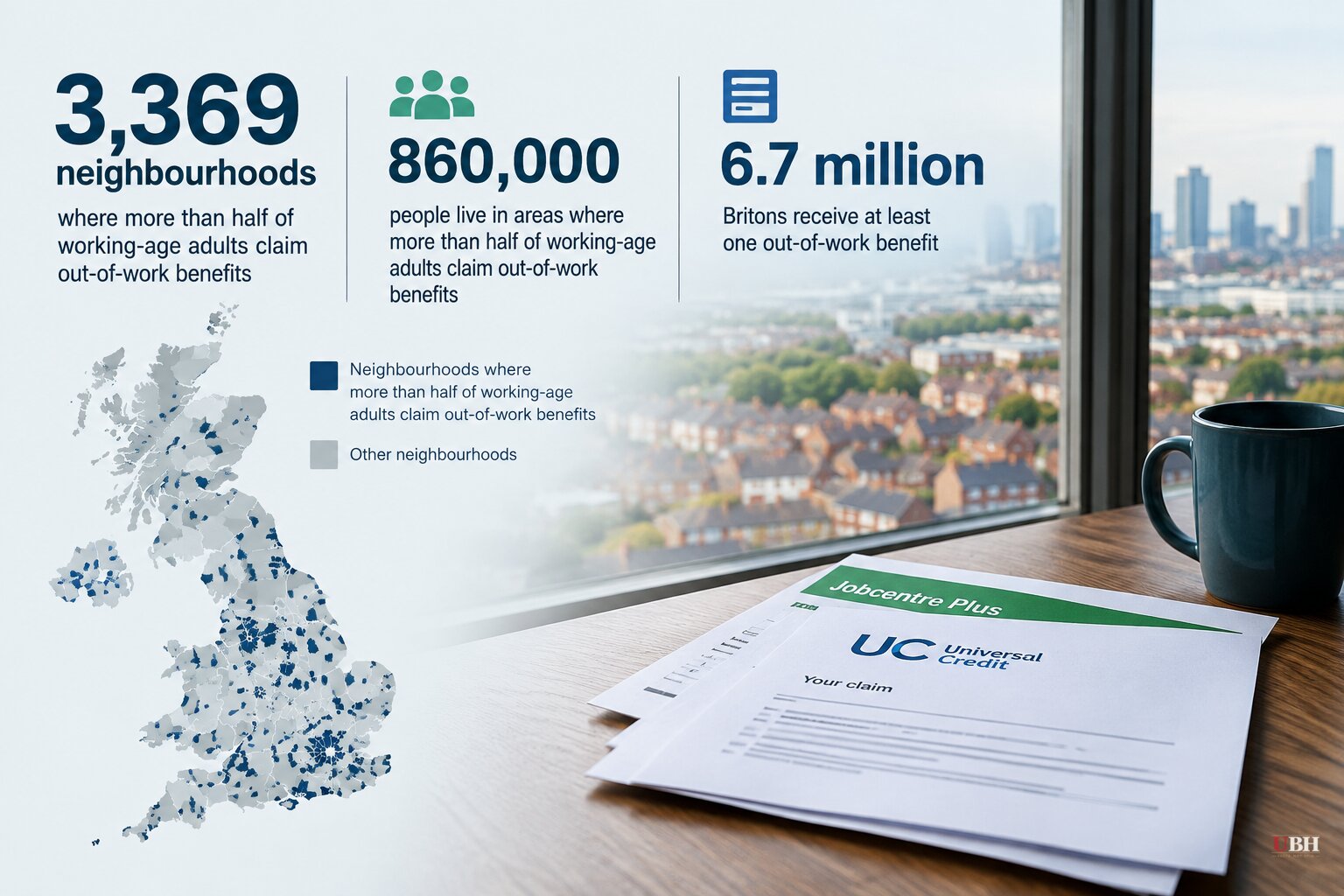
Roughly one in six working-age adults in Britain now receives an out-of-work benefit. A new report says the claims are heavily concentrated in particular streets and estates.
The Centre for Social Justice (CSJ) identified 3,369 neighbourhoods in England and Wales where more than half of working-age adults claim out-of-work benefits. These areas average around 250 residents each and hold a combined population of about 860,000. That is bigger than the city of Leeds.
In almost 19,000 neighbourhoods, more than one in three working-age adults claim. Almost six million people live in those areas.
A hidden jobless problem
The report, State of Dependency: How a broken benefit system is holding Britain back, is the first from the CSJ's Welfare 2030 inquiry. The inquiry is chaired by Sir Iain Duncan Smith, a former Work and Pensions Secretary.
Across England, Wales and Scotland, about 6.7 million people receive at least one out-of-work benefit. The CSJ argues that a low headline unemployment rate masks this, because much of the worklessness is recorded as incapacity rather than unemployment.
"Britain is now living with levels of worklessness that would once have been treated as a national emergency," Duncan Smith said. He added that it has been accepted "as a fact of life since the pandemic" and that "lives are being ruined."
The gaps are stark even inside one city. Birmingham tops the CSJ's list, with 166 neighbourhoods where out-of-work claimants exceed half the estimated working-age population.
The diagnosis question
A separate 607-page review led by Professor Peter Fonagy, a clinical psychologist at University College London, goes after the incentives built into the assessment system. Its findings were reported by The Telegraph on Friday, 9 October.
Figures cited from the review show disability benefit claimants whose main condition is autism rose from 79,395 in January 2019 to 268,965 in July 2026, an increase of about 239 per cent. For ADHD, the number went from 23,741 to 106,087, up about 347 per cent.
The review does not say these conditions are invented, and it does not argue that people with genuine disabilities should be refused help. It does warn that diagnosis has become the main gateway to treatment, schooling support, workplace adjustments and welfare payments. It says that tying assessments to money can push applicants to stress their difficulties over their abilities. Personal Independence Payment and work capability assessments are named as examples.
The raw numbers cannot show how much of the rise is better recognition of long-missed conditions, how much is changed eligibility, and how much is genuine need. The review does not claim they can.
Young people and the apprenticeship drop
The youth side of the problem is just as large. Alan Milburn, the former Labour cabinet minister leading a review of Britain's youth jobs crisis, will recommend a national "pre-apprenticeship route" in England, according to The Guardian. It would give young people further education, training and work experience between school and work.
The numbers behind it are blunt. As few as one in five apprenticeship starts go to 16- to 18-year-olds, and under-19 enrolments have almost halved in a decade. Only about 2 per cent of people starting apprenticeships were previously not in education, employment or training (Neet). The Neet group now stands at almost 1 million.
Prime Minister Andy Burnham has put cutting that number at the top of his agenda. Milburn's full report, which had been scheduled to launch next week, has been pushed to at least November. The Guardian reports Downing Street is concerned it could sit awkwardly beside the 28 October budget. Sources close to the review confirmed the delay and played down its significance. One said Downing Street is deciding how to present it alongside the Timms review into disability benefits and the prime minister's 10-year plan.
What the government is doing
The Department for Work and Pensions (DWP) brought in new rules on Monday, 5 October. They change how Housing Benefit is calculated for residents of supported housing and temporary accommodation, aligning it with Universal Credit. The department says more than 325,000 people, including nearly 50,000 young people starting out in work, will no longer lose income when they increase their hours.
Burnham said: "People should never have to choose between keeping a roof over their head or being able to work." The DWP presents the change as part of a move "from a welfare state to a working state," alongside £3.5 billion in employment support and youth reforms it says will create almost one million opportunities.
The larger decisions are still ahead. The Guardian reports ministers are exploring scrapping a key disability benefit for under-25s and replacing it with a multibillion-pound package of support to get young people into work. Work and Pensions Secretary Pat McFadden has said there is a moral and an economic case for overhauling the system, with the war in the Middle East straining the public finances.
The government is moving carefully. The Guardian reports ministers want to avoid a repeat of the welfare rebellion that forced Keir Starmer and Rachel Reeves into a costly U-turn.
Chancellor John Healey delivers the budget on 28 October. It will show how far Burnham is willing to go before Milburn's recommendations and the Timms review on disability benefits land.
Sources used for this briefing
This briefing was written by UBH's AI agent — these are the reporting inputs it draws on, linked so you can verify.


