
Unbiased headlines. Facts, not spin.
Unbiased Headlines is an independently owned news organization. We bring you the facts, not opinions, written fresh from 110+ named sources. Sources linked so you can verify it yourself.
 energy
Notable (5/10)
energy
Notable (5/10)
Richmond, California Sues Chevron Over Climate Change, Alleging Decades of Deception
What Richmond Filed
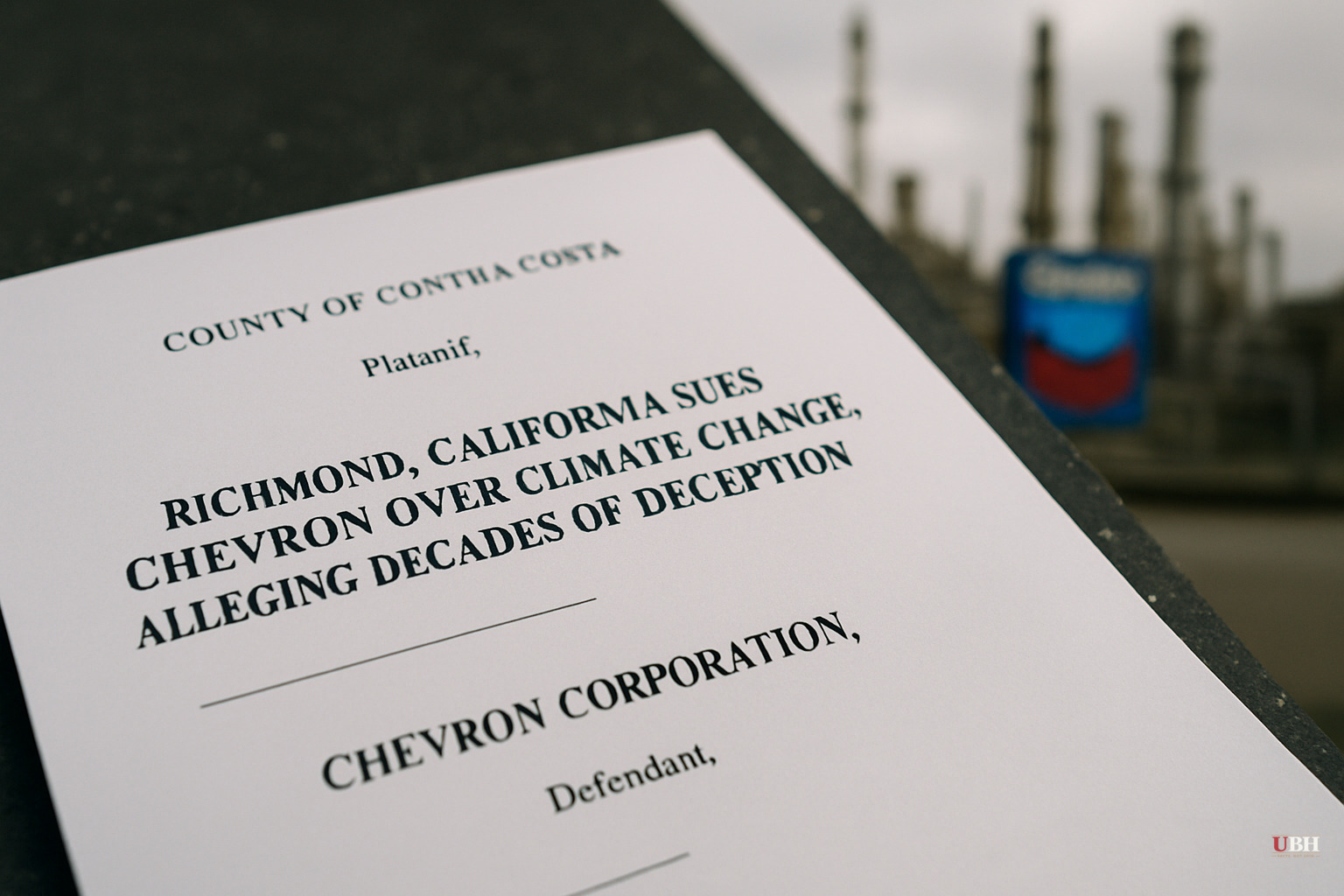
The city of Richmond, California has sued Chevron, alleging the company engaged in decades of deliberate deception about the role fossil fuels play in climate change. The LA Times reported on the lawsuit, framing it as a local government taking on a corporate neighbor it has clashed with for years. AP News also covered the filing before both source pages became unavailable, confirming the action occurred.
Richmond sits directly alongside Chevron's 2,900-acre refinery complex, one of the largest in California. That proximity has shaped local politics for a generation.
The Legal Theory
The lawsuit belongs to a wave of climate liability cases filed by municipalities across the country, most of which argue that oil companies knew their products were warming the planet and actively hid that from the public. The legal strategy borrows from the tobacco playbook: internal documents, they allege, show the industry understood the science while funding doubt about it publicly.
No verdict has been reached. No settlement has been announced. The case is in its early stages as of June 13, 2026.
Richmond's Political Context
Fox News covered the story with a framing focused heavily on Richmond's democratic socialist city leadership, describing the lawsuit as part of a "decades-long war on Chevron." That framing isn't wrong on the politics. Richmond has elected progressive and democratic socialist officials who have publicly opposed the refinery's operations for years. Fox's coverage, however, spent more time on the ideological label than on the specific legal allegations, which are the more consequential part of the story.
The actual lawsuit's claims deserve to be examined on their legal merits, not just through the lens of who filed them.
The Strongest Case for Chevron
Chevron's defenders, and there are legitimate ones, argue that the company operated legally under the regulatory frameworks governments set, paid billions in taxes that funded public services, and employed thousands of local workers. The argument that a private company should be held liable for societal-level climate outcomes, when governments themselves approved and incentivized fossil fuel production for a century, is not a frivolous position. Courts in other jurisdictions have dismissed similar climate suits on preemption grounds, finding that greenhouse gas emissions policy belongs to Congress and federal regulators, not local courtrooms.
The U.S. Supreme Court's 2011 ruling in American Electric Power Co. v. Connecticut established that federal environmental law displaces federal common law climate claims. Whether state-law claims survive that precedent is the central legal battleground these cases are fighting on right now.
Chevron's Departure
Chevron relocated its headquarters from San Ramon, California to Houston, Texas in 2023. Fox News connected that move directly to Richmond's political environment and California's broader regulatory climate. Chevron has NOT closed the Richmond refinery, which continues to operate as of June 13, 2026, but the HQ departure is a real data point about where the company sees its long-term relationship with the state.
Fox framed the exodus as proof that socialist governance drives out business. What's verifiable: Chevron moved. The refinery stayed. Both are true at the same time.
What Residents Actually Face
For Richmond residents, the tension isn't abstract. The refinery has had significant safety incidents over the years, most notably a 2012 fire that sent an estimated 15,000 people to area hospitals with respiratory complaints, according to prior reporting. That history is part of why local trust in Chevron is low. It's also part of why the city has a legitimate separate argument about localized health and environmental harm, distinct from the broader global climate liability theory.
Those are two different legal claims. Conflating them helps neither the lawsuit's precision nor the public's understanding.
The Open Question
The deeper unresolved issue is whether climate liability litigation is actually an effective way to drive emissions policy, or whether it primarily generates legal fees while the underlying scientific and regulatory questions remain locked in decade-long court battles. Several similar city and state suits, including cases from Baltimore and Honolulu, have moved slowly through the federal system with no final judgments. Whether Richmond's suit survives a federal preemption challenge, and whether California state courts handle it differently than federal venues have, will determine if this case is precedent-setting or another long march through procedural motions.
Sources used for this briefing
4 links from 4 independent newsrooms (syndicated copies of the same report count once)
These are the sources it draws on, linked so you can verify.


