
Unbiased headlines. Facts, not spin.
Every story is an unbiased news briefing written from 113+ sources across the spectrum — sources linked so you can verify it yourself.
 energy
Major Story (7/10)
October 5, 2026 at 12:17 AM
energy
Major Story (7/10)
October 5, 2026 at 12:17 AM
Private Equity Giants Managing $7.3 Trillion Grew Their Fossil Fuel Holdings Since 2024, Advocacy Report Finds
The Numbers
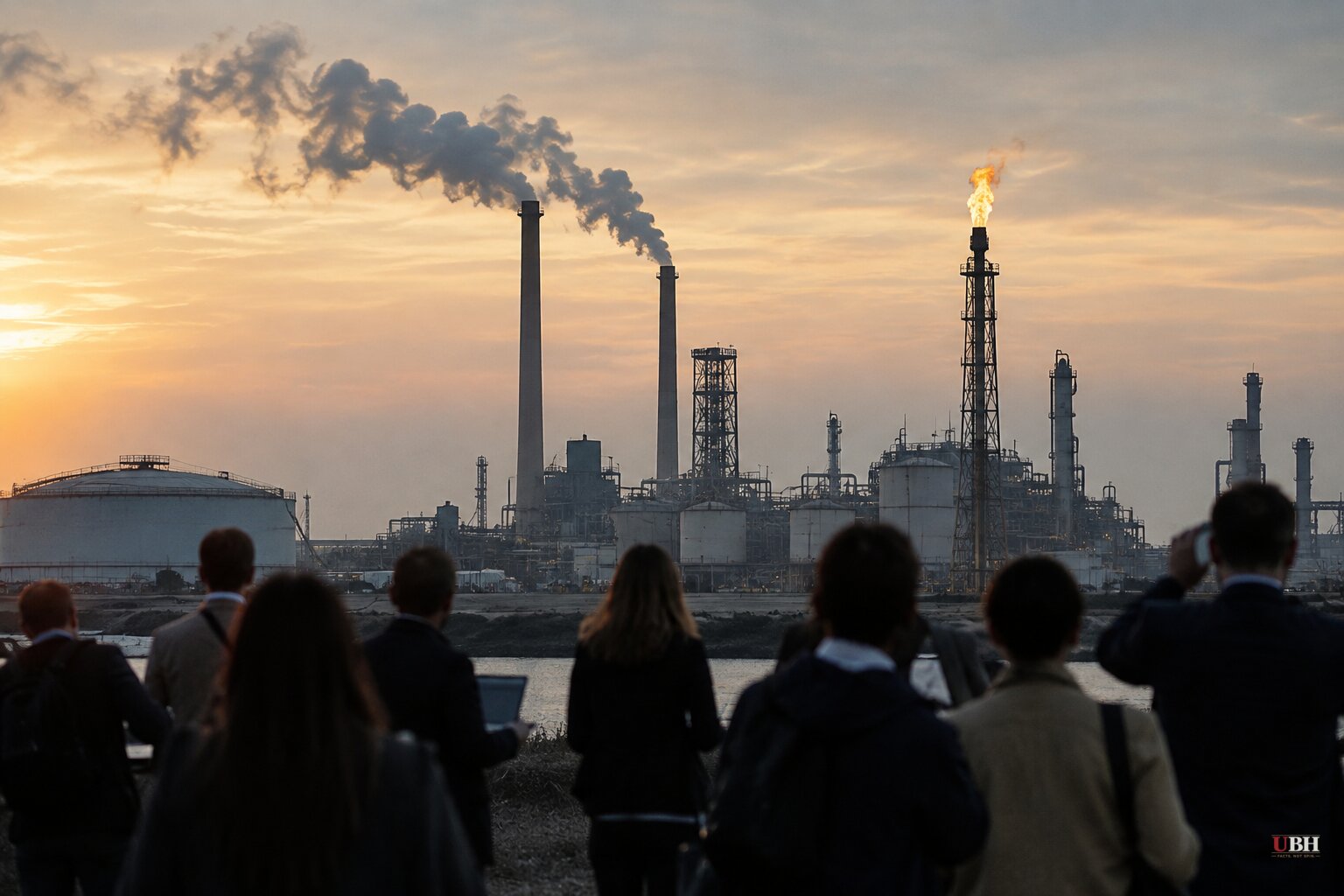
Twenty private equity firms managing a combined $7.3 trillion in assets own energy portfolios that produce an estimated 1.5 billion metric tons of greenhouse gases a year, according to the 2026 Private Equity Climate Risks Scorecard. That would rank fifth globally behind only China, the United States, India and Russia, if the portfolios were a country.
The scorecard, its third edition, was produced by the Private Equity Stakeholder Project, the Americans for Financial Reform Education Fund and Global Energy Monitor, and released September 15, 2026. These are activist organizations that track private equity's environmental footprint, not neutral auditors, and their findings should be read with that in mind. But the underlying asset counts are specific and checkable.
The researchers mapped more than 1,050 fossil fuel assets tied to these firms: at least 244 energy companies, more than 250 oil and gas fields, 15,000 miles of pipelines, 35 LNG terminals, 13 coal terminals, dozens of LNG tankers and hundreds of oil, gas and coal-fired power plants generating 124 gigawatts across 370 facilities. They built the analysis using PitchBook data along with company filings, press releases and news reports, and acknowledged they couldn't verify the total dollar amount invested because of gaps in disclosure.
Who's Buying, and Why
Five firms stood out for growing their fossil fuel holdings since 2024: BlackRock, Global Infrastructure Partners, Energy Capital Partners, EQT and Kayne Anderson, according to the report. A separate PitchBook analysis found private equity funded more than $1 trillion in energy assets since 2010, most of it fossil fuel.
The reason isn't mysterious. Artificial intelligence data centers need enormous, reliable electricity, and natural gas delivers it on demand in a way solar and wind still can't match at scale. Private equity firms back nearly half of the top 25 U.S. data center companies, and PE investment in U.S. data centers hit $45.7 billion in 2025, about 72% of all investment in that sector, according to the Americans for Financial Reform Education Fund.
Matt Parr, communications director for the Private Equity Stakeholder Project, told the Guardian the industry "doesn't get enough scrutiny and credit for its contribution to global emissions," calling it "a very opaque business model." That's a fair complaint on transparency grounds. Private equity ownership structures are genuinely harder to trace than public utility filings, and the report's own authors say that opacity is part of the point of the research.
The EQT Problem
The sharpest example of the gap between branding and behavior is EQT. The firm has marketed itself as a climate-conscious investor supporting the energy transition. Yet EQT, together with BlackRock's Global Infrastructure Partners and the California Public Employees' Retirement System, could soon acquire AES Corporation, which owns more than 20 power plants where natural gas accounts for roughly 32% of generating capacity, coal 16% and oil 2%, according to PrimeXBT's reporting on the scorecard.
Amanda Mendoza of the Private Equity Stakeholder Project called the potential deal "alarming," telling the Guardian it would make the buyers "owners of a fleet of coal power and gas powered plants" and that "it seems like they're transitioning to fossil fuels instead of away." EQT did not respond to the Guardian's questions about its fossil fuel investments. As of today, the AES acquisition has not closed, and none of the named parties have put a public timeline on it.
The strongest defense here isn't really a defense of EQT's marketing, it's a defense of the economics. CalPERS is a public pension fund with a fiduciary duty to retirees, not a climate nonprofit. If gas and coal assets throw off reliable cash flow while demand for grid power explodes, buying them is arguably the responsible move for pensioners' money, whatever it does to EQT's green reputation.
The Other Side of the Ledger
The picture isn't uniformly bleak for clean energy. BloombergNEF's Energy Supply Fund Ratio, covering more than 85,000 funds, found that for every dollar of capital expenditure flowing to oil, gas and coal projects through public-market funds, 80 cents went to low-carbon energy like solar and wind at the end of 2025, up from 73 cents at the start of 2024. Fixed income and private markets funds typically post higher ratios still, though they move less total money.
Vanguard and BlackRock together enable more capex than the rest of the top ten asset managers combined, and their ratios held roughly flat through 2025, per BloombergNEF. Much of that is simply a function of index design: most capital sits in funds tracking broad benchmarks like the S&P 500, where managers have little say over which companies get added or dropped. Natural gas producer Expand Energy joined the index in 2025 while solar equipment maker Enphase Energy exited after its market value fell, dragging the S&P 500's own ratio down regardless of what any fund manager wanted.
What's Unproven, and What Isn't
The report's claim that 145 oil and gas funds raising $190.4 billion between 2001 and 2016 underperformed after inflation is a specific, testable assertion, but the available reporting doesn't include the actual return figures behind it. That's a gap worth watching for when the full scorecard data becomes available for independent review.
The advocacy groups tied their release to the Trump administration's rollback of federal emissions limits on coal and gas power plants and to July 2026 ranking as the hottest month in the contiguous U.S. since recordkeeping began in 1895. Both are real, dated developments. But no source here establishes that the policy rollback caused the private equity buildout in fossil assets. The timeline and the capital flows into gas-fired power for data centers predate this year's regulatory changes. Treat them as parallel facts, not cause and effect.
The open question is whether the EQT-GIP-CalPERS bid for AES Corporation closes, and whether CalPERS's board faces pressure from California lawmakers over owning a coal-and-gas fleet through a private equity vehicle. Neither EQT nor CalPERS has set a public timeline.
Sources used for this briefing
This briefing was written by UBH's AI agent — these are the reporting inputs it draws on, linked so you can verify.


