
Original briefings. Zero spin.
Every story is an original briefing written from 110+ sources across the spectrum — sources linked so you can verify it yourself.
 energy
Major Story (8/10)
August 28, 2026 at 02:09 AM
energy
Major Story (8/10)
August 28, 2026 at 02:09 AM
Nvidia Posts $96.2 Billion Quarter as Jensen Huang Admits AI Data Centers Are Straining the Power Grid
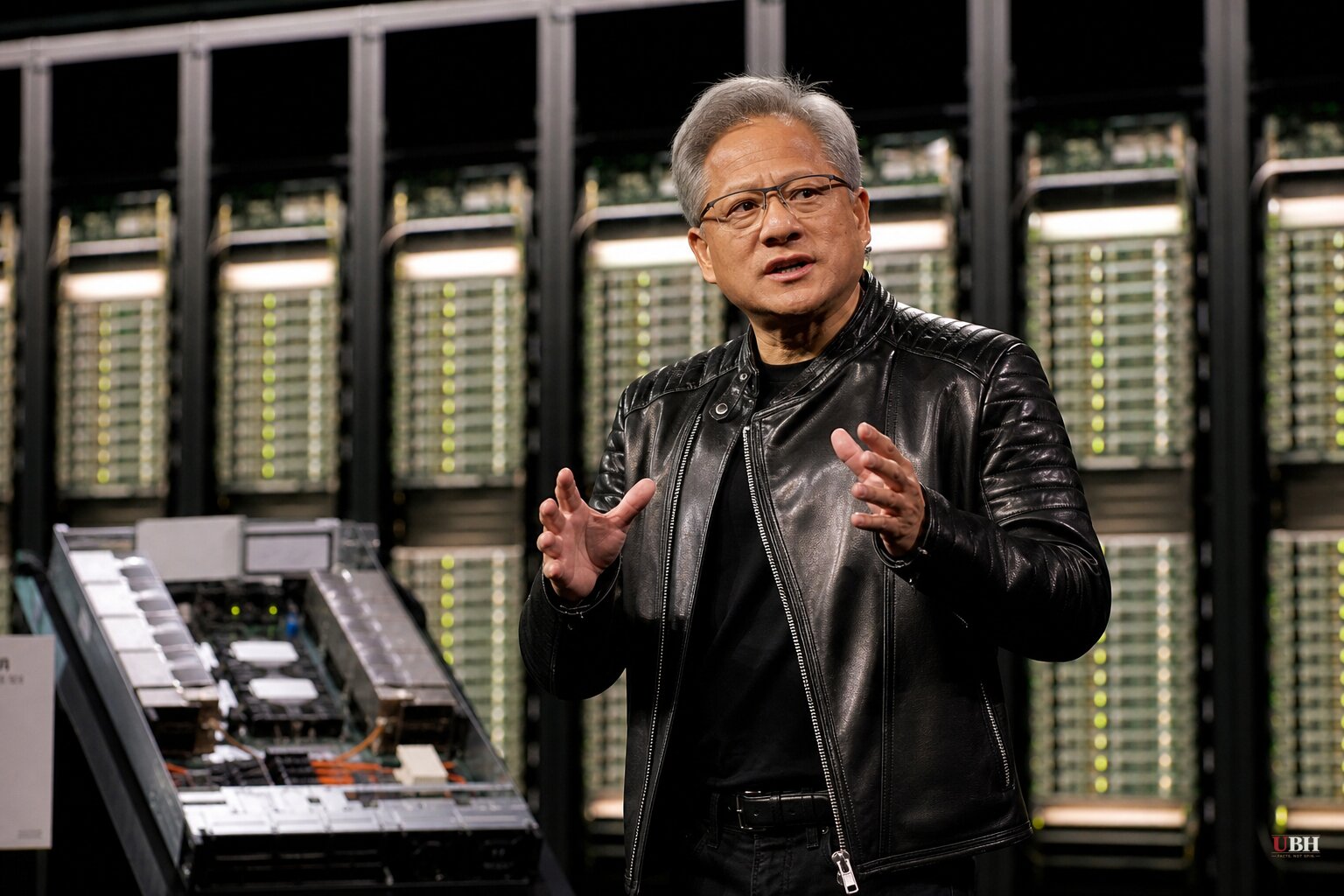
Nvidia's earnings landed Wednesday and they were not close. The chipmaker posted $96.2 billion in quarterly revenue for the period ended July 26, according to SiliconANGLE, and guided for $108 billion in the current quarter. Data center revenue alone hit $89 billion, up 117% from a year earlier, according to Business Insider. Shares rose 4% on the report, according to Fox Business.
Nvidia CEO Jensen Huang used the moment to do two things: defend a coming hit to profit margins and admit his industry has a trust problem with the communities hosting its data centers.
On margins, Huang told Fox Business anchor Liz Claman that Nvidia decided to "rip the Band-Aid off" and reset Wall Street's expectations. Gross margins will fall from 75% to between 72% and 73% next year, Huang said, after the company absorbed cost increases and repriced products. That comes as reports circulated of potential 15% price hikes on Nvidia chips, according to Fox Business.
On the community trust problem, Huang told CNBC's Jim Cramer that "the technology industry, the builders" have to do "a much better job working with the communities to get prepared for this AI infrastructure build-out," according to Business Insider. That is a notable admission from the CEO of the world's most valuable company. Polling cited by Business Insider shows Americans have grown skeptical of the massive facilities being built to house AI chips, largely over concerns about electricity costs and water use.
The Real Argument Is Over Who Pays
Huang's pitch is that data center investment can lower energy costs long-term by funding grid upgrades that wouldn't otherwise get built. "This is the first time in history that we're able to do that because of the enormous market dynamics," he said, according to Business Insider.
Research cited by Business Insider from MIT found that data centers shifting power use to off-peak hours could cut average energy costs by up to 5% in Texas, 4% in the Mid-Atlantic, and 2% across 11 western states. The catch: some scenarios require shifting nearly half of energy consumption to non-peak hours, which is a big operational lift most facilities aren't doing today.
Meanwhile, the skeptics' concern is straightforward and deserves to be stated plainly. Massive, always-on compute clusters draw enormous amounts of power and water, and residents worry they'll get stuck paying for grid upgrades that primarily benefit tech companies, not households. That's not a fringe worry. Data Center Knowledge, in an Aug. 27 report, described "PJM's Power Shortfall" as putting data center growth in focus, and another Aug. 27 piece from the same outlet noted the "Data Center Backlash" has reached local ballot boxes. Communities are voting on this with their feet, and increasingly their ballots.
Quincy, Washington, as the Counter-Example
The Epoch Times pointed to Quincy, Washington, as a case study cutting the other way. Citing CNN's reporting, the outlet noted the town's more than 30 data centers now generate an estimated 57% of Quincy's property tax revenue. That's paid for a $15 million aquatic center, a 143,000-square-foot sports complex, a $120 million high school, a new hospital, library, and wastewater treatment plant, according to the Epoch Times.
Residential electricity rates in the county rose 3.5% last year while the data centers themselves absorbed a 9.1% increase, the Epoch Times reported. That's the opposite of the community complaint in most other markets: here, the industrial users are eating more of the cost increase, not less. Cheap hydroelectric power and a $30 million water reuse facility built with Microsoft helped make that math work. The tradeoff, the Epoch Times noted, is that housing prices have climbed across the area as the boom accelerated.
Contrast that with Microsoft's West US 3 campus near Phoenix, built in an arid region where water is scarcer. Microsoft invested $40 million directly into the local water utility and is testing zero-water cooling technology, according to the Epoch Times, but the site selection itself drew criticism for straining a desert city's water supply in the first place.
The Jobs Argument
Huang also leaned on jobs. Nvidia employs roughly 42,000 people worldwide, and Huang said the company is "creating jobs everywhere," according to Fox Business. Half of Nvidia's employees have a net worth exceeding $25 million, according to Yahoo Finance figures cited by Fox Business, underscoring how concentrated the wealth from this boom has been so far among a relatively small workforce.
Outside Nvidia's own payroll, the buildout is creating construction and trades jobs tied to data center campuses. Chicago pastor Corey Brooks wrote in Fox News that a young man who worked construction at his South Side community center went on to a job at a nearby AI manufacturing facility, a small but concrete example of blue-collar work flowing from the buildout rather than just white-collar Silicon Valley hiring.
Whether the Quincy model can scale to the hundreds of new sites needed to keep up with Nvidia's growth remains uncertain. SiliconANGLE reported that modern AI racks can require up to 140 kilowatts of power density, while most existing edge facilities are capped at 30 to 50 kilowatts per rack. That mismatch, not community goodwill, may end up being the harder engineering problem Huang's industry has to solve.
Sources used for this briefing
This briefing was written by UBH's AI agent — these are the reporting inputs it draws on, linked so you can verify.


