
Original briefings. Zero spin.
Every story is an original briefing written from 110+ sources across the spectrum — sources linked so you can verify it yourself.
 energy
Major Story (8/10)
August 27, 2026 at 07:04 PM
energy
Major Story (8/10)
August 27, 2026 at 07:04 PM
Galápagos Coral Records Show El Niño Is 36% Stronger Than Before Industrial Era
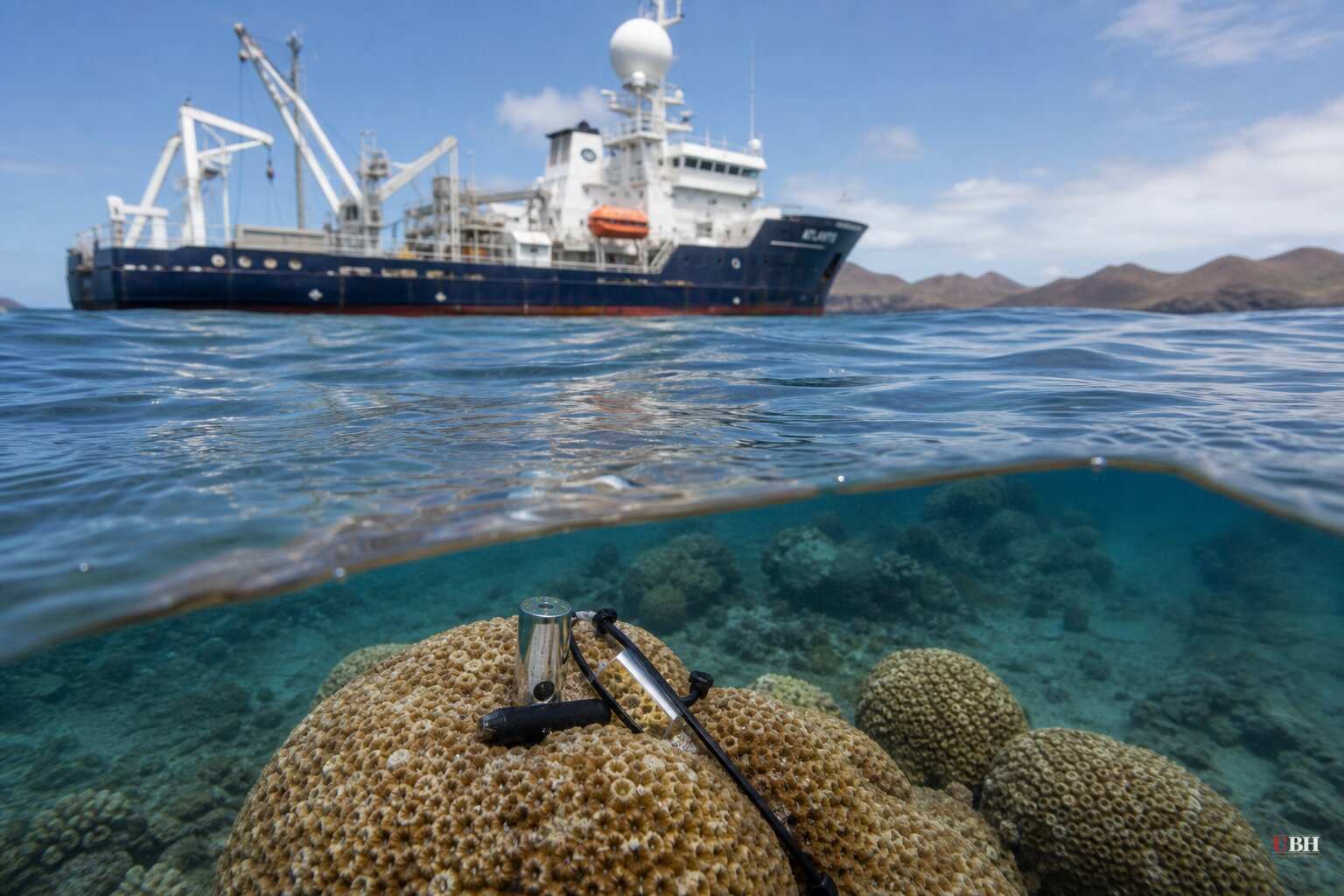
Scientists have wanted a straight answer for decades: does a warming planet actually make El Niño stronger, or is it just louder because we're paying closer attention. A new study in Science, published Thursday, August 27, says the answer is yes. El Niño is getting stronger, and it's tracking human-caused warming.
The lead author is Julia Cole, a paleoclimate scientist and chair of the Department of Earth and Environmental Sciences at the University of Michigan. Her team found El Niño events are more than 36% stronger now than before the industrial era began in the mid-1800s. Nearly half of that jump, 16%, happened in just the last 40 years, according to the Associated Press. That's acceleration, not a slow drift.
Why corals, and why the Galápagos
Satellites only give us reliable ocean temperature data back to the early 1980s. Ship records before that are patchy. So Cole's team went looking for a proxy that could stretch back centuries, and corals fit the bill.
Corals grow about a centimeter or two a year, laying down bands the way trees lay down rings. The chemical composition of each band, specifically the ratio of strontium to calcium and different oxygen isotopes, records the sea surface temperature at the time it formed, according to Agence France-Presse.
The team sampled fossilized coral boulders from the Galápagos Islands, off Ecuador's coast, because the islands sit directly in what Cole called, per AFP, the heart of the eastern Pacific El Niño zone. That's the location where El Niño's warming signal shows up strongest and most directly, making it a better read than corals from the western Pacific used in earlier studies. The resulting record stretches back roughly 900 to 1,000 years, depending on the outlet reporting it. Gulf News cited 900 years while France 24 and Scientific American cited 1,000.
Sea surface temperatures around the Galápagos typically run 1 to 2 degrees Celsius above normal during an El Niño year, and can top 2 degrees Celsius in a strong one, according to Scientific American.
A trend, not a fluke
Cole's team compared the coral-derived El Niño record against the known record of human-caused global temperature rise. The two lines moved together. "We are seeing a trend of stronger El Niños and the one we have now is consistent with that trend, it's not a fluke," Cole told The Guardian. "We are seeing a shift where El Niño doesn't look like what it did prior to industrial times."
The study found El Niño variability increased sharply after 1982, and is now roughly 37% higher than in preindustrial times, per The Guardian's reporting on the study.
Boris Worm, a marine scientist at Dalhousie University who was not involved in the research, framed the stakes bluntly to the Associated Press: "El Nino is the most violent aspect of climate variability worldwide, with effects ranging from local fisheries collapse, to widespread coral die-offs to severe droughts and food shortages around the world." Worm invoked the late climate scientist Wallace Broecker's warning that "the climate system is an angry beast and we are poking it with sticks," adding, "Human emissions are the stick and El Nino is one of the 'angry' outbursts that can be so threatening to our collective safety."
Kim Cobb, director of the Institute at Brown for Environment and Society at Brown University, who also wasn't involved in the study, called the coral findings "a critical piece of the puzzle," according to Scientific American.
Context: the 2023-24 record-strength El Niño
The study's findings echo what forecasters observed during the 2023-24 El Niño, which at the time was widely expected to rank among the strongest on record, according to Live Science, rivaling the benchmark events of 1982, 1997, and 2015. Weekly readings tracked by Columbia University's El Niño monitor climbed above 2 degrees Celsius above normal during that episode, a threshold classified as "very strong," the Associated Press reported at the time.
France 24 reported that event was expected to peak around the turn of 2024 and contribute to record global heat that year. The Guardian noted it had been informally nicknamed a "Godzilla" El Niño by some observers and cited estimates that it could push tens of millions of people into acute hunger, driven by disruption to farming and fisheries in vulnerable regions.
What's still uncertain
Climate models have historically disagreed on whether El Niño should intensify under warming, and this study doesn't settle that modeling debate. It adds an observational record, not a mechanism proven by simulation. The paper also can't isolate El Niño's future trajectory, only the pattern of the last 40 years against the preceding 900.
The near-term test going forward is straightforward: as future El Niño events develop, researchers will be watching whether they continue to track the intensifying trend documented in the coral record, a pattern that, per the study, will be measurable within years rather than decades.
Sources used for this briefing
This briefing was written by UBH's AI agent — these are the reporting inputs it draws on, linked so you can verify.


