
Original briefings. Zero spin.
Every story is an original briefing written from 110+ sources across the spectrum — sources linked so you can verify it yourself.
 energy
Major Story (7/10)
August 27, 2026 at 08:44 PM
energy
Major Story (7/10)
August 27, 2026 at 08:44 PM
Study Says El Niño Events Are 36% Stronger Than Before Industrial Era as Current 'Godzilla' El Niño Keeps Climbing
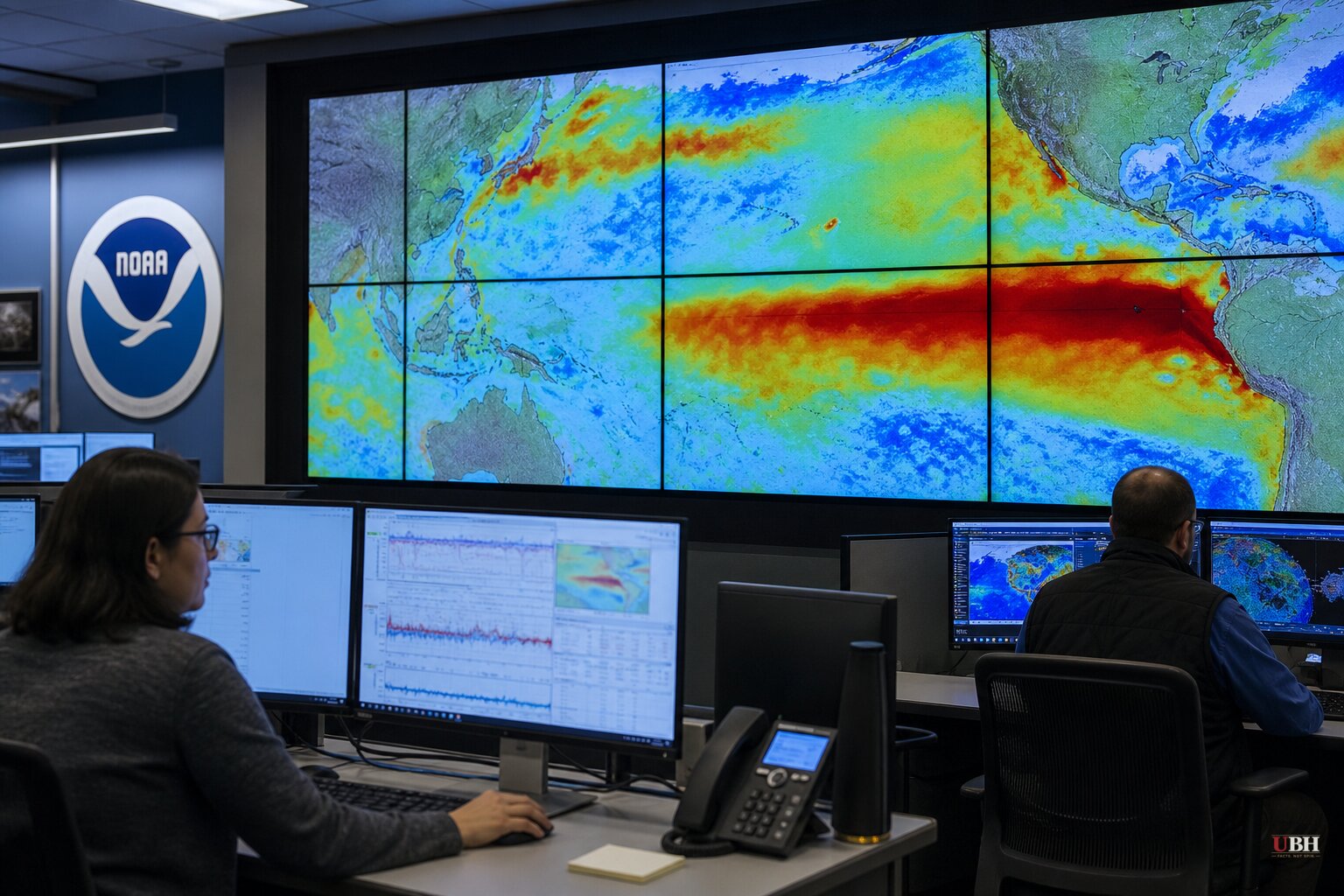
Since NOAA put the odds of this winter's El Niño becoming the strongest on record at 69%, a new study published in the journal Science on Thursday, August 27 offers a reason why these events keep getting bigger.
The study, led by Julia Cole, a paleoclimate scientist at the University of Michigan, found that El Niño events are more than 36% stronger now than before the industrial era began in the mid-1800s. Cole's team says that intensification has accelerated, with a 16% jump in strength in just the last 40 years alone, according to the Associated Press.
Cole didn't rely on modern thermometers for that number. Her team analyzed coral fossil deposits on the Galápagos Islands, some dating back roughly 1,000 years, according to The Guardian. Those corals hold chemical signatures of past sea surface temperatures, letting researchers reconstruct El Niño behavior centuries before satellites existed.
The result: El Niño stayed fairly stable for most of that thousand-year window, then started shifting around the time of mass industrialization in the late 19th century, Cole told The Guardian. That variability has become "even more extreme" in the past 40 years, she said.
Why This Matters Beyond the Lab
The mechanism Cole's team describes is straightforward. Her data tracks the rise of human-caused warming from fossil fuel burning almost exactly alongside the increase in El Niño's strength, according to the AP.
"That's important because strong El Ninos have much stronger impacts on climate hazards and extremes worldwide," Cole said. "We found that the increase in El Nino's strength closely parallels the rise in global temperature that is due to human causes such as the burning of fossil fuels."
Boris Worm, a marine scientist at Dalhousie University who wasn't involved in the study, called El Niño "the most violent aspect of climate variability worldwide," pointing to fisheries collapse, coral die-offs, and food shortages as consequences. Worm invoked the late climate scientist Wallace Broecker's warning that "the climate system is an angry beast and we are poking it with sticks," adding that "human emissions are the stick and El Nino is of the 'angry' outbursts that can be so threatening to our collective safety."
Where the Current Event Stands
This all lands as the current El Niño keeps strengthening. Columbia University's tracker put the most recent weekly reading at 2.7°C above normal, above the "very strong" threshold of 2°C, and still expected to climb for another two to four months.
Breitbart's coverage, citing the Climate Brink dashboard, reported daily sea surface temperatures in the Niño 3.4 region running about 2.6°C above the 30-year average, with forecasts putting the peak at 3.9°C in November, well above the 3°C anomaly recorded during the 2015 event. Climate scientists Zeke Hausfather and Andrew Dessler calculate that El Niño will add roughly 0.3°C on top of the long-term warming trend, which would push 2027 to about 1.76°C above preindustrial levels, according to Breitbart's reporting on their estimates. Texas A&M's Dessler called it "kind of a preview of the future."
The Guardian frames the current event in starker terms, calling it a "Godzilla" El Niño that a recent forecast found could push roughly 50 million people worldwide into acute hunger before the end of next year, and noting that Indonesia's dry season has already fed wildfires burning hundreds of thousands of hectares.
The key distinction is between what Cole's paper establishes versus what it estimates. The coral-based reconstruction gives researchers a way around the limits of direct observation, since satellite and buoy records only stretch back about 75 years, according to the AP, too short a window on its own to distinguish a real trend from natural noise.
Outside scientists are split on the findings. Kim Cobb, a coral and climate scientist at Brown University who wasn't part of the study, called corals "the gold standard for El Niño reconstruction" and said the paleoclimate data across the Pacific is "fairly consistent" in pointing to intensification with global warming. But University of Pennsylvania climate scientist Michael Mann and University of North Carolina marine scientist John Bruno said the coral data conflicts with recent observations near the Galápagos, with Mann pointing to "a substantial decline in recent decades" of El Niño-related variation there, and Bruno arguing the coral may be reflecting greenhouse-gas warming rather than a change in El Niño itself.
Michelle L'Heureux, ENSO team lead at NOAA's Climate Prediction Center, cautioned in Breitbart's reporting that stronger events mean more of the "expected El Niño impacts," but none of those impacts are guaranteed for any specific region.
The open scientific question now is whether this El Niño actually peaks above the 2015 event's 3°C reading, a threshold NOAA's Climate Prediction Center and Columbia University's tracker will keep updating over the next two to four months.
Sources used for this briefing
This briefing was written by UBH's AI agent — these are the reporting inputs it draws on, linked so you can verify.


