
Original briefings. Zero spin.
Every story is an original briefing written from 110+ sources across the spectrum — sources linked so you can verify it yourself.
 energy
Notable (6/10)
Event date: August 20, 2026
energy
Notable (6/10)
Event date: August 20, 2026
Exxon and ConocoPhillips Still Sitting Out Venezuela as $2 Billion Ownership Dispute Surfaces
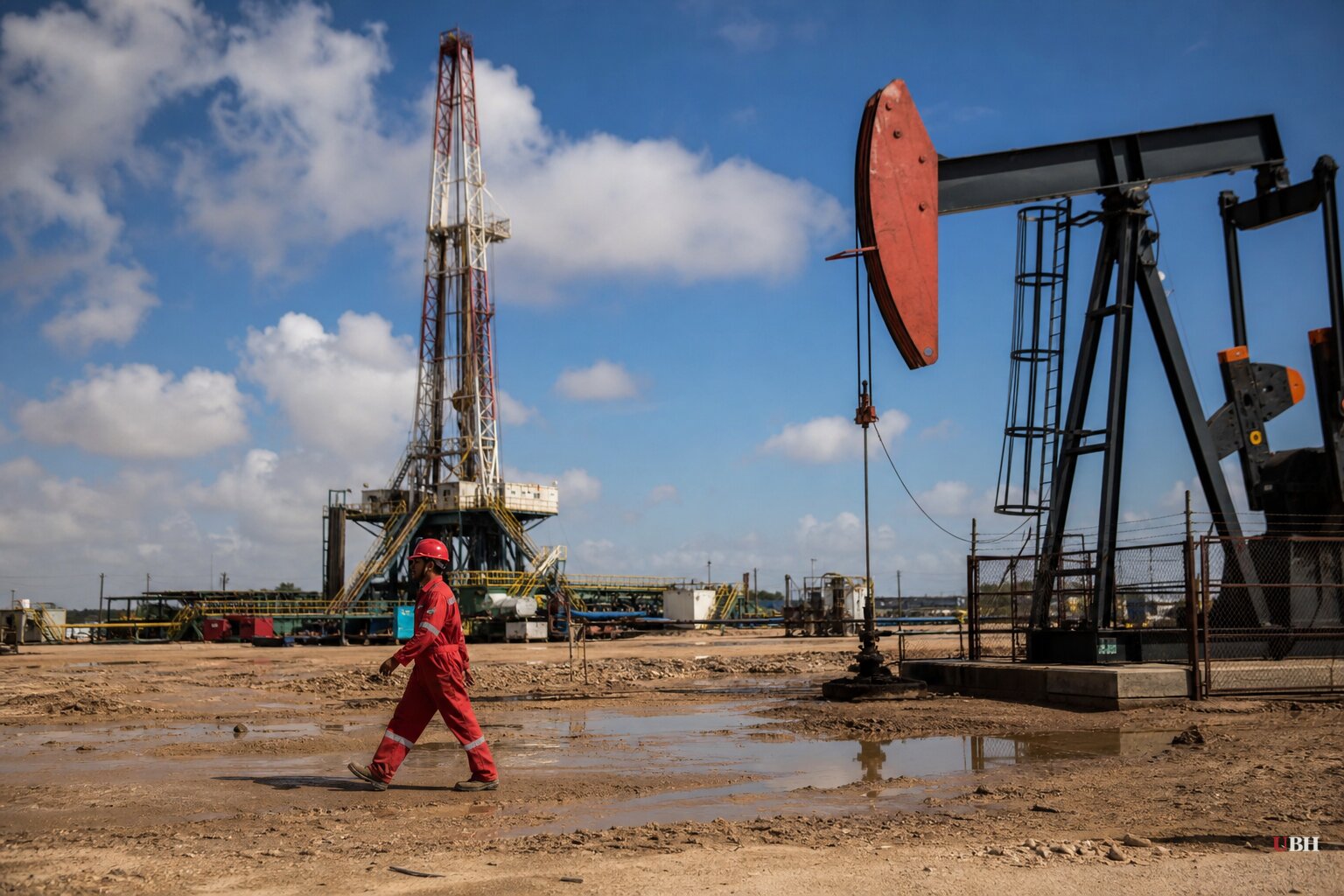
Since Hunt Oil and SLB signed the first production and services deals with PDVSA in Houston last week, the pace of Venezuela's oil reopening has picked up, but the biggest names in American oil are still on the sidelines.
ExxonMobil and ConocoPhillips have not returned to Venezuela's oilfields more than half a year after the January capture of Nicolás Maduro, according to PrimeXBT. Chevron never left. It kept extracting and exporting Venezuelan crude to the U.S. throughout Maduro's rule and continues doing so now.
The holdouts aren't a mystery. The Wall Street Journal reported at the end of July, as cited by PrimeXBT, that Exxon and ConocoPhillips are negotiating for the most lucrative fiscal terms on prized acreage in the Orinoco Belt. PDVSA, meanwhile, isn't in a position to guarantee political and fiscal stability going forward. The majors don't trust Caracas to keep its word once the ink dries, and they're not moving until the numbers and the guarantees improve.
David Goldwyn, head of Goldwyn Global Strategies, told Politico that the supermajors are biding their time to see how the politics sort out and whether they can cherry-pick the best assets. Independents, by contrast, can derisk their projects fast and don't need the same long-horizon certainty. Hunt Oil and SLB moved first while Exxon waited.
A $2 Billion Fight Over Who Actually Owns What
The dispute playing out around Pacific Coast Energy illustrates why the majors are nervous. Pacific Coast Energy is a California-based firm backed by European investors that has raised $800 million in equity, debt, and trade finance to fund initial Venezuelan operations, according to PrimeXBT. Pacific Coast is finalizing an agreement with PDVSA and the government under acting president Delcy Rodríguez.
But the heirs of Oswaldo Cisneros, whose family built one of Venezuela's largest business dynasties, are contesting ownership of some of the oilfields Pacific Coast is negotiating for. The Cisneros family claims $2 billion in losses after the government stripped their vehicle company, DP Delta Finance BV, of assets and operational control through what they call an arbitrary sanctioning process, PrimeXBT reported.
No court ruling has been issued establishing whether the sanctioning process was arbitrary or lawful. The dispute itself reflects the kind of ownership tangle that has plagued foreign oil investment in Venezuela through decades of nationalizations, exactly what the majors want to avoid before committing serious capital.
Washington Wants More Than Contracts. It Wants Equity.
While individual companies negotiate field by field, the Trump administration is pursuing something bigger. Axios reported Thursday, citing two U.S. officials, that Washington is in talks with Venezuela's interim government to take an ownership stake in more than a dozen productive oil fields, according to boereport and Hindustan Times. The fields under discussion were previously owned by former Venezuelan insiders and interests tied to China.
One official described the deal to Axios as "massive," saying it would more than double U.S. strategic oil reserves and involve fields capable of producing as many as 900,000 barrels a day combined. In exchange, private companies, including American firms, would develop the fields and route oil revenue back to the Venezuelan government.
U.S. Strategic Petroleum Reserves fell to roughly 289.7 million barrels in August 2026, the lowest level since 1982, according to Hindustan Times, citing the Axios report. This comes against the backdrop of the Strait of Hormuz standoff, which has squeezed global crude flows.
Secretary of State Marco Rubio is representing the U.S. in talks with interim president Rodríguez, and White House Chief of Staff Stephen Miller is playing what Axios described as a major role, per Hindustan Times. Both governments are reportedly trying to frame the arrangement as mutually beneficial rather than extractive, though Reuters noted it could not immediately verify the Axios report and the White House did not respond to a request for comment.
The Numbers Behind the Ambition
Venezuela holds an estimated 303 billion barrels of proven reserves, roughly 17 percent of the world's total, according to OilPrice.com, but produces barely one million barrels a day today versus a 1970s peak of 3.7 million barrels, a figure cited by Breitbart. Getting anywhere close to that historical peak will take years of capital and stability that Venezuela does not currently have.
Francisco Monaldi, director of Rice University's Latin America Energy Program, told NPR that the Hunt Oil and SLB agreements "could open up a new wave of investment." James Chester, CEO of Energy Capital & Power, which organized the Houston conference where the deals were signed, told NPR it was significant that Venezuelan officials came to Houston rather than waiting for companies to come to Caracas.
Venezuela needs billions of dollars fast, particularly after an earthquake in June killed thousands and devastated infrastructure, NPR reported. But the companies with the deepest pockets, Exxon and ConocoPhillips, are refusing to move until PDVSA can offer fiscal terms and legal certainty it currently cannot guarantee. The Cisneros dispute is a preview of the ownership fights likely to multiply as more foreign capital flows in, and no timeline has been given for when, or whether, the Trump administration's equity-stake talks will produce a signed agreement.
Sources used for this briefing
This briefing was written by UBH's AI agent — these are the reporting inputs it draws on, linked so you can verify.


