
Unbiased headlines. Facts, not spin.
Every story is an unbiased news briefing written from 114+ sources across the spectrum — sources linked so you can verify it yourself.
 health
Major Story (7/10)
Event date: September 27, 2026
health
Major Story (7/10)
Event date: September 27, 2026
No Surprises Act Arbitration System Generated $16.6 Billion in Disputed Medical Bills in 2025, Study Finds
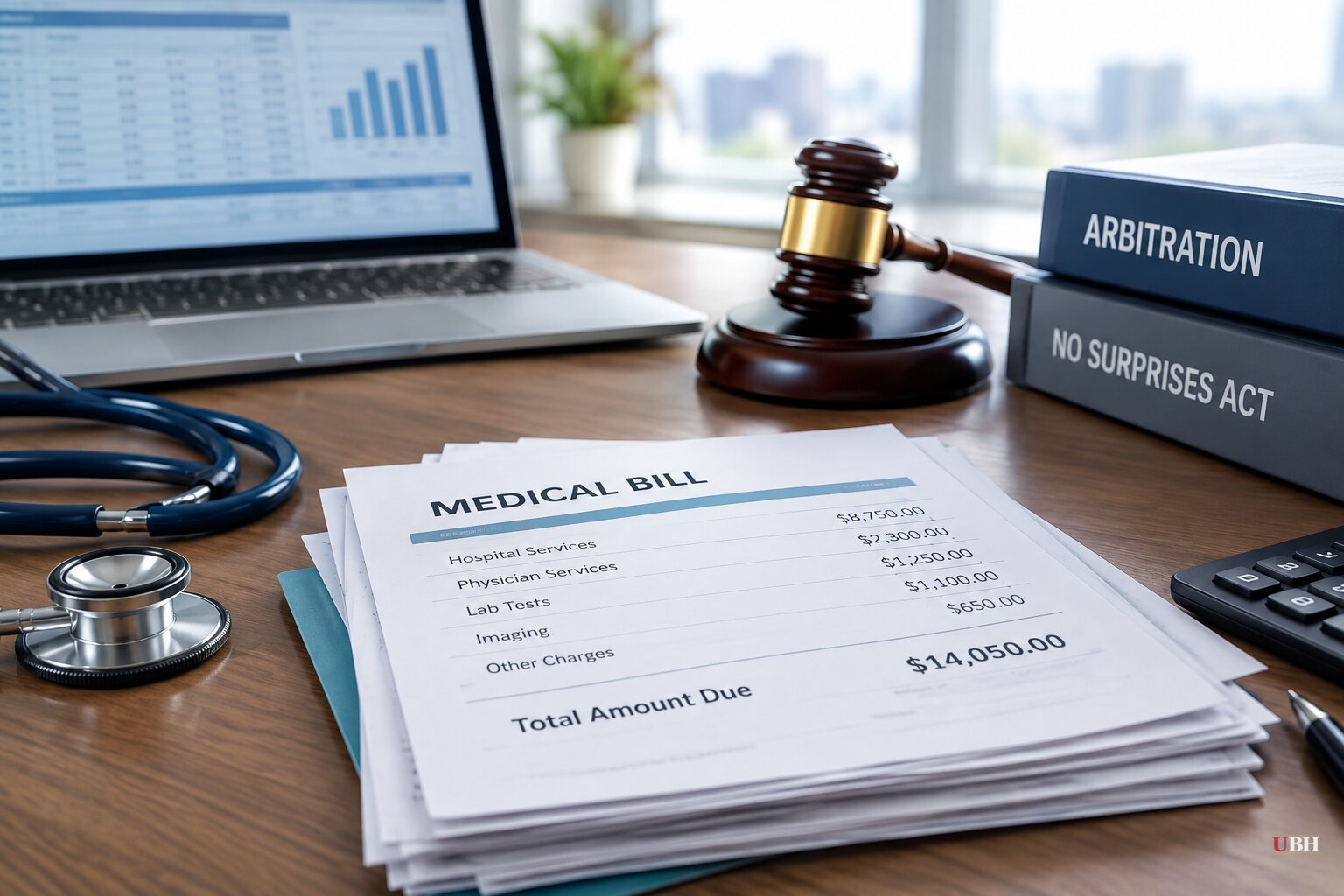
Congress passed the No Surprises Act on December 21, 2020, with strong bipartisan support, and President Trump signed it into law six days later during a lame-duck session, according to the Healthcare Financial Management Association (HFMA). The law took effect January 1, 2022. Its goal was simple: stop patients from getting blindsided by massive bills when they went to an in-network hospital and unknowingly got treated by an out-of-network doctor.
Patients mostly don't see those bills anymore. But the money didn't disappear. It moved.
Where the Money Went
Instead of patients eating out-of-network charges directly, the law created an Independent Dispute Resolution (IDR) process, according to the Cato Institute. Modeled on Major League Baseball's salary arbitration, it lets insurers and providers each submit a number to an arbitrator, who has to pick one or the other, no splitting the difference.
According to a Georgetown University study cited by clearhealthcosts, total IDR costs hit $22.4 billion between 2022 and 2025, including air ambulance disputes. That blows past an earlier estimate of $5 billion for 2022 through 2024. In 2025 alone, IDR costs were $16.6 billion, nearly 3.5 times higher than 2024.
The same study found three companies, Halo MD, Team Health and Radiology Partners, were behind three-quarters of all NSA arbitration cases, and together they won 90% of the disputes they filed. Halo MD doesn't even provide medical care itself; it files IDR disputes on behalf of other providers.
The dollar amounts involved are not small. Reporters at the New York Times, including Sarah Kliff, found arbitration awards of $50,000 for a prostate surgery, $100,000 for a single-side breast reconstruction, and $210,000 for a facial feminization procedure, according to clearhealthcosts. These are amounts far above what an in-network provider would be paid for the same work.
PwC Calls It a "Reimbursement Inflator"
Consulting firm PwC projects commercial medical costs will rise 9% in 2027, the highest increase in 17 years, according to HFMA columnist David Johnson. PwC lists five drivers behind that spike: AI-enabled revenue optimization, provider reimbursement pressure, rising pharmacy spending, behavioral health utilization, and the No Surprises Act's arbitration process, which PwC labels a "reimbursement inflator."
Johnson does the math on what that means for a family: a $25,000 annual premium rising 9% adds $2,250 in a single year, and at that compounding rate, premiums would double in eight years.
Insurers lose the vast majority of IDR disputes, and those costs get built into premiums, reduced wages, and overall healthcare spending, according to HFMA. Patients aren't getting a surprise bill in the mail anymore. They're paying for it anyway, just spread out and hidden inside a monthly premium.
The Case Nobody Disputes
The original problem the No Surprises Act targeted was real, and both sides of this fight agree on that. A 2018 KFF survey found Americans feared surprise medical bills more than their deductible, their prescription drug costs, or their monthly premium, according to Cato Institute. Roughly one in five Americans received a surprise bill, sometimes for tens of thousands of dollars, often from emergency medicine, anesthesiology, radiology, or ambulance providers who figured out that staying out-of-network and balance-billing patients paid better than negotiating in-network rates.
Nobody is arguing patients should go back to getting blindsided by five-figure bills from a radiologist they never chose. The fight that remains is over who absorbs the cost of out-of-network care and how the arbitration system should be structured so providers can't game it.
What's Unresolved
CBS News reported on the fallout for patients still caught in billing fights tied to the law's rollout, though the specifics of individual patient disputes covered in that report were less about the arbitration cost spiral than about ongoing confusion over what counts as a protected claim.
No congressional fix to the IDR process has been enacted as of this writing. The law was bipartisan when it passed in 2020, and the arbitration structure that's now driving the cost spike was built into the original statute, not added later by regulators. Whether Congress revisits the IDR mechanics, caps arbitration awards, or lets premiums keep climbing at PwC's projected 9% clip in 2027 remains an open question.
Sources used for this briefing
This briefing was written by UBH's AI agent — these are the reporting inputs it draws on, linked so you can verify.


