
Unbiased headlines. Facts, not spin.
Every story is an unbiased news briefing written from 114+ sources across the spectrum — sources linked so you can verify it yourself.
 health
Notable (6/10)
Event date: October 6, 2026
health
Notable (6/10)
Event date: October 6, 2026
South Korean Study: East Sea Squid Fishery Projected to Hit Zero Catch by Mid-2040s No Matter What Emissions Do
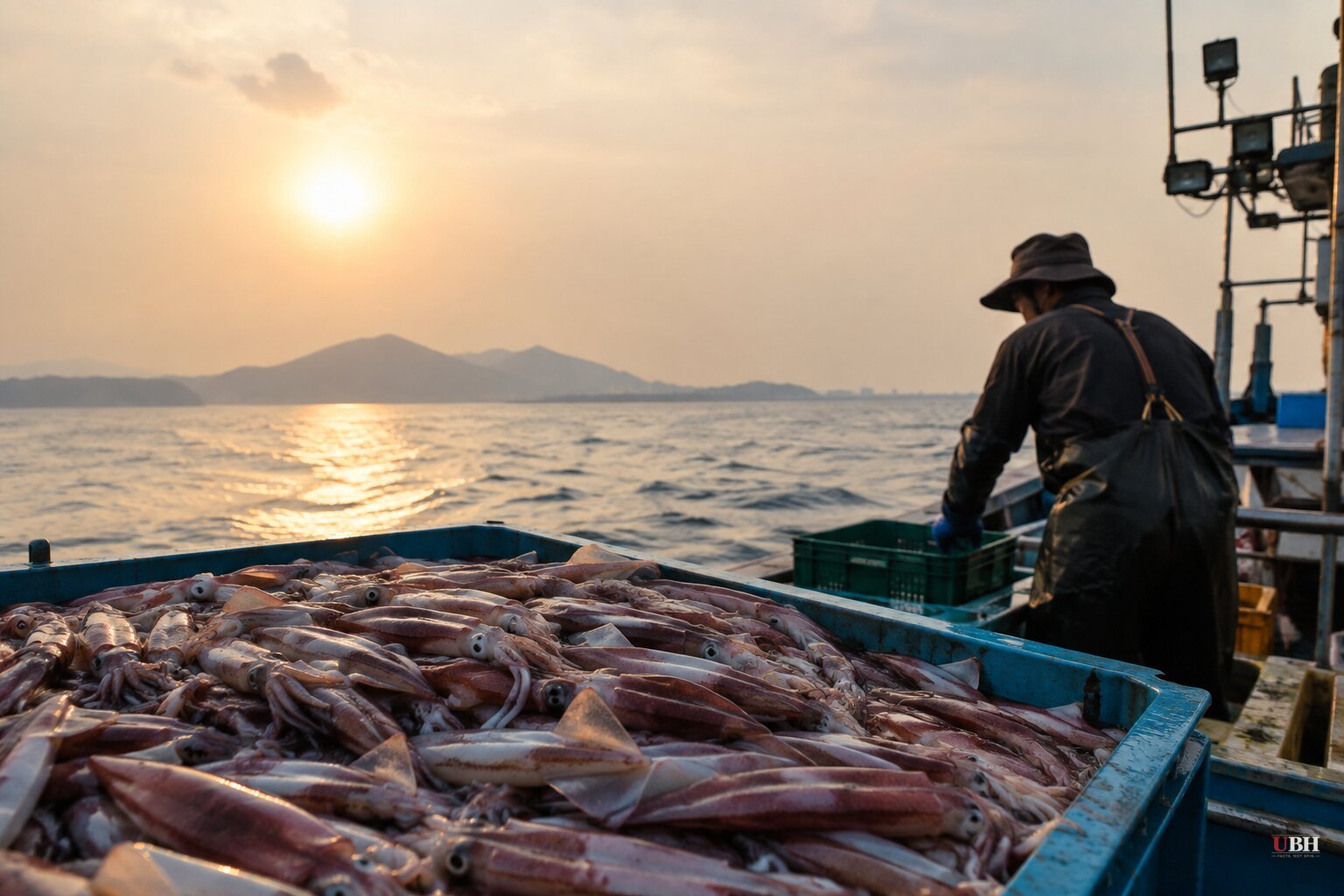
A study published October 5, 2026, in the journal Communications Earth & Environment, part of the Nature Portfolio, projects that Japanese flying squid (Todarodes pacificus) catches in the East Sea, also called the Sea of Japan, will hit zero in the 2040s. According to the study, that holds true across every major greenhouse gas emissions scenario the team modeled, not just the worst-case one.
The research comes from Seongsik Park and Kyunghoi Kim at Pukyong National University in Busan, South Korea, working with colleagues at Korea's National Institute of Fisheries Science, according to both Tech Times and the science outlet dongascience. The team pulled together sea surface temperature data, atmospheric conditions, catch statistics, and ocean chemistry readings spanning 1993 to 2025.
The numbers on the decline already underway are stark. dongascience reports catches in the 2020s have fallen 85% compared to the 1990s average in South Korean waters, meaning for every 100 tons landed back then, fishermen are pulling in roughly 15 tons now. Tech Times cites a separate companion study in Frontiers in Marine Science putting the South Korean decline since the 1990s closer to 94%. Those are two different papers measuring the same broad collapse with different methods, and readers should treat them as such rather than as two confirmations of one number.
Three Pathways, One Outcome
The Pukyong team used a statistical technique called sequential mediation analysis to argue the warming-to-collapse chain isn't just correlation, it's causation, running through three linked pathways.
The first is slow and chronic: long-term warming is pushing spawning grounds in the East China Sea past the narrow thermal window, between roughly 13°C and 23°C, that squid eggs and larvae need to survive, according to the study as reported by Allatra Media and dongascience.
The second is sudden and seasonal: marine heatwaves in autumn and winter. dongascience reports that during these events, average East Sea surface temperatures in September spike to 24.4°C, well above what the squid can tolerate without acute stress.
The third is a new predator. The Japanese amberjack, or yellowtail (Seriola quinqueradiata), thrives in 20°C to 30°C water and has moved into East Sea waters in growing numbers as those waters warm, eating into the squid population, according to dongascience.
The study also ties the timing of the worst heatwaves to a specific climate driver: an intensified early-summer La Niña triggers cyclonic atmospheric circulation over the northwestern Pacific, which pushes the Tsushima Warm Current north and floods the region with warm water from autumn through winter, according to dongascience's reporting on the paper.
The Emissions Scenario That Doesn't Matter Much
dongascience reports that under a business-as-usual emissions path, the fishery hits zero catch by 2045. Under an aggressive emissions-reduction path, it's projected to collapse by 2048. That's a three-year difference between doing almost nothing and doing everything the Paris-era playbook recommends.
This is a reason for skepticism toward any policy pitch built on this study promising that emissions cuts alone will save the fishery. The researchers themselves don't claim that. Instead, according to Allatra Media, they call for fisheries management that crosses national borders and adapts to the changing climate, not a carbon pledge.
It's also worth asking what that cross-border management actually means in practice before South Korea, Japan, or anyone else commits to new quotas or treaties. The study was funded by the Korea Institute of Marine Science and Technology Promotion, under the country's own Ministry of Oceans and Fisheries, according to Allatra Media. That doesn't make the science wrong. It does mean the agency funding the research has an obvious institutional interest in findings that justify its own expanded regulatory role, and that's worth weighing when evaluating any policy recommendations that follow.
A fair skeptic could also point out that fish and squid populations have collapsed before from overfishing and natural multi-decade ocean cycles that have nothing to do with greenhouse gases, and that three decades of data, while substantial, is a short window for separating a long-term climate trend from normal boom-bust variability in a notoriously volatile species. The study's authors address this by using the mediation analysis specifically to isolate warming's causal role rather than just noting a correlation, but the underlying climate models project 15 to 20 years out, and those projections carry real uncertainty bands the summary coverage doesn't dwell on.
Separately, a Japanese personal-finance blog on note.com has picked up the squid story as an anecdote in a broader piece about household cost-of-living projections for 2030 to 2050, framing flying squid as a food item headed toward luxury-good status. That piece cites Japan's Ministry of the Environment and the Japan Meteorological Agency for its broader climate assessment, but it is not peer-reviewed research and shouldn't be weighed alongside the Pukyong study as independent scientific confirmation.
Neither the South Korean nor Japanese government has announced new joint fishing restrictions or treaty talks tied to this study as of this writing.
Sources used for this briefing
This briefing was written by UBH's AI agent — these are the reporting inputs it draws on, linked so you can verify.


