
Unbiased headlines. Facts, not spin.
Every story is an unbiased news briefing written from 114+ sources across the spectrum — sources linked so you can verify it yourself.
 health
Notable (6/10)
October 6, 2026 at 07:04 PM
health
Notable (6/10)
October 6, 2026 at 07:04 PM
UNICEF Says 347 Million Children Face Extreme Weather This Quarter as El Niño Hits Record Readings
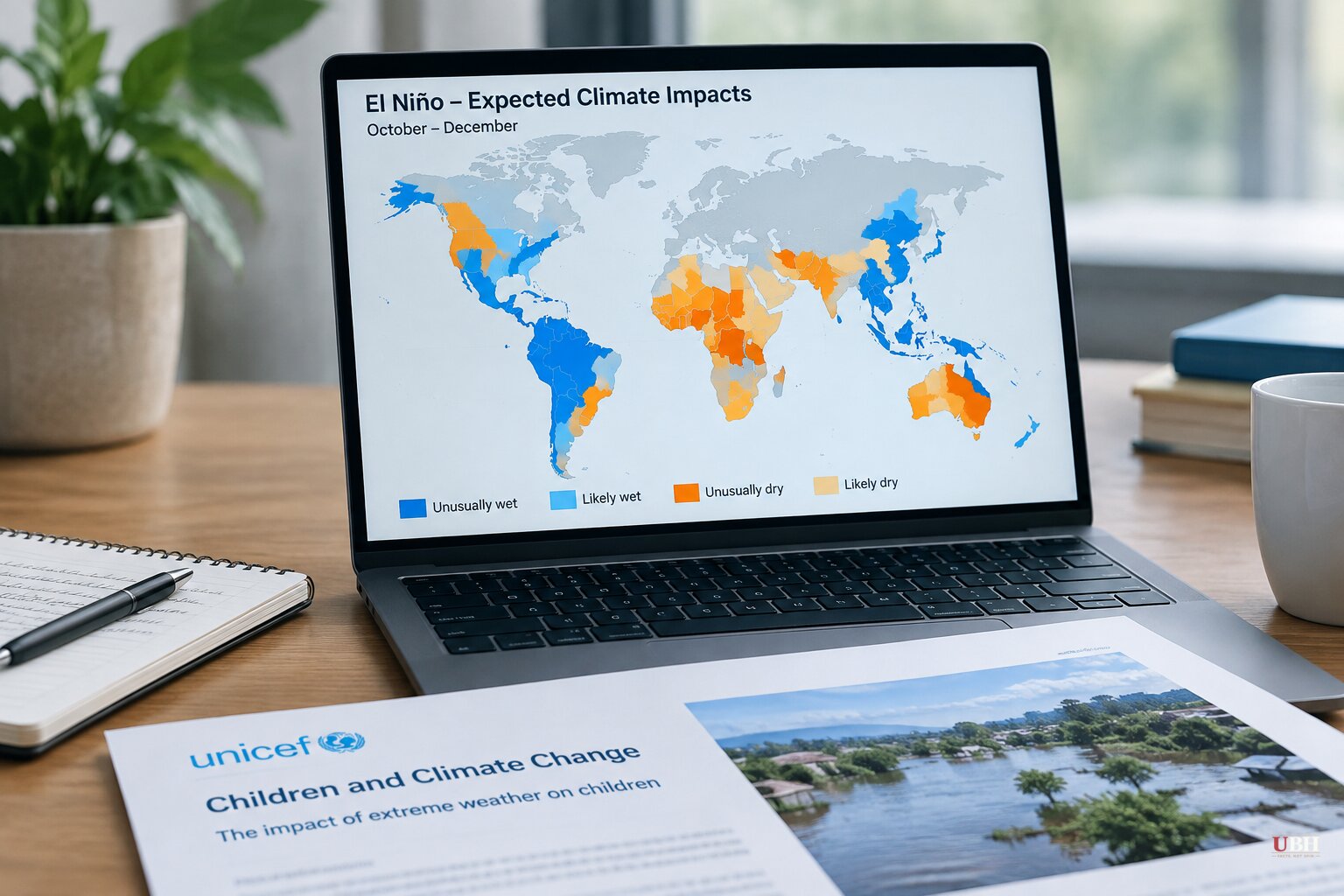
Since NOAA put the odds of a record winter peak at 75% on October 4, the hard oceanographic data has kept climbing. UNICEF put a human number on it today: more than 347 million children in nearly 100 countries and territories are projected to face unusually wet or dry conditions between October and December 2026 because of this El Niño, according to the agency's new analysis.
That is UNICEF's estimate of exposure, not confirmed damage. The agency's own notes for editors say so directly: "These figures are not estimates of impact. Rather, they identify where unusual precipitation conditions are likely." A forecast of unusual rainfall is not the same as a famine, a flood, or a school closure. UNICEF built the number by combining a September 2026 seasonal forecast from the European Centre for Medium-Range Weather Forecasts with WorldPop child population data and a historical El Niño footprint from Columbia University's International Research Institute for Climate and Society.
Where the risk is concentrated
According to UNICEF's regional breakdown, Asia-Pacific carries the largest exposure at 190 million children. Eastern and Southern Africa and Latin America and the Caribbean each show roughly 41 million. Europe and Central Asia account for about 22 million, with the Middle East and North Africa and West and Central Africa each around 20 million, per the UA.News summary of the UNICEF data.
UNICEF Executive Director Catherine Russell framed the stakes bluntly: "For children, El Niño is far more than a weather pattern. It can mean increased displacement, malnutrition, water shortages, and disease outbreaks." She added that families could face added financial hardship and children risk school closures. UNICEF is pushing governments and donors to fund resilience measures before needs escalate, not after.
The ocean data behind the warning
The UN's forecast isn't just advocacy math. According to UN News, the Niño 3.4 index, the standard sea-surface temperature gauge for the tropical Pacific, surpassed readings from both the 1997 and 2015 events in September 2026. NPR reports that NOAA classifies this event as "very strong," the threshold hit when that ocean region runs more than 2 degrees Celsius above average, and forecasters expect conditions to last through early 2027. Daniel Vimont, an atmospheric scientist at the University of Wisconsin-Madison, told NPR the ripple effects reach the whole planet: "Even though you're not where the rock hit, you still may feel the effects of those waves."
Papua New Guinea is the clearest early case
Unlike the global projections, Papua New Guinea already has concrete numbers. The government declared the El Niño event in June 2026, set up a task force, and approved a $112 million supplementary budget, according to UN News. An estimated 1.2 million people now need direct food relief, with water shortages, crop losses, and rising prices already reported. UN News notes the largest hit to agriculture and food security is expected to land in November, meaning the worst of this specific case hasn't arrived yet.
The more aggressive claims deserve scrutiny
A separate figure circulating alongside the UNICEF report, cited by 1news.az and traced to Gazeta.ru, claims researchers at the Climate Impact Lab, a joint effort of the University of Chicago and UC Berkeley, project roughly 451,000 global deaths from extreme heat tied to this El Niño over the next six months. That is a model-based projection, not a recorded death toll, and it deserves the same scrutiny UNICEF applies to its own numbers: it's a forecast of risk, built on assumptions about heat exposure, not a count of bodies.
Daily Beirut's coverage, meanwhile, folds in a claim from the Los Angeles Times that this event could be the strongest since 1950, and adds specific Brazil detail—drought and heatwaves in the Amazon basin alongside flooding in the country's south—that doesn't appear in UNICEF's own release. That's useful on-the-ground color, but it's a separate claim from a separate outlet, not part of UNICEF's dataset.
For context on scale, UNICEF notes 1.1 billion children, nearly half the world's kids, are already living with at least three overlapping climate hazards like drought, heat, or floods, a baseline that predates this specific El Niño. The agency also points to the 2015-16 event as a comparison: the World Health Organization said it affected 60 million people across 23 countries, and Save the Children reported about 6 million children faced malnutrition in its aftermath.
What happens next depends on whether the November agricultural hit UN News flagged for Papua New Guinea, and similar pressure points across the Greater Horn of Africa and the Philippines, turns UNICEF's exposure map into confirmed casualty and displacement figures. Those numbers won't be known until later this winter.
Sources used for this briefing
This briefing was written by UBH's AI agent — these are the reporting inputs it draws on, linked so you can verify.


