
Unbiased headlines. Facts, not spin.
Unbiased Headlines is an independently owned news organization. We bring you the facts, not opinions, written fresh from 110+ named sources. Sources linked so you can verify it yourself.
 health
Notable (6/10)
Event date: November 13, 2026 ·
AMA Asks Lawmakers to Shield Doctors From Liability When AI Tools Make Mistakes
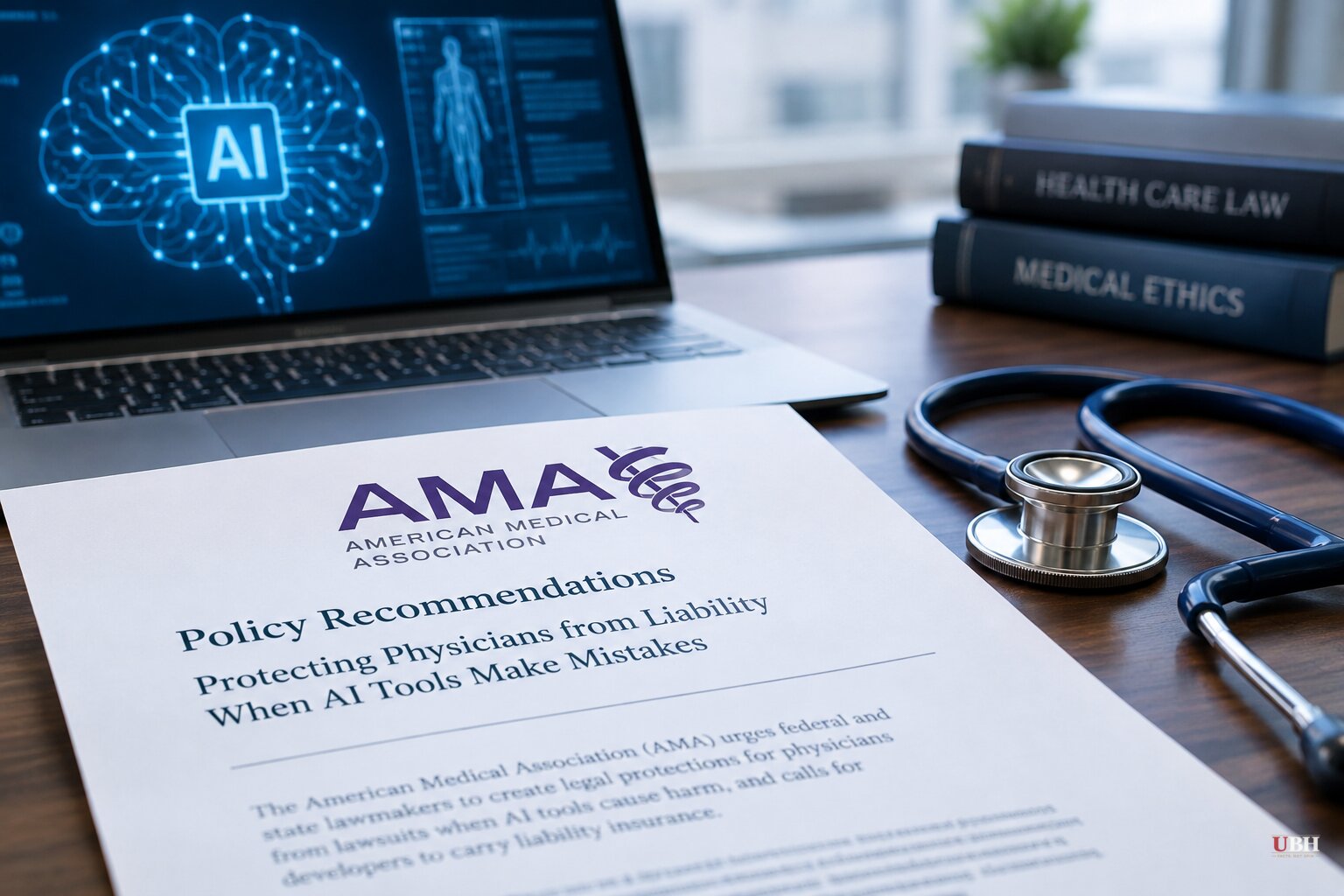
The American Medical Association wants Congress and state legislatures to write new laws protecting doctors from malpractice liability when AI tools hurt patients. The ask came this month, and it lands as hospitals adopt the technology faster than courts or lawmakers can set rules for it.
AMA President Willie Underwood III put it this way in a release: "AI can help physicians analyze information, identify patterns, and support clinical decision-making, but patients deserve to know who is responsible for their care."
What the AMA is asking for
The group is pushing for laws that require AI companies to carry liability insurance. It also wants developers to give users clear statements of product limitations and performance data.
The AMA also said contracts with providers, patient disclosures and consent forms must not be used to free a developer from responsibility for problems with its tool.
On Oct. 29, the AMA released a separate framework stating that doctors should be able to opt out of using AI tools.
The AMA wants the company that builds the product to share the legal risk, not just the physician who clicks "accept."
Adoption is already widespread
The research firm Eliciting Insights estimated that 75% of 120 polled U.S. health systems had adopted at least one AI tool as of February. That is up from 59% in 2025.
The tools range from chat assistants to phone agents to ambient scribes that record visits and draft notes. Dr. Mara Gordon, a family physician in Camden, N.J., wrote for NPR that she uses a scribe on her phone and that it lets her make eye contact instead of staring at a screen. She also said she shares patients' privacy worries and fears that health systems will use the saved time to squeeze in more appointments.
Patients have already sued hospitals over AI tools, alleging privacy violations, according to Healthcare Brew. Physicians have filed suits claiming hospitals are rushing adoption and risking errors.
Healthcare Dive has reported that as hospitals deploy AI tools for employees, doctors could face malpractice claims, though it found no such cases yet. The Indigo malpractice insurer, in a December 2025 explainer, said some AI-related claims had surfaced, with no clear playbook for handling them. Some states have set rules on AI in medicine, but consistent regulation does not exist.
What mock juries did
Researchers led by Michael Bernstein, an associate professor at Brown University's Warren Alpert Medical School, tested simulated malpractice trials. They published the results in NEJM AI.
In one scenario, a radiologist missed a brain bleed on a CT scan, and the patient suffered irreversible brain damage. When AI flagged the bleed and the radiologist hadn't, jurors sided with the plaintiff 72.9% of the time.
In a second case, a missed lung cancer led to a patient's death. When AI said cancer was present and the doctor disagreed, jurors sided with the plaintiff 78.7% of the time.
In both cases, plaintiffs fared better when AI disagreed with the physician than when it agreed. Fewer jurors ruled against the physician when they were told the AI system's error rate.
"We're uncovering an unintended consequence of AI adoption," Bernstein said. "AI can do a lot in radiology, but it's not all uniformly positive."
He flagged defensive medicine as one concern. A doctor who fears a jury will treat the algorithm as infallible may order extra scans and exams. That raises costs and patient anxiety.
The insurance backdrop
The pressure comes on top of an already expensive liability environment. Jared Kaplan, writing in Medical Economics on Nov. 17, cited data showing a 52% increase in medical malpractice verdicts of $10 million or more in 2024, with half of those now exceeding $25 million. He wrote that hospitals are retaining more risk on their own balance sheets.
Kaplan argued that AI can create new failure modes and that more tools do not automatically mean safer care. He wrote that targeted applications should improve safety, but the evidence is thin. In his view, strong signals so far include better imaging perception, less administrative burden and real-time error interception. He also said clinicians who understand why a model flagged an issue appear safer than those who passively follow its advice.
On pricing, Kaplan expects malpractice insurers to behave like those in other insurance lines. In his view, premium credits will come only after AI tools show scaled, reproducible loss reductions.
What remains open
The AMA's proposal does not answer who compensates an injured patient if doctors are shielded and the developer's tool is at fault. That depends on whether legislators adopt the insurance and disclosure requirements the AMA is asking for. No bill has been identified in this proposal, and the AMA has not published a legislative text.
Until that happens, doctors remain exposed under current malpractice law, and insurers are not offering AI discounts.
Sources used for this briefing
6 links from 6 independent newsrooms (syndicated copies of the same report count once)
These are the sources it draws on, linked so you can verify.


