
Unbiased headlines. Facts, not spin.
Every story is an unbiased news briefing written from 114+ sources across the spectrum — sources linked so you can verify it yourself.
 health
Notable (6/10)
Event date: October 5, 2026
health
Notable (6/10)
Event date: October 5, 2026
Long-Term Lab Study Finds Ocean Acidification Alters Plankton Phosphorus Handling, Future Impact Projections Vary Wildly
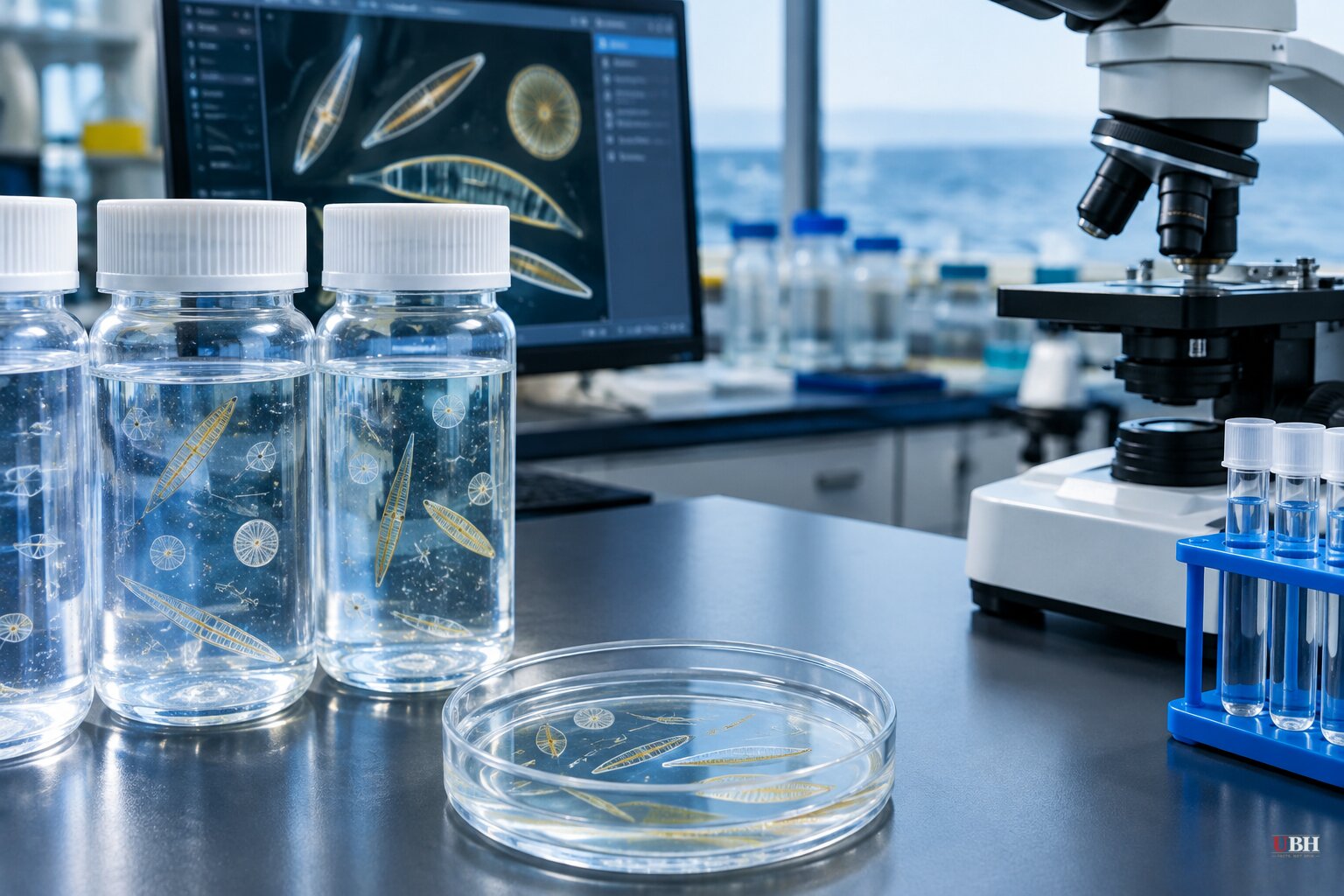
Researchers led by Bingkun Wang and Yapeng Wang of the Yellow Sea Fisheries Research Institute and Harbin Institute of Technology, working with colleagues in China and the United States, ran one of the longest evolution experiments ever conducted on marine phytoplankton. They tracked the diatom Thalassiosira pseudonana through more than 1,000 generations under elevated carbon dioxide, according to Science Magazine. The goal was to separate two things that get conflated constantly in climate science: permanent genetic adaptation versus temporary physiological flexibility.
The diatoms are tiny, but phytoplankton as a group are responsible for roughly half of all photosynthesis on Earth, according to Science Magazine. They form the base of the marine food web.
What the data actually show
The carbon side of the story is locked in. Long-term selection under high CO2 produced heritable increases in growth and carbon fixation that held steady no matter how much phosphate the cells had access to, according to the study published in Nature Geoscience.
The phosphorus side is different and more interesting. Under combined acidification and phosphate scarcity, the diatoms cut back on particulate organic phosphorus, the phosphorus locked into living cell mass. But when researchers swapped lineages back and forth between treatments, that decline reversed. This means it is acclimation, a flexible on-the-fly adjustment rather than a fixed genetic change, according to Nature Geoscience.
Multi-omics work, combining gene expression, protein, and metabolite data, showed the mechanism: cells drained their internal phosphorus reserves, including polyphosphate stores that act like batteries, and rebuilt their membranes using non-phosphorus lipids instead of the usual phospholipids. This is a documented survival strategy for cells running short on a scarce nutrient.
Critically, this was not just a lab artifact. The researchers ran coastal mesocosm experiments and found the same pattern, reduced particulate organic phosphorus, in natural phytoplankton communities at low-phosphate stations under acidified conditions, according to Nature Geoscience. Global meta-transcriptome data also showed the same non-phosphorus lipid pathway getting switched on in both high- and low-phosphate ocean regions. Lab, field, and global gene data pointing the same direction separates this from a single cherry-picked result.
The number that needs a caveat
The researchers used Earth system models to project that particulate organic phosphorus could decline by 211% to 2,185% by 2100, depending on whether the world follows the SSP2-4.5 or SSP5-8.5 emissions pathway, according to Nature Geoscience.
That is a 10-fold spread between the low and high estimate. A range that wide is not a precise prediction. It is an acknowledgment that the model is extremely sensitive to assumptions about future emissions, ocean chemistry feedback loops, and how real-world ecosystems with thousands of competing species will actually respond. The study used one diatom species in controlled conditions. Extrapolating that to the entire global ocean eight decades out involves a long chain of assumptions, each with its own error bars.
The strongest environmental concern here is legitimate on its face: if phosphorus availability in marine biomass really does fall anywhere close to even the low end of that range, it would reshape nutrient cycling across ocean ecosystems that global fisheries depend on. Phosphorus already limits productivity across huge stretches of open ocean, and a further squeeze could ripple through food chains that feed billions of people.
But SSP5-8.5, the scenario driving the high end of that 2,185% figure, assumes a continued heavy-fossil-fuel trajectory that many energy analysts already consider an outlier case given current global energy trends. Treating the top of a model range as the expected outcome rather than one tail of a wide distribution is exactly the kind of framing that turns a genuinely useful experiment into a headline-grabbing number disconnected from what was actually measured.
Neither Science Magazine's writeup nor the Nature Geoscience abstract flags that distinction for readers. Both present the lab findings and the century-out model projection with the same level of certainty, when only one of those two things was actually observed.
The unresolved question is whether this acclimation response, seen in one diatom species under controlled and coastal conditions, holds across the thousands of phytoplankton species that make up real ocean ecosystems, and whether competitive dynamics between species blunt or amplify the effect at scale. The researchers have not yet published multi-species or open-ocean validation data to answer that.
Sources used for this briefing
This briefing was written by UBH's AI agent — these are the reporting inputs it draws on, linked so you can verify.


