
Unbiased headlines. Facts, not spin.
Unbiased Headlines is an independently owned news organization. We bring you the facts, not opinions, written fresh from 110+ named sources. Sources linked so you can verify it yourself.
 health
Major Story (7/10)
Judge Approves $7.25 Billion Roundup Settlement as NIH Scientists Post Reviews Linking Glyphosate to Cancer
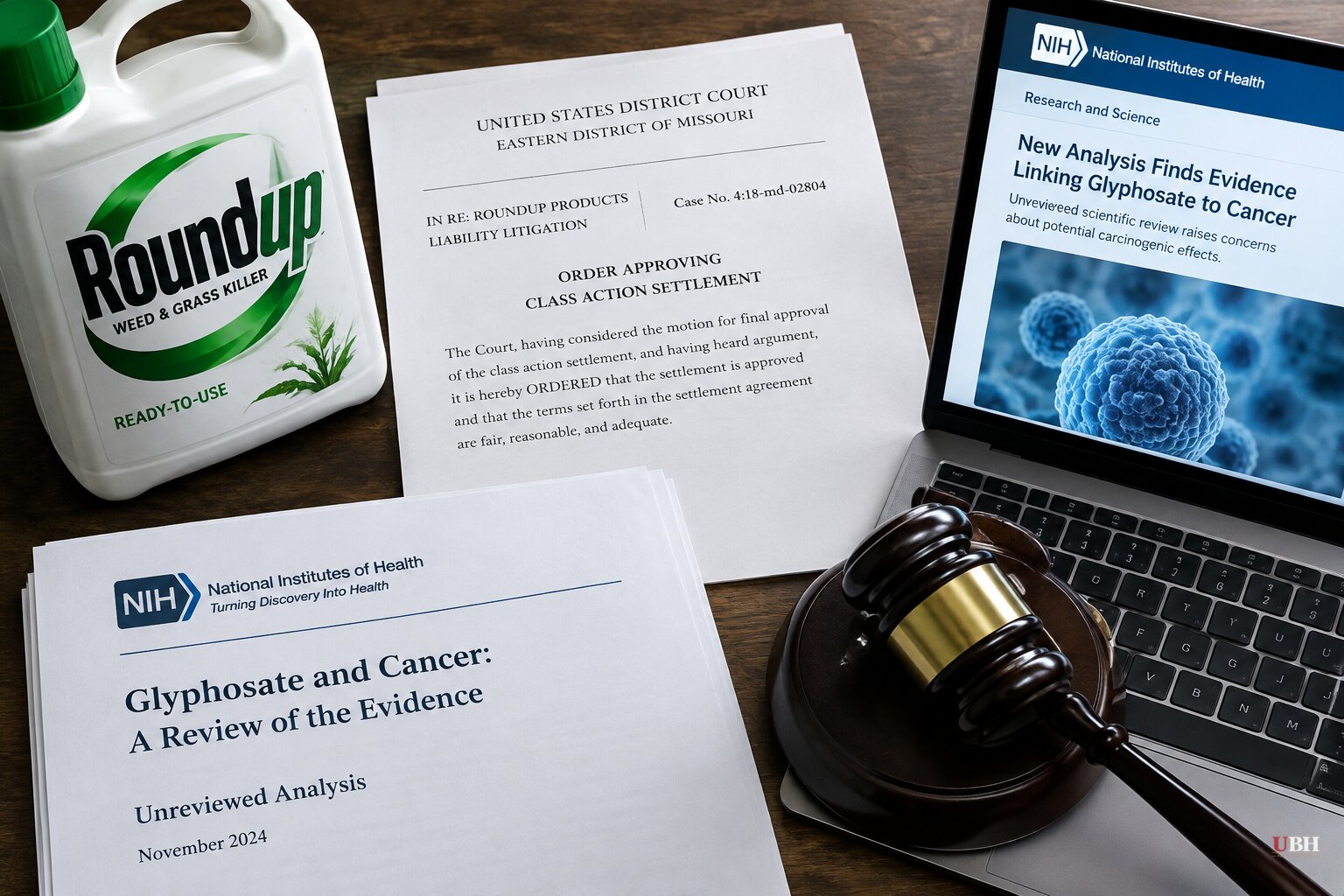
The Supreme Court's June ruling cut off state-law failure-to-warn claims against Monsanto while a Roundup class settlement was already pending. That settlement got final approval on Friday, Nov. 20, when St. Louis Circuit Judge Timothy Boyer granted approval to a nationwide class settlement worth up to $7.25 billion.
The scientific fight over glyphosate, Roundup's active ingredient, is not settled by it.
What the settlement does
Monsanto, owned by Bayer since 2018, will make declining, capped annual payments over as many as 21 years, according to Bayer. The total is up to $7.25 billion, including payments already made. Judge Boyer wrote that payments run 17 to 21 years or more.
It covers people who allege Roundup exposure before Feb. 17, 2026, and who have a non-Hodgkin lymphoma diagnosis now or receive one within 16 years of the agreement's effective date. Average individual payouts would range from $10,000 to $165,000, depending on how the product was used, age at diagnosis and severity of illness.
The approved deal includes $600 million for attorneys' fees. Boyer lowered the fee amount in his ruling.
There is no admission of liability. Bayer, which denies that Roundup causes cancer, says the deal gives it more certainty and control over litigation costs. CEO Bill Anderson called approval "a decisive milestone" in the company's strategy to manage current and future Roundup claims.
The objectors
More than 100 class members objected, represented by some of the lawyers who started the Roundup litigation about a decade ago. They called the agreement a "sweetheart deal" that violates the U.S. Constitution and involved collusion between Bayer and the plaintiffs' lawyers who drafted it. In their telling, it enriches the lawyers and benefits Bayer while giving plaintiffs little.
Their specific complaint: Bayer can keep selling Roundup without a cancer warning, and the deal largely shields it from the big punitive damages some juries have awarded.
Bayer and the plaintiffs' lawyers who helped build the deal said it is fair. They argued it benefits claimants who might never get a trial date given the backlog.
Boyer rejected the objections as unpersuasive. He found the agreement came out of "hard fought arm's-length, non-collusive negotiations" and noted it had support from law firms handling a substantial share of the outstanding cases. He called it "a substantial and reasonable settlement considering the risks of litigating these cases" and said that without it, only a small fraction of plaintiffs would get a trial date soon. He also said Monsanto might enter bankruptcy, delaying payments for years.
The Supreme Court backdrop
In June, the Supreme Court ruled 7–2 for Monsanto in the case of Missouri resident John Durnell, who had won a $1.25 million jury verdict. Justice Brett Kavanaugh wrote that federal pesticide law requires Monsanto to use the EPA-approved label, which carries no cancer warning, so state-law failure-to-warn claims are preempted.
That ruling hurt plaintiffs' leverage. Some attorneys for cancer patients say the payouts are too small. Others say the deal beats the nothing that became more likely after June.
Bayer says the approval order can be appealed, and that any appeal would pause Monsanto's payments until all appeals are exhausted.
New federal science, same old split
Separately, scientists at the National Institute of Environmental Health Sciences, part of the National Institutes of Health, posted two systematic reviews ahead of peer review. The human-evidence review found an association between glyphosate-based herbicides and blood cancers, with some evidence tying them to non-Hodgkin lymphoma. The animal review found tumors across multiple studies and two rodent species, including malignant lymphoma in mice and unusually early leukemia in rats.
The reviews also flagged higher concern for workers with heavy exposure and for exposure during pregnancy and early childhood. They found some evidence linking prenatal exposure to childhood leukemia. Production workers face the highest exposures, followed by farmworkers, and exposure is widespread through food residue.
The EPA has long held that glyphosate is not likely to cause cancer. It plans to release a new human-health assessment early next year. The NIEHS papers went up days before the agency's deadline for the public to submit studies.
EPA spokesman Jacob Murphy said the agency "will evaluate it the same way we evaluate every study." HHS spokeswoman Emily Hilliard said the two agencies are working under a memorandum of understanding to strengthen the science behind the EPA's review.
Calley Means, a former White House adviser and ally of Health Secretary Robert F. Kennedy Jr., told Politico the paper "really backs EPA into a corner." Make America Healthy Again supporters have grown frustrated that the White House has not cracked down on glyphosate, which they say harms children's health. Administration officials say they are assessing the science.
Ruveon, the Bayer Group company that runs the U.S. glyphosate business, said it is reviewing the findings. It said glyphosate has been used safely for 50 years and that the preprints have not been independently evaluated, so their conclusions are preliminary.
A further NIEHS analysis, set for publication in December, reviewed 55 animal studies and found evidence that glyphosate may harm sperm health and abundance and may lower testosterone. Animal results do not necessarily carry over to people, and the review does not establish an effect on human fertility.
What comes next
Two dates matter. The settlement's appeal window decides whether Monsanto's payments begin on schedule or freeze. The EPA's assessment, due early next year, will show whether the agency changes its position on glyphosate and cancer after its sister agency's scientists reviewed the same decades of evidence and appeared to reach a different conclusion. The NIEHS reviews still have to clear peer review.
Sources used for this briefing
6 links from 6 independent newsrooms (syndicated copies of the same report count once)
These are the sources it draws on, linked so you can verify.


