
Unbiased headlines. Facts, not spin.
Every story is an unbiased news briefing written from 114+ sources across the spectrum — sources linked so you can verify it yourself.
 health
Notable (6/10)
Event date: October 6, 2026
health
Notable (6/10)
Event date: October 6, 2026
Breast Cancer Diagnoses Are Climbing Fastest in Women Under 50, New Data Shows
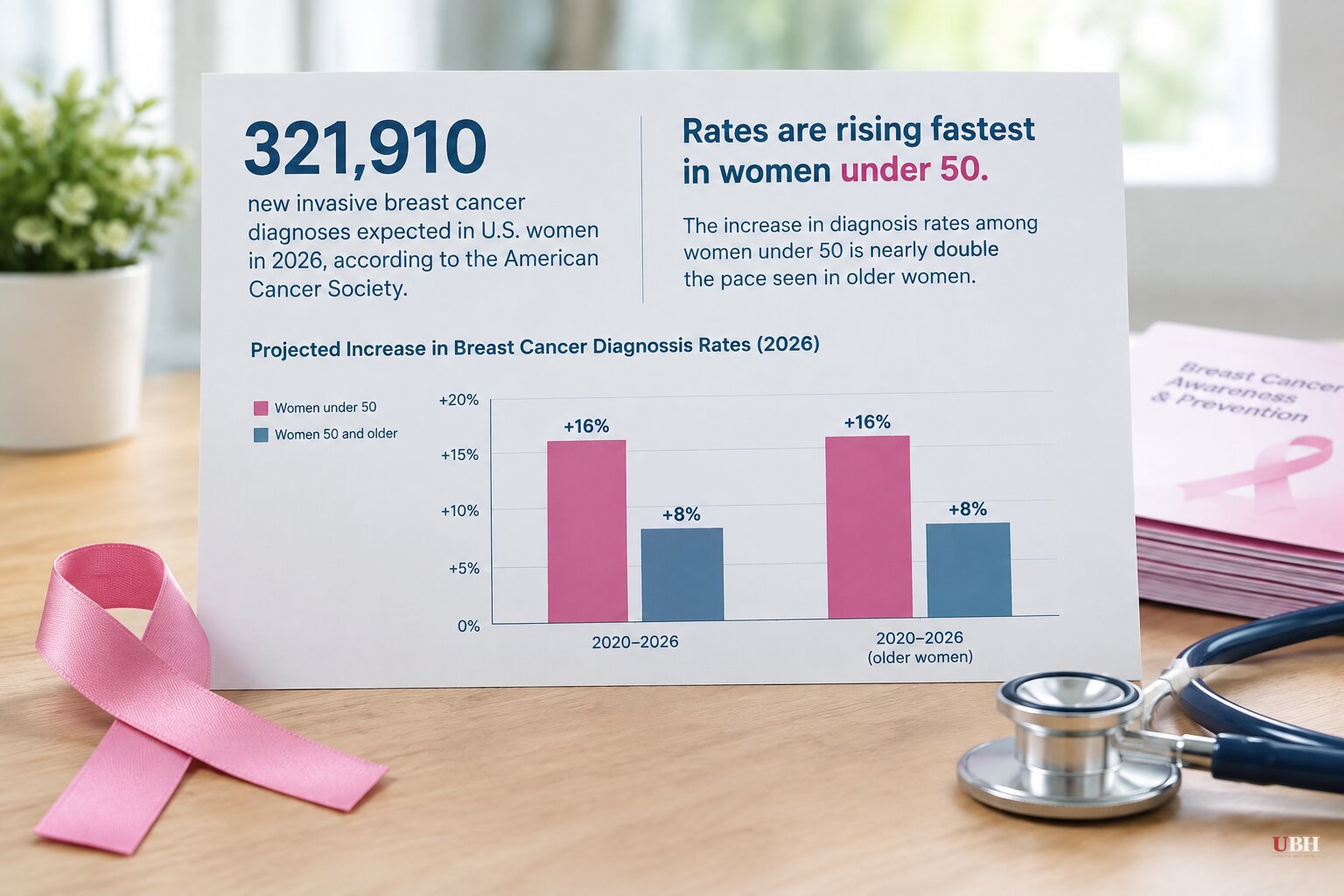
Breast cancer incidence in American women under 50 is rising about 1.4% a year, roughly double the 0.7% annual increase in women 50 and older, according to the Breast Cancer Research Foundation (BCRF), which tracked the trend from 2012 to 2022. The American Cancer Society (ACS) projects 321,910 new invasive breast cancer diagnoses among U.S. women in 2026, with more than 42,000 deaths expected.
The disease is now the leading cause of cancer death in American women aged 20 to 49, according to BCRF. Women under 50 have an 82% higher overall cancer incidence rate than men the same age, a gap the ACS says is driven mainly by breast cancer.
What's behind the rise
Dr. Eleonora Teplinsky, author of the new book "Beyond the Pink," told CBS News the idea that younger women are "too young for cancer" is false and dangerous. She points to diets high in ultra-processed foods and declining physical activity as contributing factors with real data behind them.
Reproductive patterns matter too. Women who start menstruating earlier and women who have their first child later in life face a longer window of hormone exposure linked to higher breast cancer risk, Teplinsky said. She was careful to add this isn't about blaming anyone's choices, just understanding the biology.
Environmental exposure is a murkier picture. Teplinsky said there's "a lot of interest" in plastics, parabens and phthalates as possible contributors, but she was direct that the research simply isn't there yet: "these are all things that just don't have concrete data." That's a fair concern raised by many patients and advocates worried about chemical exposure, and it deserves more research funding rather than dismissal, but as of now no sourced study in this reporting establishes a causal link.
On alcohol, the evidence is much firmer. Teplinsky calls it a direct carcinogen and recommends women eliminate it, even though she acknowledges "this is something no one wants to hear."
The racial and geographic gap
Dr. Anitha Srinivasan, Deputy Chief Medical Officer at NYC Health + Hospitals/Metropolitan, told the Bronx Times she regularly sees women in their 40s present with advanced breast cancer. The youngest patient she's treated was 27, with a strong family history of the disease.
Srinivasan recommends annual mammograms starting at age 40 for the largely Hispanic and racially diverse population she serves, noting that Hispanic women can experience different timing of first menstruation and menopause compared to Caucasian women, changing their lifetime hormone exposure. She also argues non-Caucasian populations have been historically underrepresented in the studies that built current screening guidelines, a gap that limits how precisely doctors can tailor advice by race and ethnicity.
BCRF data backs up why self-awareness matters most for younger women: nearly 80% of women under 50 who are diagnosed find the abnormality themselves, since most aren't yet in routine screening programs. Some estimates cited by BCRF suggest women under 40 are nearly 40% more likely to die from breast cancer than women over 40.
Genetic testing and a UK research tool
For women with inherited BRCA1 or BRCA2 mutations, discovered by Cancer Research UK-funded scientists in the 1990s, risk can run as high as 72%, compared to a 13% lifetime average. Gabrielle Hansen, 29, of Buffalo, New York, tested positive for BRCA2 after her mother was diagnosed at 35 and her sister at 30, and chose a prophylactic double mastectomy, a procedure that can cut risk by up to 95%, according to Women's Health.
But inherited mutations only explain part of the picture. Cancer Research UK notes that almost 3 in 4 women under 50 diagnosed with breast cancer have no family history that would have flagged them under current guidelines. Its CanRisk tool, built on the BOADICEA algorithm, uses a saliva sample and a GP questionnaire to estimate risk more broadly. An early study this August suggested offering it to all women under 50 could identify multiple times more at-risk women than existing guidelines catch. The tool is currently limited to genetics specialists, and researchers are still working out how to adapt it for routine care.
Knowing versus doing
An ACS survey of 33,000 women, published October 1, 2026, found a wide gap between awareness and action. Ninety-nine percent of women knew family history matters, though the ACS notes 85% of breast cancers occur in women with no family history at all. Ninety-one percent knew exercise helps, yet only 27% met the recommended 150 to 300 minutes of moderate activity weekly. Eighty-five percent knew alcohol raises risk, but 69% still drink. Nearly half didn't know breastfeeding lowers risk.
"Knowing your risk factors isn't the same as acting on them," said Alpa Patel, ACS senior vice president of population science, in the organization's news release.
The ACS estimates 30% of breast cancer cases are preventable through behavior changes. Whether that gap between awareness and action narrows, and whether tools like CanRisk eventually make it into routine U.S. and U.K. primary care, remains an open question for researchers and clinicians alike.
Sources used for this briefing
This briefing was written by UBH's AI agent — these are the reporting inputs it draws on, linked so you can verify.


