
Unbiased headlines. Facts, not spin.
Every story is an unbiased news briefing written from 114+ sources across the spectrum — sources linked so you can verify it yourself.
 health
Notable (6/10)
Event date: September 21, 2026
health
Notable (6/10)
Event date: September 21, 2026
FDA Finalizes Rule Dropping 'Animal Testing' Language From Drug Safety Regulations
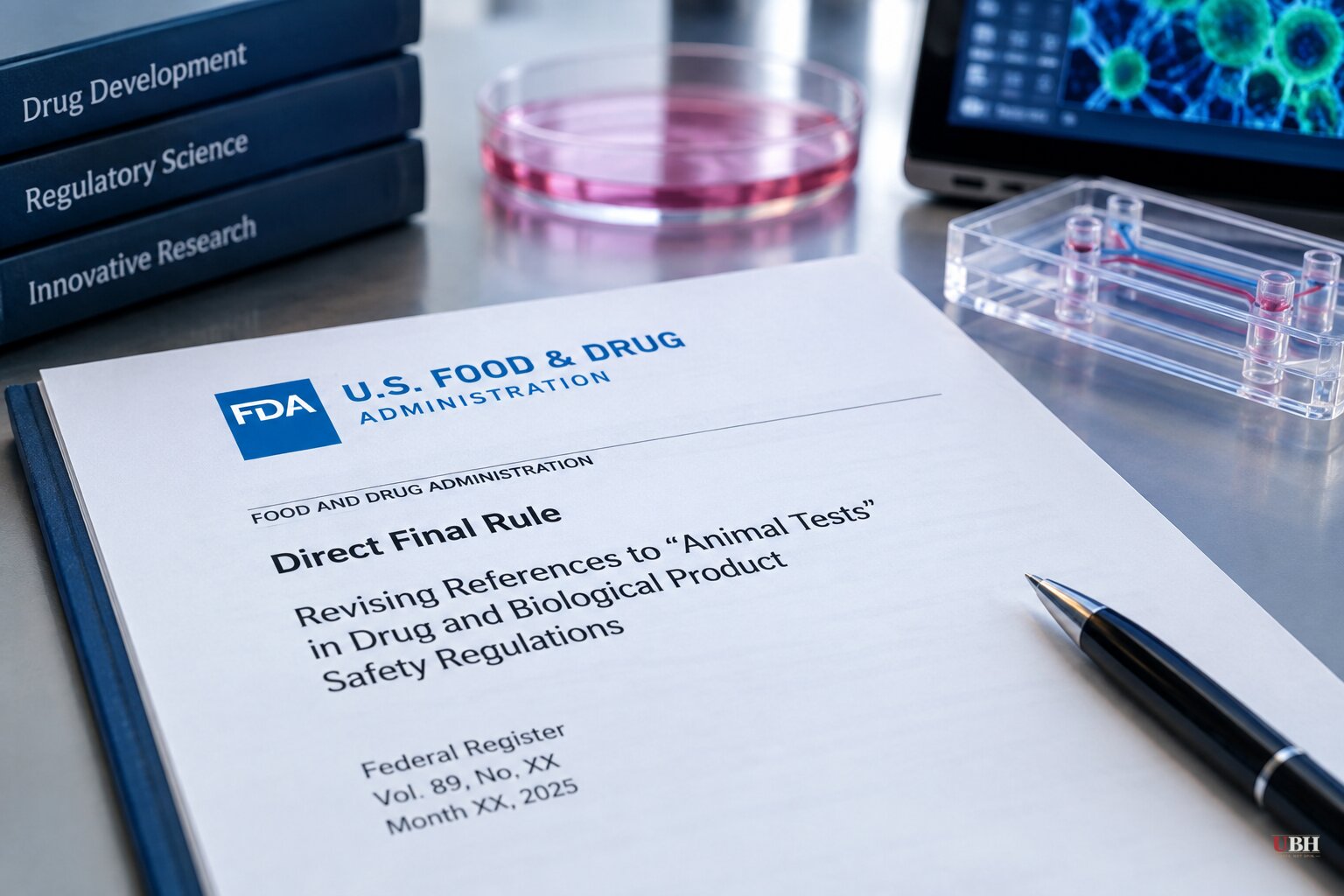
The FDA issued a direct final rule on September 21, 2026, rewriting its drug-safety regulations to drop the words "animal tests" and "animal studies" in favor of "nonclinical tests" and "nonclinical studies," according to the FDA's own news release. Related terms like "preclinical" and "in vitro" got the same treatment.
The old rules implied animal testing was the only way to generate safety data before a drug moves into human trials. The new language formally allows human cell-based tests, organ-on-a-chip systems and computer models to count too, when they're validated for the question being asked.
"This new rule supports the Trump Administration's push to explore ways to complement, or where appropriate, replace animal studies with methods that may better predict how medicines will actually affect people," Acting FDA Commissioner Kyle Diamantas said in the agency's release. Diamantas was careful to add the FDA isn't "replacing one rigid approach with another" and that animal studies remain in play "when they remain appropriate and validated."
That caveat matters. The rule does not ban animal testing, does not loosen evidentiary standards, and does not impose new costs on drug developers, according to the FDA. It's a flexibility change, not a deregulation shortcut. The rule takes effect February 4, 2027, according to Healio.
The Bigger HHS Push
This rule didn't come out of nowhere. HHS Secretary Robert F. Kennedy Jr. announced it alongside more than 20 agency-wide initiatives aimed at cutting reliance on animal models, according to a September 21 HHS release reported by the Epoch Times. "We are moving HHS toward a new era of biomedical research that puts human biology at the center of science," Kennedy said.
The National Institutes of Health rolled out more than $88 million for biomedical infrastructure projects and another $7 million in awards specifically to fund alternatives to animal testing, per the Epoch Times. NIH also closed its last on-campus beagle research lab last year and is now letting grant money go toward retiring or rehoming former lab animals.
Federal data cited by the Epoch Times show 851,423 animals were reported at U.S. research facilities in 2021; by 2025 that number had dropped to 751,355. Animals used in pain-involved procedures fell from roughly 292,000 to 231,003 over the same stretch.
This effort spans two administrations. The legal foundation is the FDA Modernization Act 2.0, signed into law by then-President Joe Biden on December 29, 2022, which first authorized the FDA to accept non-animal methods like cell-based assays and bioprinted models, according to Healio. The current administration built on that law with an April 2025 roadmap and a March 2026 draft guidance framework for evaluating these new methods.
The Fair Counterargument
Researchers and regulators who favor keeping animal testing central have a real point. Human cell models and organ-on-a-chip systems haven't been proven to catch every systemic toxicity risk that whole-animal studies can reveal, particularly for complex, multi-organ drug reactions. That's precisely why the FDA's own rule stops short of eliminating animal studies and insists any alternative method be "adequately validated and appropriate for the product and regulatory question," per the agency's release. The FDA also launched a new database of 25 examples where these alternative methods have already factored into real regulatory reviews, giving developers a concrete reference point rather than an untested leap of faith.
Where the Stock Promoters Jumped In
The rule also became fodder for small-cap stock promotion almost immediately. VivoSim Labs Inc. (Nasdaq: VIVS), which sells 3D human liver and intestine tissue models, put out a release celebrating the rule and touting its technology's ability to "help the world get from an 8% success rate in clinical trials to a 30% success rate," according to its own statement from Executive Chairman Keith Murphy.
A separate piece published the same day lumped VivoSim in with four other low-priced Nasdaq names, OLB Group, Arrive AI, Algorhythm Holdings and Freight Technologies, explicitly describing them as stocks "under $0.25" with "potential multibagger opportunities." That's investor-pitch language, not independent reporting, and the same piece admits VivoSim "has not announced FDA qualification" of its platform and "has not disclosed a drug application" where its data replaced an animal study. Its reported 91% predictive accuracy figures are the company's own, not independently confirmed.
The open question isn't whether the FDA changed its rulebook. It clearly did. It's whether any company's human-cell platform actually earns a place inside a real drug application before February 2027, when the new rule takes effect.
Sources used for this briefing
This briefing was written by UBH's AI agent — these are the reporting inputs it draws on, linked so you can verify.


