
Unbiased headlines. Facts, not spin.
Unbiased Headlines is an independently owned news organization. We bring you the facts, not opinions, written fresh from 110+ named sources. Sources linked so you can verify it yourself.
 energy
Major Story (7/10)
Event date: November 2, 2026 ·
No Russian Diesel Delivery Confirmed in U.S. Five Weeks After Trump-Putin Deal, as Gas-Through-Ukraine Pitch Surfaces
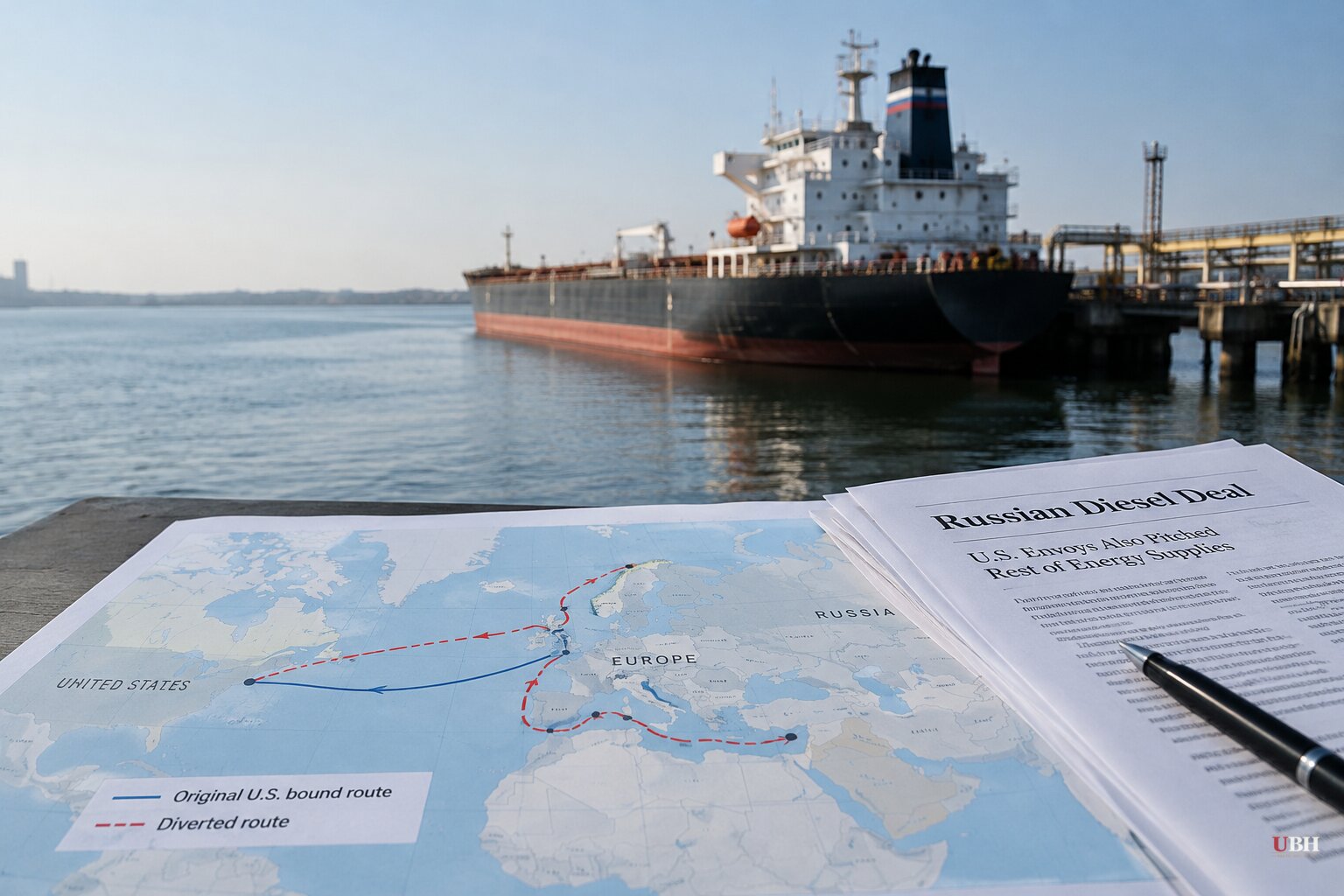
Since President Trump announced a diesel agreement with Vladimir Putin on Oct. 9, the deal has produced no confirmed delivery to a U.S. port, and a second Russian energy idea has now surfaced from the same diplomatic channel.
The diesel deal stalls at sea
Trump said Russia would immediately make more than 300,000 metric tons of diesel available to U.S. and global markets. Larger shipments were to follow: 500,000 tons in November and one million tons after that. That adds up to roughly 1.8 million tons.
The Treasury Department's Office of Foreign Assets Control authorized Russian diesel transactions that would ordinarily be subject to U.S. sanctions until April 7. The U.S. banned Russian energy imports after the 2022 invasion of Ukraine.
The tankers have not cooperated. Greenpeace, which tracked the fleet using shipping databases, counts six vessels carrying an estimated 268,000 tonnes. That is below the 300,000-ton first tranche Trump announced.
Two sanctioned tankers that left the Baltic port of Primorsk first declared U.S. East Coast destinations. According to Kpler and MarineTraffic data, one has since turned toward Brazil and the other into the Mediterranean. A third changed its destination from New York to "for orders," which leaves its unloading point open.
Bloomberg and the Kyiv Post reported that the Malta-flagged Agioi Fanendes, carrying about 40,000 metric tons, reversed course roughly 400 nautical miles from New York on Tuesday.
Neither the White House nor the Kremlin has said whether the deal was put in writing. Neither has disclosed the price, payment terms or participating companies.
State and federal pushback
New Jersey Gov. Mikie Sherrill, a Democrat, sent a letter dated Monday telling port and terminal operators to turn away the fuel. She called the deal "corrupt and illegal" and argued that the administration cannot override an import ban Congress enacted. "Any effort to profit from the illegal trade in Russian fuel will be met with harsh penalties," she wrote.
A bipartisan group of senators urged Trump to cancel the arrangement, saying the U.S. "should not provide Putin with a financial lifeline." Lawmakers also warned banks, port authorities and fuel distributors of possible civil or criminal liability and congressional investigations.
The administration maintains its authorization was lawful. The Treasury Department said the exemption was consistent with previous actions and "in compliance with all applicable laws." No court has ruled on the dispute.
The price effect looks small. Analysts have said the volumes are unlikely to move U.S. diesel prices much. Diesel cost $6.19 a gallon on Oct. 5 and $6.29 on Nov. 2, according to figures cited in recent reporting. AAA put regular gasoline at $4.17.
The gas pipeline pitch
The Wall Street Journal reported, citing American, European and Ukrainian officials, that Jared Kushner and Steve Witkoff pitched restarting Russian natural gas exports to Europe through pipelines crossing Ukraine. The pitch came on September trips to Moscow and Kyiv.
Per the Journal, an American intermediary would sell the gas to get around sanctions, and U.S. investors could profit. A senior U.S. official said Russia would deposit proceeds in an escrow account in a third jurisdiction so the Kremlin could not spend the money on the war.
A U.S. official told the Daily Caller News Foundation that Europeans have shown interest and that gas prices across the continent would fall sharply. The official added that any economic arrangement would come only as part of a broader deal to end the war.
The administration's argument is that energy revenue could be traded for an energy ceasefire before winter, with Ukraine collecting transit fees. The EU says the Iran war has added about €100 billion to Europe's energy bill.
European officials are not buying it. A senior Nordic official told the Journal that restarting Russian purchases would contradict everything Europe stands for. Another compared the idea to Neville Chamberlain's appeasement of Hitler. EU law requires Russian gas imports to end by the end of 2027, and Energy Commissioner Dan Jorgensen said in October: "I certainly would not trust Russia. Even if there were peace tomorrow, which we all hope for."
Doubts inside the energy world
Skeptics are not limited to Brussels. Ellen Wald of the Atlantic Council's Global Energy Center said she suspects the plan "will not get very far," saying Russia will never go for it, especially since it is still selling LNG to Europe. She called the proposal an apparent attempt to show consumers the administration is working on prices.
Richard Goldberg of the Foundation for Defense of Democracies noted that the administration has pushed American LNG deals across Europe. Reopening Russian gas "would seem a step backward," he said. Max Pyziur of the Energy Policy Research Foundation called the proposal "poorly conceived, of dubious legality, desperate in execution."
The reversal is stark. In 2019 Trump sanctioned Nord Stream 2 and said it made Germany "captive to Russia."
What comes next
The diesel license runs to April 7. Until a cargo is unloaded, the legal question stays theoretical. The third tanker's "for orders" destination is the next test, and Sherrill has said New Jersey will act if a ship tries to unload there. No court has been asked to rule.
On gas, no European government has signed on. The EU's 2027 phase-out date stays on the books.
Sources used for this briefing
6 links from 6 independent newsrooms (syndicated copies of the same report count once)
These are the sources it draws on, linked so you can verify.


