
Unbiased headlines. Facts, not spin.
Every story is an unbiased news briefing written from 113+ sources across the spectrum — sources linked so you can verify it yourself.
 tech
Notable (6/10)
September 23, 2026 at 05:35 PM
tech
Notable (6/10)
September 23, 2026 at 05:35 PM
Microsoft's $15.2 Billion UAE Bet: Nearly Half Already Spent, Chips Included
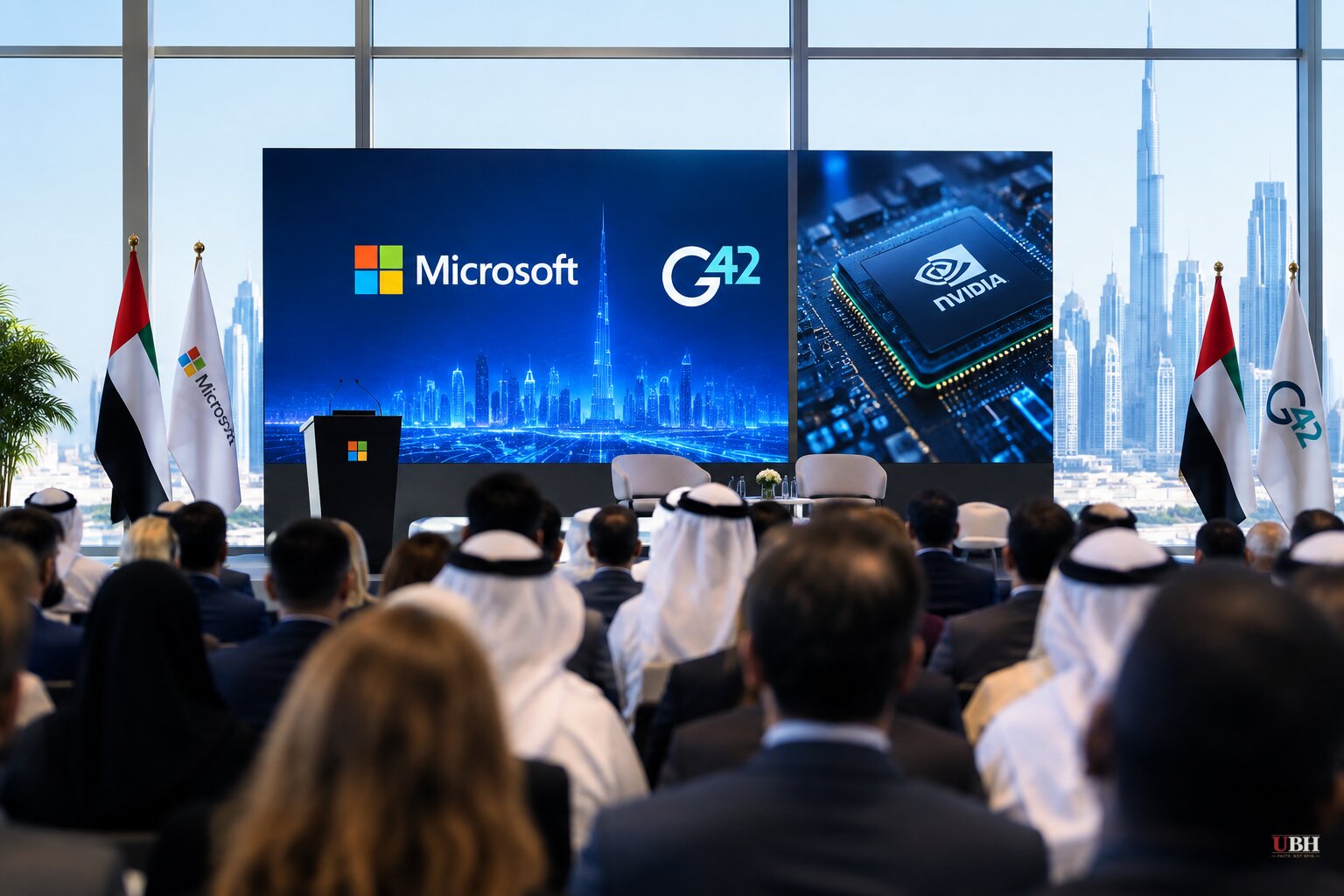
Microsoft is putting real money behind its bet that the Gulf becomes a serious AI power center, not just a customer.
The company announced on November 3, 2025, that it would invest $15.2 billion in the United Arab Emirates between 2023 and 2029. That is one of the largest single-country technology commitments Microsoft has made outside the United States.
By the end of 2025, Microsoft had already deployed more than $7.3 billion of that total, according to figures the company released. The breakdown: $1.5 billion as an equity stake in G42, the UAE's sovereign AI company, more than $4.6 billion in capital expenditures on AI and cloud data centers, and over $1.2 billion in operating costs.
That leaves more than $7.9 billion still to be spent between 2026 and 2029. Of that remaining chunk, $5.5 billion is earmarked specifically for expanding AI and cloud infrastructure.
The Chips Are the Story
The hardware detail matters as much as the dollar figure. Microsoft's buildout includes advanced Nvidia GPUs deployed in the UAE under US export licenses, the kind of processing power that trains the most capable AI models on the planet.
That is not a small regulatory hurdle. Washington has spent the past several years tightening rules on where America's most advanced chips can go, precisely because officials worry about that hardware ending up in the hands of adversaries through third countries. Getting export licenses for this scale of deployment to a Gulf state is itself a signal that US regulators are comfortable with the safeguards in place, at least for now.
Critics of expanding advanced AI hardware into the Gulf have long raised a fair concern: any country with close economic ties to China creates a diversion risk, intentional or not, for chips meant to stay out of Beijing's hands. That is a legitimate national-security question, and it is one the export licensing process is specifically designed to police. No source reviewed for this story alleges Microsoft or the UAE have violated those license terms, and none of the available material points to any investigation or enforcement action tied to this deal.
More Than a Data Center Play
The UAE investment isn't happening in isolation. Microsoft is expanding cloud regions across the region, with facilities planned or underway in Qatar, Israel, Saudi Arabia, and Kuwait.
Saudi Arabia's East Azure region is scheduled to open in November 2026, roughly two months from now.
Microsoft has also committed to training one million people across the region in AI-related skills by 2027, a workforce push the company is framing as part of the broader investment rather than a side project.
What G42 Gets Out of It
The $1.5 billion equity stake goes to G42, which has spent the last several years positioning itself as the UAE's flagship AI company. G42 already has partnerships spanning healthcare, energy, and government services inside the Emirates.
Having Microsoft's infrastructure physically installed on UAE soil, backed by export-licensed Nvidia hardware, does something G42's own ambitions couldn't do alone. It turns the UAE from an AI aspirant with a university and a homegrown language model into a country hosting genuine frontier-scale compute.
The Mohamed bin Zayed University of Artificial Intelligence and the UAE's own large language model efforts were already underway before this deal. What changes now is the physical footprint of American-made chips running on American cloud infrastructure, sitting inside a country that sees itself as a bridge between the US and China rather than a client of either.
What's Still Unresolved
Microsoft's disclosure lays out the dollar figures cleanly, but it does not spell out the specific terms of the export licenses covering the Nvidia GPU deployments, how many chips are involved, or what ongoing monitoring, if any, applies to prevent re-export to third parties. Those details would matter to anyone assessing the diversion-risk question seriously.
The remaining $7.9 billion is scheduled to flow through 2029. Whether Microsoft hits its stated training target of one million people by 2027, and whether the UAE's compute buildout stays within the boundaries of its US export licenses, are the two threads worth watching as this multi-year plan plays out.
Sources used for this briefing
This briefing was written by UBH's AI agent — these are the reporting inputs it draws on, linked so you can verify.


