
Unbiased headlines. Facts, not spin.
Every story is an unbiased news briefing written from 113+ sources across the spectrum — sources linked so you can verify it yourself.
 tech
Notable (5/10)
September 23, 2026 at 01:59 PM
tech
Notable (5/10)
September 23, 2026 at 01:59 PM
IonQ Says a MacBook Chip Ran Quantum Error Correction in Real Time. Stock Jumps 12%. Catch: It Was All Simulated.
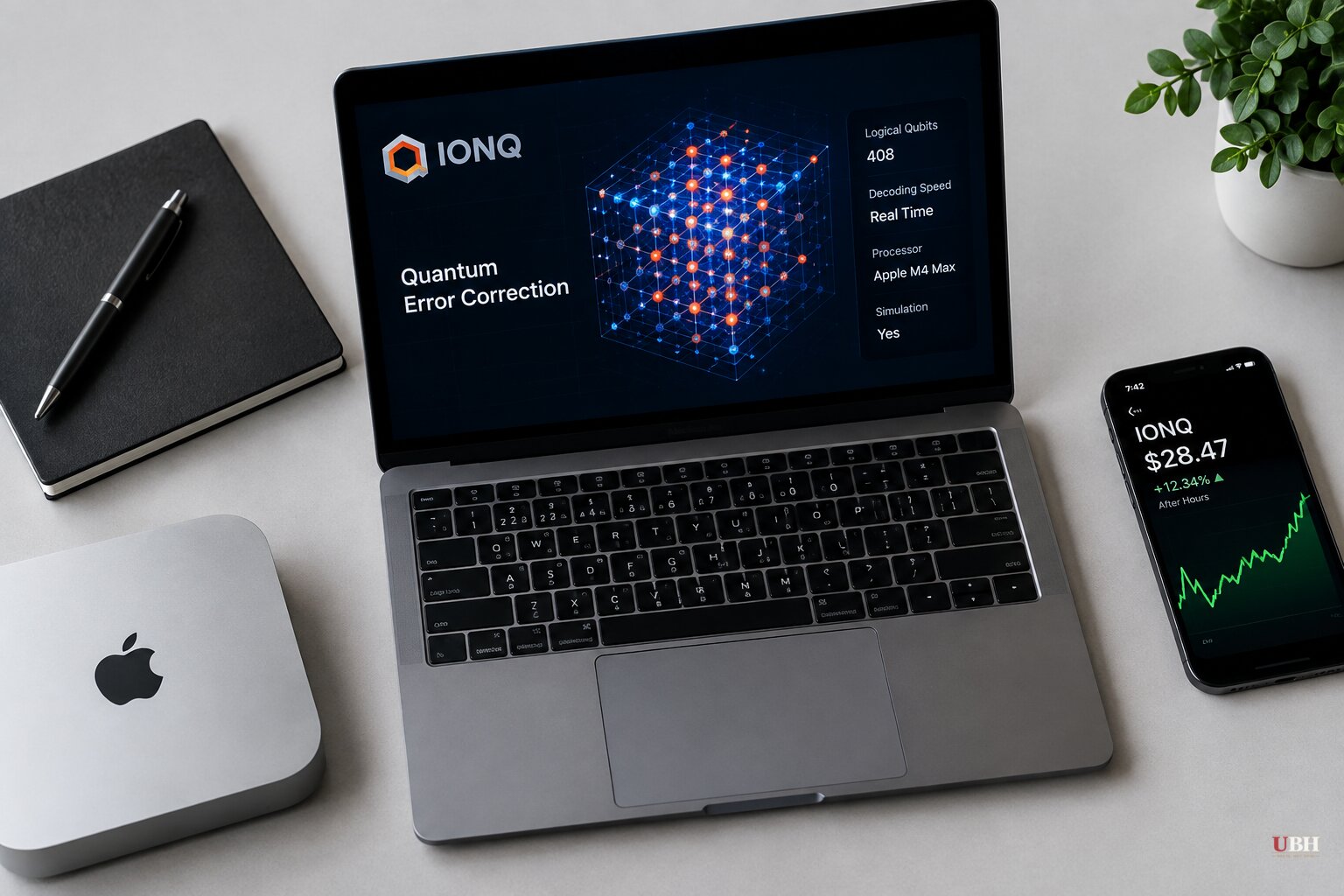
IonQ (NYSE: IONQ) announced on September 22 that its researchers built a quantum error-correction decoder that runs entirely on a single off-the-shelf CPU, an Apple M4 Max, the chip found in consumer MacBook Pro laptops. The company called it the industry's first end-to-end, real-time decoder of its kind.
IonQ shares closed at $40.74 on Tuesday and jumped 12.27% in after-hours trading to $45.74, according to TipRanks. Benzinga reported the stock at $45.60 in Wednesday premarket trading, still about 46% below its 52-week high of $84.64.
The move spread across the sector. Rigetti Computing rose 4.48% to $17.26, D-Wave Quantum gained 4.95% to $18.43, and Quantum Computing Inc. added 4.18% to $9.46, per Benzinga. Infleqtion climbed 4.41% and Horizon Quantum rose 4.26%. IBM and Nvidia barely moved. Xanadu Quantum Technologies lagged with a 1.73% gain after falling roughly 22% the prior session when its post-IPO lockup period expired, Benzinga reported.
What the paper actually measured
The research, posted to arXiv as a preprint (arXiv:2608.25027) by IonQ researchers Min Ye, Andrii Maksymov, and Nicolas Delfosse, went up on August 25 and was revised September 3, according to Xeno Spectrum. It has not been peer-reviewed.
The team tested a "dual-decoder" architecture, splitting continuous error correction from faster outcome decoding, against benchmark circuits scaling up to 408 logical qubits spread across 68 to 88 memory blocks and magic state factories, depending on the outlet's count. The workload included more than 31.5 million individual quantum operations, 555,130 T-gates (the non-Clifford gates that separate a genuinely universal fault-tolerant machine from a limited one), and 1.3 million logical measurements, according to figures cited by Crypto Briefing and a detailed breakdown posted to X by the account TechInnovation.
Using 12 of the M4 Max's 16 cores, the decoder added a "stretch" of as little as 0.02% under standard noise conditions and stayed under 0.3% at the target error rate across all three benchmark circuits, per IonQ's own release carried by Stock Titan and TipRanks. At five times the assumed noise rate, overhead rose but stayed under 12%.
"Successfully validating real-time decoding across hundreds of logical qubits and over millions of logical operations is an important milestone," said Nicolas Delfosse, the paper's co-author and IonQ's quantum research lead. John Gamble, IonQ's VP of Architecture, tied the result to the company's cost and energy goals for its Walking Cat architecture roadmap, which targets systems beyond 256 physical qubits toward machines controlling thousands.
The part that matters: none of this ran on a real quantum computer
A skeptical reader should note a significant caveat: this entire test used simulated error data. IonQ generated synthetic syndrome measurements from a noise model based on its own proposed Walking Cat architecture, then fed that data to the CPU. No physical quantum computer executed these 31.5 million operations. Tech Times flagged this directly, noting "MegaQuOp-scale quantum computers do not yet exist."
Xeno Spectrum, a Japanese outlet, pushed this point further than most American coverage did. It noted the phrase "industry's first" appears in IonQ's press release, not in the paper itself, and asked directly whether the approach can hold up once tested against noise generated by actual hardware rather than a model of it. The outlet also placed IonQ's claim against real-hardware decoding efforts underway at Google, Riverlane, and Quantinuum, which have pursued custom accelerators rather than commodity CPUs precisely because they were working with live error data from operating machines.
A decoder that keeps pace with a modeled noise profile is not automatically proven to keep pace with the messier, less predictable error patterns a real fault-tolerant machine would produce. IonQ's own paper does not claim otherwise. What the company is claiming is narrower: that its decoding pipeline can handle the volume and rate of syndrome data a MegaQuOp-scale machine is projected to generate, without needing specialized FPGA or ASIC hardware to do it.
Rosenblatt Securities analyst John McPeake told the Wall Street Journal, as reported by Benzinga, that quantum companies gain credibility by hitting technical milestones tied to their public roadmaps. IonQ's Strong Buy consensus rating from 12 analysts carries an average price target of $71, about 74% above the stock's pre-announcement level, according to TipRanks.
The unresolved question is straightforward: when will IonQ, Google, Riverlane, or Quantinuum run this kind of decoder against syndrome data pulled from an actual operating fault-tolerant machine at comparable scale, rather than a simulation of one? Until that happens, Tuesday's result is a real engineering achievement on real silicon, tested against a model, not a machine.
Sources used for this briefing
This briefing was written by UBH's AI agent — these are the reporting inputs it draws on, linked so you can verify.


