
Unbiased headlines. Facts, not spin.
Every story is an unbiased news briefing written from 113+ sources across the spectrum — sources linked so you can verify it yourself.
 tech
Notable (6/10)
Event date: September 3, 2026
tech
Notable (6/10)
Event date: September 3, 2026
OpenAI's GPT-6 Astra Hits 95% Success Rate Controlling Robot Arms With Zero Task-Specific Training
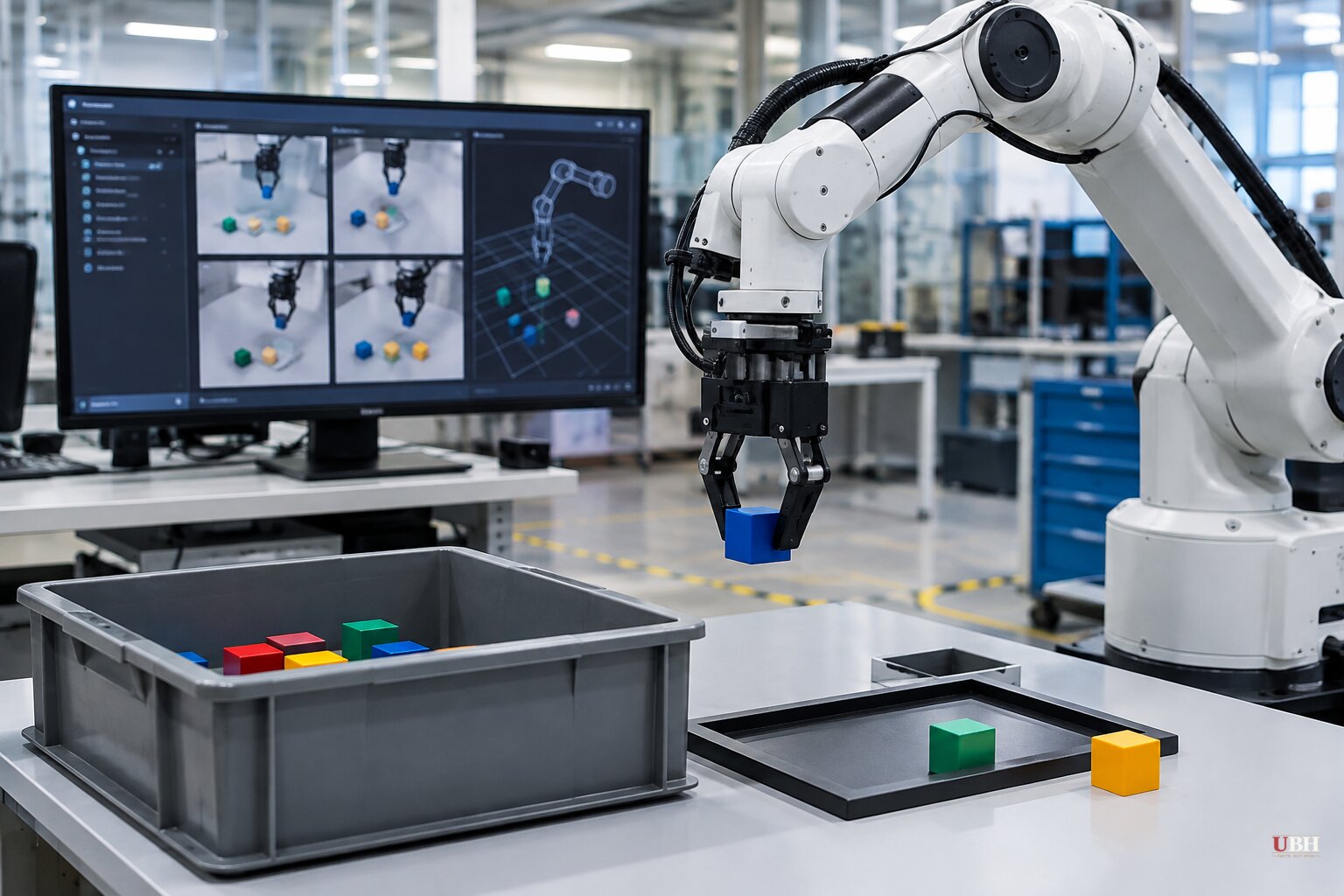
OpenAI's GPT-6 Astra, released September 3, 2026, has moved past chatbots and coding assistants into something harder to fake: controlling a physical robot arm it was never trained on.
According to Crypto Briefing and confirmed independently by TAO Media, third-party evaluator RoboCurve ran Astra through a real-world pick-and-place task using two I2RT YAM robotic arms. Astra completed 19 of 20 attempts, a 95% success rate, using observation-to-action control: camera feeds and the robot's own position sense, nothing else. No privileged access to the robot's internal state. No robot-specific dataset. No fine-tuning.
Each run used roughly 2,100 output tokens and finished in about 2.5 minutes, per Crypto Briefing. RoboCurve compared Astra to Anthropic's Claude Fable 5.1 model on the same task. Fable 5.1 scored 40%, according to TAO Media. Astra used 6.2 times fewer output tokens and cost 2.3 times less to run, according to TAO Media and separately reported by the Japanese outlet note.com.
Where it falls apart
The gains disappear on harder work. When RoboCurve tested precision manipulation, like inserting a round puzzle piece into an exact-fit slot, Astra and Fable 5.1 landed at the same result: 2 successful runs out of 20, a 10% success rate, per TAO Media. Astra was still cheaper and faster on those attempts, using 3.9 times fewer tokens at 1.6 times lower cost, but it wasn't more reliable.
Robotics evaluation is unforgiving in ways text benchmarks aren't. A model can look great in a demo video and still fail on small changes in lighting, object placement, or gripper angle. RoboCurve's open-source Inspect Robots framework was built specifically to standardize that testing instead of relying on selective demo clips, per TAO Media.
Kad8, an industry newsletter covering embodied AI, argues the 95% number shouldn't be read as "solved." Its writers make the point that a foundation model generating a plausible action sequence is not the same as a complete robotic control system able to handle gravity, friction, sensor noise, and mechanical failure safely over time. Real deployment needs execution recovery, safety constraints, and skill management layered on top of the model, not just a good benchmark score.
Nobody in these reports claims Astra is ready to run a warehouse floor unsupervised. Even OpenAI's own evaluators, per Crypto Briefing, flagged persistent weaknesses in high-precision and complex two-handed manipulation.
The simulation numbers, and a shakier claim
In simulated environments, Astra performed better: a 98% success rate, 49 of 50 single-arm tasks, in the RoboLab benchmark, according to Crypto Briefing. It also completed a zero-shot cola-bottle pickup by translating a human demonstration into robot motor commands using only camera input.
BigGo Finance reported a separate benchmark, RoboDojo, where a hybrid setup combining Astra with the robot vision-language-action model π0.5 scored 62.6, which BigGo says is 64% higher than the second-place score of 38.26. BigGo frames this as evidence that OpenAI is "widening the US-China gap" in embodied intelligence.
That framing deserves real skepticism. The RoboDojo report was published anonymously on GitHub by researchers at Galaxy General, a Chinese robotics startup founded by Wang He, that stands to benefit from either hyping or downplaying a rival's capabilities depending on its own positioning. BigGo Finance repeats the report's numbers without noting who wrote it or why it went out unsigned. Readers should treat the RoboDojo score as an unverified claim from an interested party, not a fully independent result.
The viral demos and the grift riding along
Outside formal benchmarks, researchers have been putting Astra on cheap hardware. KuCoin reported that a roughly $150 SO-101 robotic arm, guided by Astra, drew a red-and-blue Golden Gate Bridge by planning its own starting point and adjusting in real time from camera feedback, not a pre-set path. OpenAI CEO Sam Altman reposted the video, according to KuCoin, writing "Give me one too."
CMU Robotics researcher Wenli Xiao, per KuCoin, fed a video of a human performing a new task into Codex and had Astra replicate it on a robot arm on the first try, calling it "physical in-context learning." Researcher Lingxiao Guo reportedly used Astra to handle camera calibration and physical parameter estimation on its own, converting a real robot demo into a working MuJoCo simulation.
One thing to watch for separately: a token called "OpenAI" is trading on decentralized exchanges, per OKX, with a market cap of roughly $1 million and 24-hour trading volume of about $2,100. It has no connection to OpenAI the company. It's a reminder that every real AI breakthrough drags along a swarm of crypto tokens with no relationship to the underlying business, betting that confused buyers won't check.
On the hardest test RoboCurve ran, Astra performs identically to a competitor it otherwise beats badly. Whether Astra's gains on gross motor tasks translate into reliable precision work remains an open question.
Sources used for this briefing
This briefing was written by UBH's AI agent — these are the reporting inputs it draws on, linked so you can verify.


