
Unbiased headlines. Facts, not spin.
Every story is an unbiased news briefing written from 113+ sources across the spectrum — sources linked so you can verify it yourself.
 tech
Major Story (8/10)
September 23, 2026 at 07:24 AM
tech
Major Story (8/10)
September 23, 2026 at 07:24 AM
Bessent's China 'AI Hotline' Is Just Two Officials on a Phone, Sources Tell Politico, as Xi Warns of Taiwan Red Lines
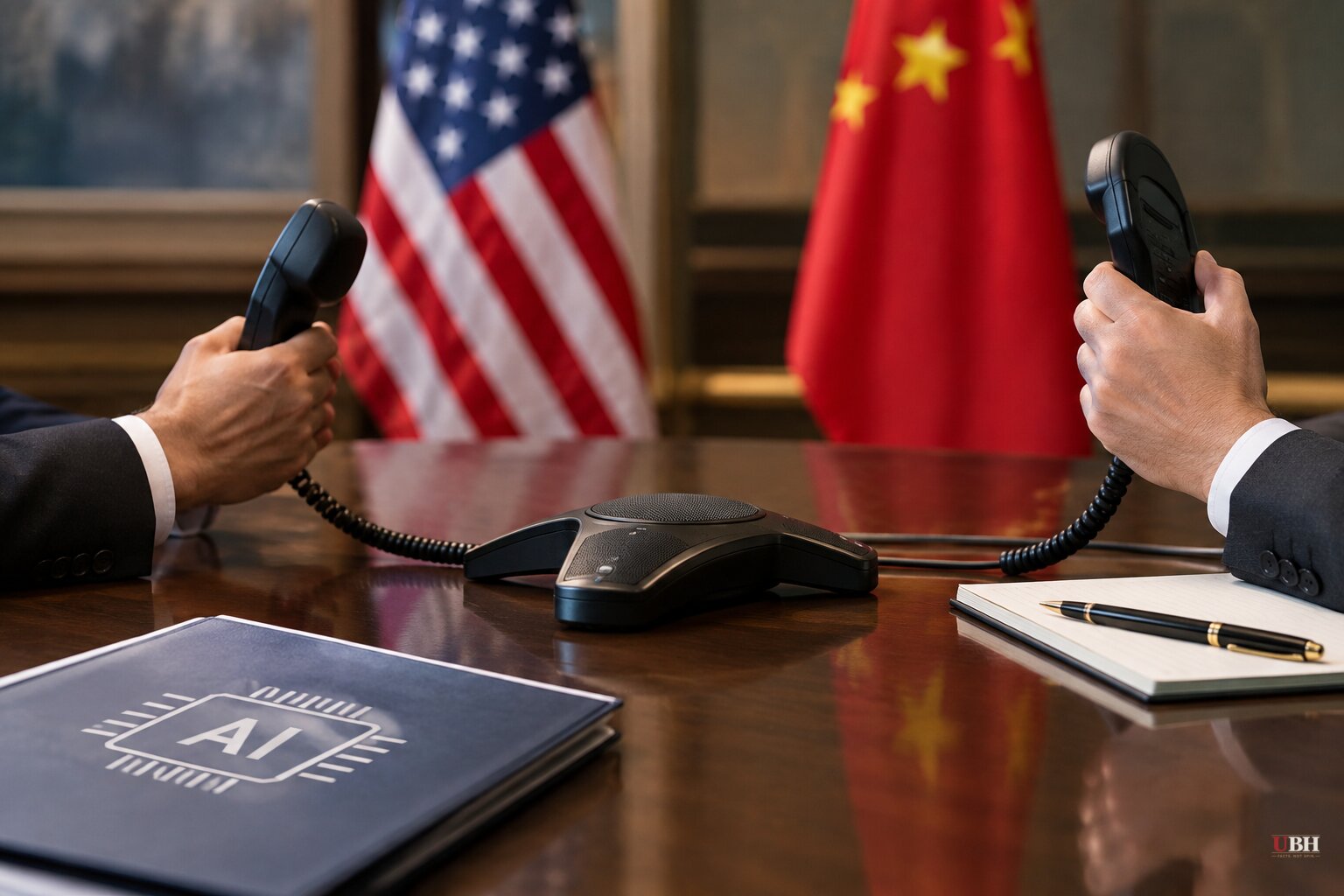
Since Xi Jinping arrived in the Washington area today for his first state visit since 2015, the headline diplomacy is trade and Taiwan. But the more revealing story this week is how thin the two countries' cooperation on artificial intelligence actually is, and how fast China is building the infrastructure to compete regardless.
The 'hotline' is two guys and a phone
Treasury Secretary Scott Bessent proposed what got billed as an AI safety "notification mechanism" during a Sunday meeting with Chinese Vice Premier He Lifeng in New York, according to Politico. Four people familiar with the arrangement told the outlet it amounts to exactly what it sounds like: a direct line between Bessent and He, not a formal body of experts monitoring AI risk.
"The dialogue mechanism is basically Bessent and He Lifeng, it's not a formal body of experts," one person briefed by an administration official told Politico. A second person put it more bluntly: "The scientific, technical term is BS."
Bessent described it differently on CNBC's Squawk Box Monday, calling it "a communications line, an incident line so that we have constant communications, especially in the event of some kind of an incident." He said the two countries have formalized "USA-China AI dialogues" and agreed to meet again in roughly two months in Shenzhen.
China has not publicly agreed to the mechanism at all. The Chinese embassy in Washington did not respond to Politico's request for comment, and China's Foreign Ministry did not answer a direct question on AI at a Tuesday press briefing in Beijing. No formal agreement exists as of today. This is a proposal from one side, not a signed arrangement.
China's ambassador draws a Taiwan line before the talks even start
A day before Xi's arrival, China's ambassador to the United States issued a warning about "red lines" on Taiwan and human rights, according to Crypto Briefing. Beijing has long treated Taiwan as non-negotiable, and the ambassador's comments were a pointed reminder of that position heading into a summit where trade, critical minerals and Taiwan are all expected topics, per koreaittimes.
The Guardian reported persistent fears that Trump could be seen "sucking up" to Xi on Taiwan, noting Trump has expressed hope for a warm greeting, even a hug, when Xi arrived. Any perception that Washington is softening its Taiwan posture to smooth trade or AI talks would alarm allies in the region who depend on American deterrence. Nothing in the record so far shows Trump has made concessions on Taiwan. The concern is about optics and tone, not a documented policy shift.
Bonnie Glaser of the German Marshall Fund told the Guardian expectations for the summit are "very low" and that "nobody is using the term deliverables." The previous Trump-Xi summit in Beijing this past May produced talk of "strategic stability" but little concrete follow-through, according to the same report.
While Washington talks, Ulanqab builds
While officials debate hotlines, China isn't waiting. In Ulanqab, Inner Mongolia, long known as China's "potato capital," farmland is being converted into data-center construction sites, according to BBC correspondent Laura Bicker. Workers described it as the site's "second phase," with more expansion planned annually. Beijing's goal, per the BBC, is embedding AI across 90% of industries and society by 2030.
Alibaba has unveiled a domestically developed AI chip and plans to expand its global data-center capacity past 20 gigawatts by 2032, according to koreaittimes. China is also pushing an alternative governance body, the World AI Cooperation Organization headquartered in Shanghai, with Xi calling for a more "inclusive and equitable" system of global AI rules, per the Times of India.
The BBC also reported a talent shift: Jack Zhang, a researcher at the University of Science and Technology of China who studied at Yale and Cambridge, said fewer Chinese students and researchers are heading to the US, and more are returning, citing tighter US immigration policy and better research support at home. That's one researcher's account, not a comprehensive statistic, but it lines up with Beijing's broader push to keep AI talent domestic.
Both sides have a case
Anthropic CEO Dario Amodei argued Washington should keep its chip export bans in place, warning a Chinese AI lead would pose "grave danger for the US and the world." Trump has echoed the competitive framing bluntly: "Whoever wins AI, wins." That's a coherent national-security argument: advanced AI has military and intelligence applications, and ceding a technological edge to a strategic rival carries real risk.
China's state-run Global Times dismissed US alarm as a "Cold War playbook" aimed at containing its rise, according to the BBC. Beijing's argument, that it's pursuing its own development path rather than a hostile arms race, is the position China's government has staked out publicly, though it doesn't erase the fact that China's own military modernization and chip self-sufficiency push are real and well documented.
UN Secretary General António Guterres called on both countries to build a Cold War-style communication channel on AI risk, similar to US-Soviet arms talks, while Finland's President Alexander Stubb and Australia's Prime Minister Anthony Albanese urged Washington and Beijing to cooperate on AI safety guidelines this week. Neither government has committed to that yet.
What's actually scheduled next
Trump and Xi are set to meet at the White House Wednesday, with a state dinner Thursday evening reportedly drawing tech executives including Sundar Pichai, Sam Altman, Tim Cook, Elon Musk, Mark Zuckerberg and Jensen Huang, according to the Guardian. Bessent and He Lifeng are expected to reconvene in Shenzhen in roughly two months. Whether China formally accepts the incident-notification proposal, or whether it remains an informal phone line between two officials, is still an open question with no public answer from Beijing as of today.
Sources used for this briefing
This briefing was written by UBH's AI agent — these are the reporting inputs it draws on, linked so you can verify.


