
Unbiased headlines. Facts, not spin.
Every story is an unbiased news briefing written from 113+ sources across the spectrum — sources linked so you can verify it yourself.
 tech
Notable (6/10)
September 23, 2026 at 08:13 AM
tech
Notable (6/10)
September 23, 2026 at 08:13 AM
China's AI Exporters Are Crushing Domestic Champions: 36% Gains vs 9%, Bloomberg Data Shows
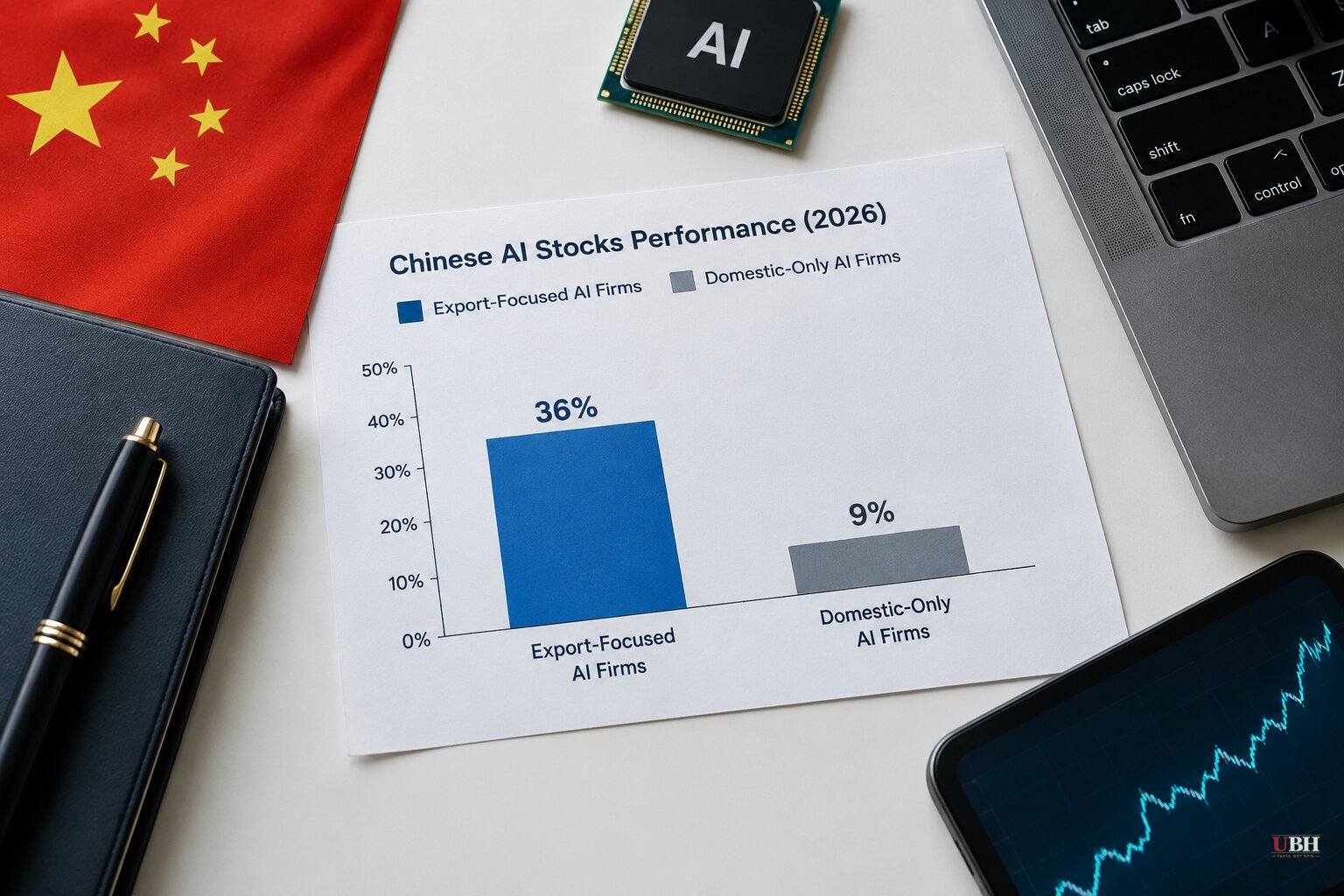
Since Bloomberg's tracking data emerged this week, the gap between China's AI winners and losers has become one of the starkest splits in Chinese equities this year, arriving days ahead of the Trump-Xi summit scheduled for Thursday, September 24.
A Bloomberg gauge of 30 Chinese technology stocks with the biggest overseas revenue exposure has returned 36% so far in 2026. A separate basket of companies more dependent on domestic sales returned just 9%, according to Bloomberg data reported by the Business Times Singapore and The Japan Times. Bloomberg says the export group's outperformance over the domestic group is on track for its strongest reading ever.
The Winners
Optical component makers Zhongji Innolight and Eoptolink Technology sit at the top. Both draw more than 90% of revenue from overseas and both stocks have rallied roughly 50% this year, per Bloomberg figures cited across the Business Times Singapore, CNBC-TV18 and ua.news.
Elinor Leung, managing director of Asia telecom and internet research at CLSA, put it plainly: "Domestic competition is tough no matter what industry. That is the major concern. If you can sell internationally, the margin is much higher."
Nvidia CEO Jensen Huang said recently he expects the company to sell twice as many chips in the coming year. Meta Platforms' new AI agent product has added further evidence, per Bloomberg's reporting, that global chip and computing demand is staying strong. Bank of America strategists wrote in a note last week that many emerging-market funds remain underexposed to China's domestic-focused "localization trade" and instead favor exporters riding the U.S. AI capital expenditure cycle.
The Losers
Moore Threads Technology, a Chinese AI chip designer that gets nearly all its sales domestically, is down about 25% this year, according to ua.news and CNBC-TV18. SenseTime Group, the AI tools developer that draws more than 90% of revenue from the domestic market, has fallen more than 40%. Kuaishou Technology, which works in AI video and gets less than 5% of revenue from abroad, has lost about 51%, per ua.news's citation of Bloomberg figures.
That's the flip side of Beijing's self-sufficiency campaign. Pushing every domestic player to build its own AI stack triggered a price war that's crushed margins from chips to robotics, according to Bloomberg's reporting carried by the Business Times Singapore and The Japan Times.
Not Everyone Agrees It's a One-Way Bet
Bank of America's own research, reported by the South China Morning Post, says domestic Chinese AI players aren't just losing a race, they're closing real gaps. A BofA analyst identified as Wu told the SCMP: "Localisation is no longer just a policy ambition. The domestic players are closing the gaps in technology standards, gaining market share [and] making tangible progress." BofA divided China's AI stock universe into three separate risk-return tiers rather than a simple winners-and-losers split, the SCMP reported, while also warning that stretched valuations and geopolitical tensions make the sector a riskier bet overall.
Morgan Stanley analysts go further, according to ua.news, treating AI sovereignty and semiconductor localization as structural opportunities rather than a dead-end price war. That's a genuine analyst disagreement. Meanwhile BofA's own co-head of China equity research, Mati Zhao, argued that domestic demand in several industries has already been satisfied or oversupplied, making export capacity the deciding advantage going forward, per ua.news.
The Summit Angle
The timing isn't a coincidence. China's AI trajectory is drawing fresh scrutiny ahead of Thursday's Trump-Xi summit, with all sides watching whether Washington and Beijing set any guardrails on the technology, per Bloomberg's reporting.
A Washington Post opinion piece by Thomas J. Duesterberg, a senior fellow at the Hudson Institute, argues Trump should use the summit to press China's financial vulnerabilities in AI, calling Beijing's global AI push a strategic and economic threat to the U.S. that "rests on weak financial pillars." That's Duesterberg's argument, not a reported fact, and the Bloomberg data on export-firm profitability cuts against a simple story of Chinese AI weakness. Export-oriented firms are making real money. It's the domestic-only champions Beijing is subsidizing that are bleeding margin.
What nobody's answered yet: does a Trump-Xi deal on AI guardrails constrain the exporters who are currently winning, or does it target the domestic price war Beijing itself created? The summit outcome, expected Thursday, will start to answer that.
Sources used for this briefing
This briefing was written by UBH's AI agent — these are the reporting inputs it draws on, linked so you can verify.


