
Unbiased headlines. Facts, not spin.
Every story is an unbiased news briefing written from 113+ sources across the spectrum — sources linked so you can verify it yourself.
 tech
Notable (6/10)
September 23, 2026 at 04:29 AM
tech
Notable (6/10)
September 23, 2026 at 04:29 AM
Qualcomm Unveils Two New Snapdragon Chips Built to Run AI Directly on Phones
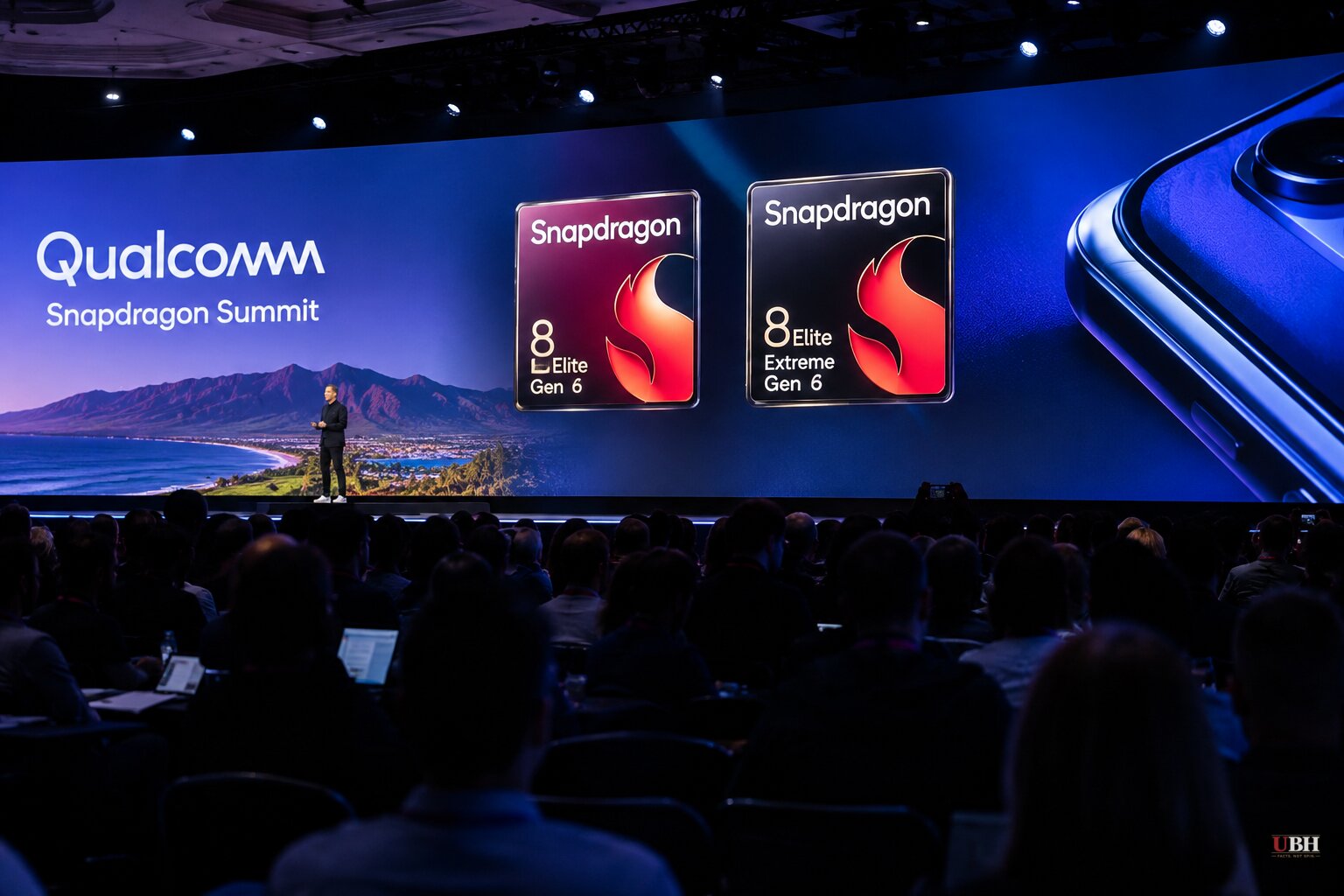
Qualcomm rolled out two new flagship smartphone chips on Tuesday, September 22, at its Snapdragon Summit in Maui: the Snapdragon 8 Elite Gen 6 and a higher-end Snapdragon 8 Elite Extreme Gen 6, according to Unite.ai and TechCrunch. Both are built on Taiwan Semiconductor Manufacturing Company's 2-nanometer process, and both are designed around one idea: run serious AI directly on the device, not in some data center.
Chris Patrick, Qualcomm's senior vice president and general manager of mobile handsets, said the launch "marks a milestone as we introduce not one, but two new flagship mobile platforms, delivering agentic AI experiences that are immediate, personal, and adaptive," according to Unite.ai. CEO Cristiano Amon told the crowd the mobile experience is shifting from "phone-centric" to "agent-centric," meaning users won't have to bounce between apps to get things done, according to TradingKey.
What the Chips Actually Do
The headline number is 30 billion. Qualcomm says the Extreme chip can run a 30-billion-parameter mixture-of-experts (MoE) model entirely on the phone, no cloud connection needed, according to TechCrunch and daily.dev. Because MoE models only activate a fraction of their parameters for any given task, the phone doesn't need to power the whole model at once.
For context, Apple introduced a 20-billion-parameter MoE model at its Worldwide Developer Conference in June, according to TechCrunch. Qualcomm's number is bigger, though bigger doesn't automatically mean better in real-world use, and Qualcomm's own product brief cautions that performance "will vary depending on OEM implementation and other factors," according to Unite.ai.
During a live demo, Qualcomm worked with StepFun, Wuliang, and Longsys to run a 30B StepEdge-Omni model on-device, hitting a prefill speed over 330 tokens per second and decoding over 28 tokens per second, with memory use cut more than 50% versus conventional setups, according to TradingKey. The demo had the assistant handle emails, plan an itinerary, sync a calendar, and draft replies, all offline.
Both chips carry Qualcomm's custom Oryon CPU, which the company's product page describes as the first mobile CPU to hit 5 GHz, pairing two prime cores at up to 5.0 GHz with six performance cores at up to 4.0 GHz, according to Unite.ai. Qualcomm claims a 13% CPU performance gain and 37% better CPU power efficiency over last year's Snapdragon 8 Elite Gen 5, plus a 44% GPU performance jump and 35% faster NPU processing. Those are the company's own comparisons, not independently verified.
A new sensing hub can run small models up to 200 million parameters for a feature Qualcomm calls Personal Scribe, differentiating between speakers and building usage-based memory to automate tasks, according to TechCrunch. On camera hardware, the Extreme chip supports 8K video at 60 frames per second and 4K at 240 frames per second for slow motion, along with a new Advanced Professional Video codec, according to Unite.ai.
Who's Building Phones With It
Qualcomm confirmed HONOR, iQOO, Motorola, OnePlus, OPPO, REDMI, RedMagic, vivo, and Xiaomi are lined up to build phones on the new chips, according to Pulse 2. TradingKey added ZTE to that list. Motorola separately announced its Signature 27 phone will use the Extreme chip, with general availability sometime this year, according to TechCrunch.
Qualcomm also announced a collaboration with Google on a new laptop category called Googlebook, built around Gemini Intelligence and powered by Qualcomm's Snapdragon X Elite chip, with Dell and HP as the first manufacturers, according to Pulse 2.
The Competitive Backdrop
CNBC reported the new chips will compete directly with Apple's A20 Pro in iPhones, according to StockTwits. Apple, Qualcomm, and Google are all racing to convince consumers that the phone in your pocket, not a separate AI gadget, is where AI agents actually live. Whether that bet pays off is unresolved. Nothing co-founder Carl Pei has previously argued phones will remain the primary AI device, a view TechCrunch says has been echoed elsewhere in the industry.
There's a fair counterpoint worth stating plainly: skeptics of the on-device AI push note that benchmark numbers from chipmakers are self-reported, run under controlled conditions, and often don't reflect battery drain, thermal throttling, or real-world app performance once phones ship. Qualcomm's own materials acknowledge results "will vary," a caveat that matters more than the marketing slides.
Money on the Table
Qualcomm stock closed Tuesday's regular session up 2.08% at $198.27, then slipped 0.24% in after-hours trading, according to StockTwits and TradingKey. TradingKey's technical analysis flagged the stock breaking above a downward trendline with an RSI of 67.57, testing Fibonacci resistance near $201.40, with potential upside targets at $215.28 and $235.05 if the breakout holds. That's a forecast built on chart patterns, not a guaranteed outcome, and TradingKey's own numbers are estimates, not settled facts.
StockTwits noted the launch lands as the broader smartphone industry deals with rising device costs and softer shipment expectations. Whether Qualcomm's AI pitch is enough to get people upgrading their phones again is the question the next few quarters of sales data will actually answer.
Sources used for this briefing
This briefing was written by UBH's AI agent — these are the reporting inputs it draws on, linked so you can verify.


