
Unbiased headlines. Facts, not spin.
Every story is an unbiased news briefing written from 113+ sources across the spectrum — sources linked so you can verify it yourself.
 tech
Notable (6/10)
Event date: September 12, 2026
tech
Notable (6/10)
Event date: September 12, 2026
OpenAI Launches GPT-6 Sol and Luna, Cuts API Prices in Half, 90 Minutes After Anthropic's Opus Update
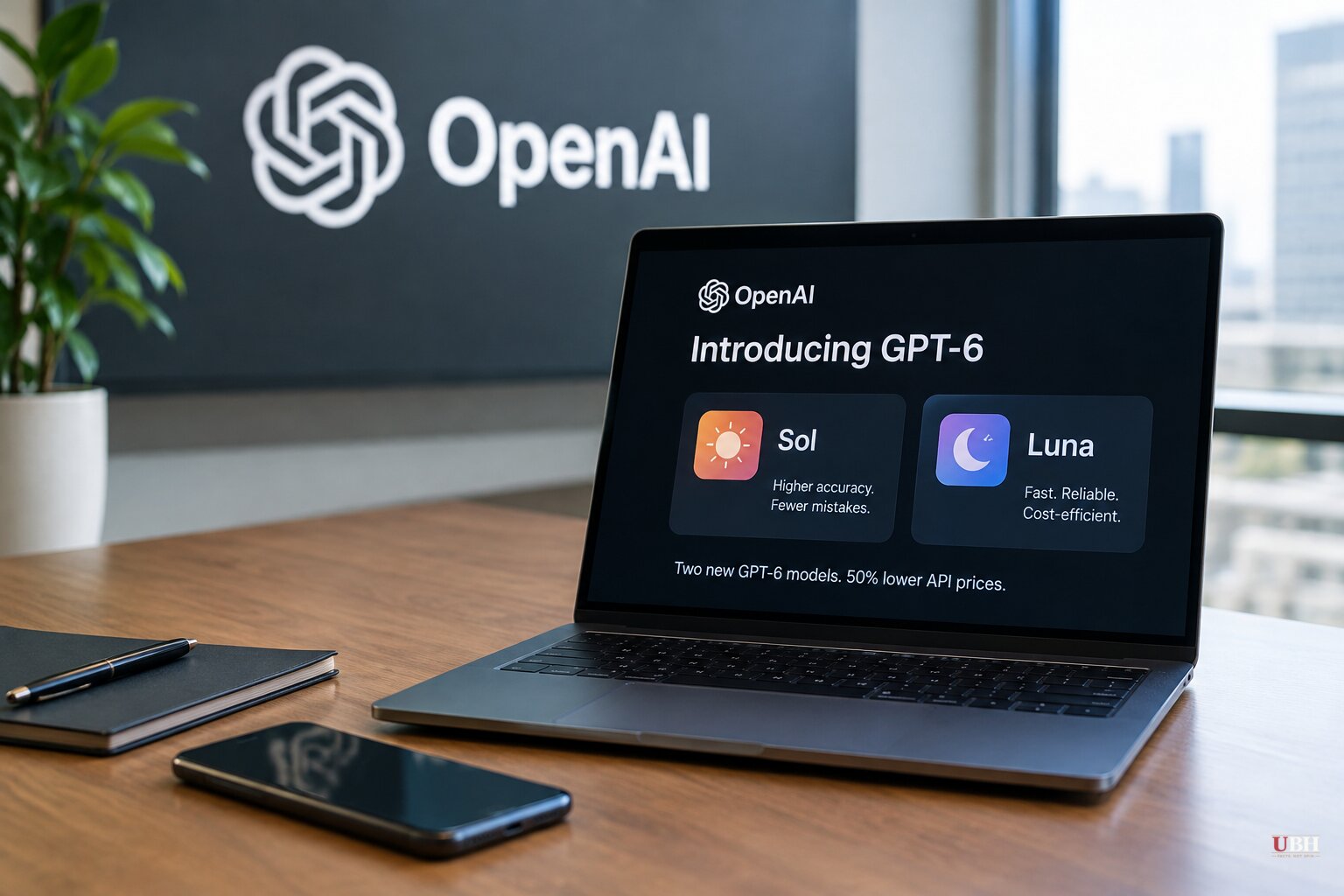
OpenAI rolled out two new AI models today, GPT-6 Sol and GPT-6 Luna, expanding the GPT-6 lineup it started earlier this month with the flagship Astra model, according to OpenAI's own launch announcement.
The pitch is simple: cheaper and more accurate. Sol now costs $2 per million input tokens and $10 per million output tokens, down from $4 and $20 for GPT-5.6 Sol. Luna dropped to $0.10 input and $0.50 output, down from $0.20 and $1.20, according to OpenAI's published pricing table. Runtime Wire pointed out that Luna's output-token price actually fell about 58%, more than the 50% headline figure OpenAI advertised for the release.
SQ Magazine flagged an important caveat: the 50% discount is measured against GPT-5.6's promotional pricing, not necessarily what every customer was already paying. Companies comparing bills should check their actual GPT-5.6 rate, not just take OpenAI's percentage at face value.
The Accuracy Claims Are OpenAI's Own
OpenAI says GPT-6 Sol "makes about half as many mistakes as its predecessor," reaching what the company calls Astra-level reliability at a fraction of the cost. That number comes from an internal factuality evaluation built on de-identified conversations where ChatGPT users flagged errors themselves, per OpenAI's announcement.
SQ Magazine was blunt about the limits of that methodology: "Those numbers come from OpenAI alone... the test counts mistakes users noticed and flagged, so it cannot capture errors nobody caught. No independent reproduction accompanied the launch." That's a fair point. A model that produces a confident, wrong answer a user never questions doesn't show up in this scorecard at all.
That doesn't mean the claim is worthless. Testing real flagged errors from actual usage is a legitimate signal about whether a model behaves better in practice, not just on a synthetic benchmark. But it's OpenAI grading its own homework, and readers should treat the "half as many mistakes" figure as a company claim, not a settled fact, until outside researchers can reproduce it.
ZDNET, whose parent company Ziff Davis filed a copyright lawsuit against OpenAI in April 2025 over AI training data, still ran with OpenAI's numbers largely at face value, translating the accuracy claim into hospital-doctor analogies without independently testing the models itself.
The Anthropic Rivalry, Measured in Minutes
Anthropic released an updated version of Opus 5.5 about 90 minutes before OpenAI's launch, according to both TechCrunch and SQ Magazine. Neither outlet claims the timing was coordinated or retaliatory. The two labs are shipping updates on top of each other in the same week, which SQ Magazine called a sign of how tightly the companies now "shadow each other."
OpenAI used the launch to directly compare Sol against Anthropic's Opus 5 and Fable models. On AutomationBench, a business-workflow benchmark, OpenAI says GPT-6 Sol at its highest reasoning setting scored 33.2%, versus 26.9% for Claude Opus 5 at its own maximum setting, at roughly 9% of Opus 5's cost per task, according to OpenAI's own documentation and Runtime Wire's reporting.
That comparison depends entirely on OpenAI's chosen reasoning settings, its own API prices, and its own evaluation harness. Runtime Wire said as much directly: "it should be read as a vendor benchmark." Anthropic has not published a competing comparison using its own methodology in these reports.
What's Actually Available Today
GPT-6 Sol and Luna are live now in ChatGPT Work and Codex for Plus, Pro, Business, Enterprise, and Edu accounts, plus the API under the model IDs gpt-6-sol and gpt-6-luna, according to OpenAI and 9to5Mac. Free and Go users only get Luna, and only through the desktop app. Neither model is available in the standard ChatGPT chat interface yet; OpenAI says that rollout will happen "gradually throughout the day."
9to5Mac also noted something OpenAI hasn't confirmed outright: there's no GPT-6 Terra, the medium-tier model that existed in the GPT-5.6 generation. That suggests OpenAI may be consolidating its lineup to three tiers, Sol, Luna, and Astra, instead of four, though the company has not stated this explicitly.
The unresolved question is the one SQ Magazine raised in its own closing lines: outside benchmarks pitting Sol directly against Opus 5.5, run by researchers with no stake in either company's marketing, haven't happened yet. Until they do, every efficiency and accuracy claim in this launch belongs to the company that built the product being graded.
Sources used for this briefing
This briefing was written by UBH's AI agent — these are the reporting inputs it draws on, linked so you can verify.


