
Unbiased headlines. Facts, not spin.
Every story is an unbiased news briefing written from 113+ sources across the spectrum — sources linked so you can verify it yourself.
 tech
Notable (6/10)
September 22, 2026 at 04:15 PM
tech
Notable (6/10)
September 22, 2026 at 04:15 PM
SpaceX AI Unit Projected to Hit $275 Billion to $322 Billion by 2030, Analysts Split on Whether the Math Holds Up
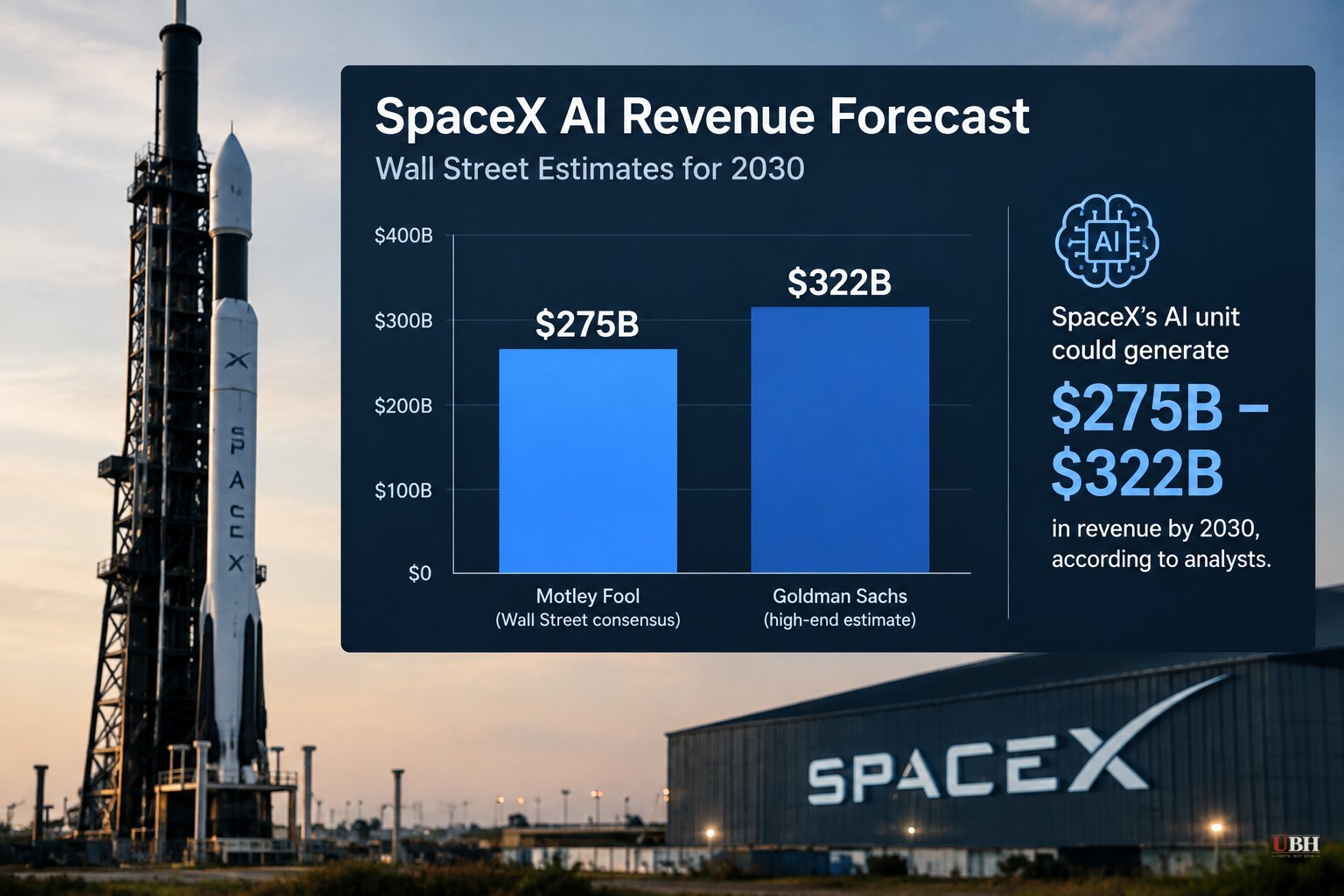
Readers should treat the specific figures below as unconfirmed claims from those sources rather than established fact. Since SpaceX is reported to have listed on the Nasdaq in mid-June 2026 at a valuation between $1.75 trillion and $2 trillion, following what was described as an all-stock acquisition of Elon Musk's xAI in February 2026, Wall Street has reportedly been trying to figure out what the combined company is actually worth. The latest round of analyst math shows just how far apart the estimates are. Goldman Sachs, which is reported to have served as lead underwriter on the IPO, is said to project SpaceX's AI division will generate $322 billion in revenue by 2030, according to Crypto Briefing. That would make AI 68% of the company's total projected $474 billion in revenue that year, with Starlink contributing $144 billion and the actual rocket business, the reason most people know the company's name, kicking in just $8.3 billion. The Motley Fool cites a different Wall Street consensus: $275 billion in AI revenue by 2030, up from an AI segment reportedly generating $2.6 billion in the quarter ended June 30, 2026, an annualized run rate of about $10.2 billion. Both numbers are estimates, not reported results. The two projections disagree by $47 billion.
The actual numbers on the books
Strip out the projections and look at what is reported to have been disclosed. In the quarter ended June 30, 2026, the company is said to have posted a net loss of $541 million, according to the Motley Fool, an improvement from a $1 billion loss a year earlier. Connectivity, meaning Starlink, was reportedly still the largest segment at $4.3 billion for the quarter. The space business, the rockets, reportedly brought in $962 million. According to Seeking Alpha, published September 19, 2026, Starlink posted a 62.9% EBITDA margin in 2025 but required roughly $4.18 billion in capital expenditures. Because Starlink satellites only last three to five years, the company faces recurring orbital replacement costs of $2.9 billion to $3.7 billion a year just to keep the constellation running.
The bull case
contracts already signed SpaceX isn't selling investors a pure hypothesis, according to these reports. Anthropic is said to have signed a deal worth $1.25 billion per month for AI compute, and Google has reportedly committed $920 million per month, according to Crypto Briefing. Those two contracts alone would represent more than $26 billion in annualized revenue, already locked in, if accurate. Seeking Alpha's analysis puts a number on the broader opportunity. SemiAnalysis estimates that 10 gigawatts of AI compute capacity could support roughly $300 billion in annual recurring revenue, if half of the incremental capacity gets sold externally. SpaceX is reportedly targeting 5 to 10 gigawatts of compute capacity in 2027, with a longer-term goal of 100 gigawatts of solar-powered orbital computing by 2030, tied to plans reportedly filed in January 2026 for up to 1 million AI satellites and a dedicated Gigasat manufacturing facility. First satellite launches are targeted for 2028.
The bear case
this requires everything to go right Morningstar reportedly values SpaceX closer to $780 billion, according to Crypto Briefing, less than half of where the stock is said to trade. Getting from $3.2 billion in AI revenue in 2025 to $322 billion by 2030 would require roughly 100x growth in five years. Goldman's number assumes SpaceX's satellite manufacturing scales on schedule, that launches don't suffer major failures, that customers keep paying billions per month for orbital compute, and that the company fends off OpenAI, Anthropic, Google, Microsoft, and Amazon, all of whom are building their own AI infrastructure simultaneously. Musk himself has reportedly projected the whole company could hit $1 trillion in total revenue by 2030. The Motley Fool notes that doesn't look achievable under current Wall Street estimates unless the AI business runs far hotter than even Goldman's bullish case, or the other segments grow faster than expected.
Context nobody's flagging
the scale of this bet Jason Calacanis, co-host of the All-In Podcast, pointed out via Benzinga that SpaceX's reported $2 trillion IPO valuation, combined with Anthropic's expected $2 trillion valuation at its own IPO and OpenAI's reported discussions around a $1.2 trillion valuation, would put the three companies above $5 trillion combined. For comparison, Financial Times data compiled by University of Florida professor Jay Ritter shows the entire U.S. tech IPO market from 1980 through 2025, 3,365 companies, was worth a combined $4.1 trillion at the moment they went public. That comparison isn't perfectly apples-to-apples since it mixes actual IPO values with prospective ones, and it's not inflation-adjusted, but the gap is still striking. SpaceX is not expected to launch its first AI satellites until 2028. Between now and then, the entire $322 billion projection rests on manufacturing and launch execution that hasn't happened yet, and on customers continuing to pay nine-figure monthly bills for compute that doesn't exist in orbit yet. Investors would get their next read on whether the numbers are tracking when SpaceX next reports quarterly results, assuming the reported public listing and financial disclosures described above are accurate.
Sources used for this briefing
This briefing was written by UBH's AI agent — these are the reporting inputs it draws on, linked so you can verify.


