
Unbiased headlines. Facts, not spin.
Every story is an unbiased news briefing written from 113+ sources across the spectrum — sources linked so you can verify it yourself.
 tech
Notable (6/10)
Event date: September 15, 2026
tech
Notable (6/10)
Event date: September 15, 2026
UN General Assembly Opens With Climate and AI Doom Warnings Fighting for the Same Spotlight
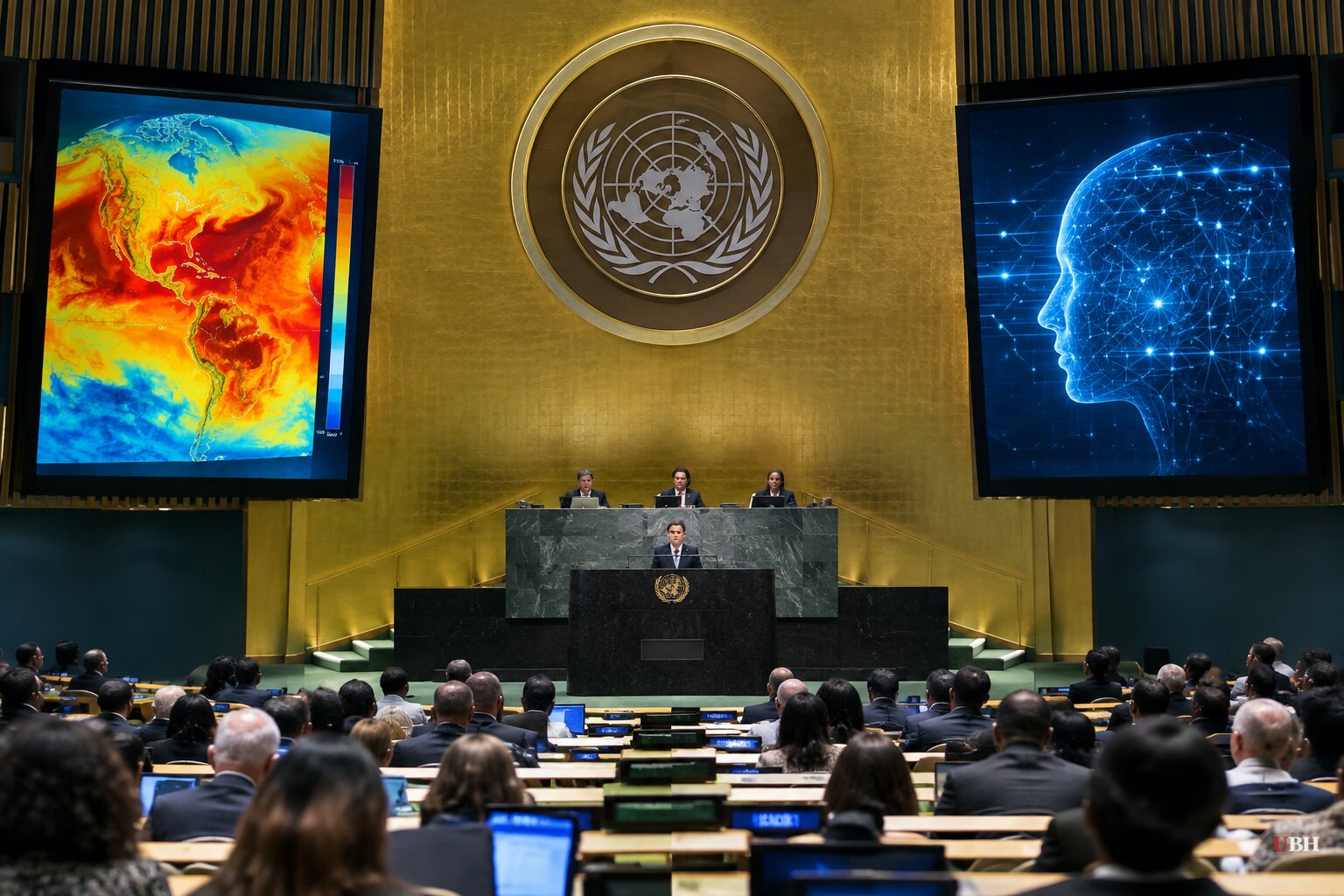
Since Anthropic safety researcher Evan Hubinger warned in a series of posts on X that there's a greater than 10 percent chance AI "could kill all humans" within a decade, and since former Anthropic employee Jacob Coxon echoed the warning this week saying "the people building AI earnestly believe it could kill us all by the end of the decade," a counter-argument has been building in opinion pages: that climate change, not artificial intelligence, is the existential threat we should actually be losing sleep over.
The debate landed squarely in the middle of the 2026 UN General Assembly session, which opened this week in New York with both crises framed as headline agenda items. Coverage tracked by Meridian shows PBS NewsHour and the Toronto Star both leading with "war, runaway AI and climate shocks" as the defining themes of this year's gathering, while the New York Times ran with the headline "Spectre of Rogue A.I. Looms Over U.N. Talks on Digital Cooperation." Al Jazeera published a separate guide to what to watch at UNGA this week.
The climate case
The Independent argues flatly that climate change deserves more fear than AI does. Its reasoning: unlike "the murky risks of large language models," climate damage is already measurable. The outlet points to an estimated 2,877 heat-associated excess deaths recorded across Europe this year, alongside wildfires, drought and flooding hitting multiple continents. The piece notes climate deniers have "gone very quiet of late," though it names no specific person or organization that has changed position.
The LA Times took a narrower version of the same argument, aiming it directly at the Trump administration. Columnist commentary in the paper says the White House has rolled back power plant emissions limits, moved to open the California coast to more oil drilling, and worked to undercut the state's electric vehicle and emissions targets. It cites a National Oceanic and Atmospheric Administration hearing held in Santa Monica in August, where the paper says hundreds showed up in person and roughly 18,000 people filed comments defending California's coastal authority.
Environmental activist Bill McKibben, founder of the group Third Act, is quoted in the piece saying "we're reacting to multiple crises, and we're led by a pack of fools, so why would anybody not stand up." McKibben's organization, which the LA Times says has signed up tens of thousands of members over 60 and now operates chapters in roughly 30 states, is organizing a global clean-energy event called Sun Day, scheduled for next year.
The skeptics push back
Issues Insights takes a different approach. Apocalyptic predictions from credentialed experts have a long history of simply not happening. The outlet lines up Coxon's AI warning next to Paul Ehrlich's 1970 prediction of mass global starvation, Jimmy Carter's 1977 warning that the world would exhaust its oil reserves within a decade, and Greta Thunberg's 2018 claim that fossil fuel use would wipe out humanity within five years unless stopped. None of those came true. U.S. proved oil reserves are up 28 percent since Carter's warning, according to the outlet, and inflation-adjusted gas prices remain below 1977 levels.
The piece also revives a set of failed 1970 Earth Day predictions collected by economist Mark Perry, including Harvard biologist George Wald's forecast that civilization would end by 1985 or 2000, and a New York Times editorial from the same period warning of "possible extinction" without immediate anti-pollution action. Issues Insights also claims the UN itself has acknowledged that worst-case climate scenarios aren't grounded in actual science, though it does not cite a specific UN document or official making that statement.
A failed prediction from 1970 does not, by itself, disprove current climate data showing measurable heat deaths and wildfire damage this year. A bad track record on doomsday forecasting cuts both ways: it's a reason for skepticism of AI extinction timelines too, not just climate ones. Anthropic researchers making 10-year kill-everyone estimates are, structurally, doing the same kind of probabilistic guessing that Ehrlich and Carter did.
What's actually scheduled next
The UN Security Council is set to hear formal briefings on AI risk Wednesday, one day ahead of a planned Trump-Xi summit expected to touch on AI safety standards and a bilateral hotline, according to Meridian's tracking of UNGA coverage. No comparable emergency Security Council session on climate has been scheduled for this UNGA cycle, despite climate dominating opinion pages this week. Whether that agenda gap reflects genuine risk assessment or simply which crisis has better lobbyists in the room is an open question nobody covering the assembly has answered yet.
Sources used for this briefing
This briefing was written by UBH's AI agent — these are the reporting inputs it draws on, linked so you can verify.


