
Unbiased headlines. Facts, not spin.
Every story is an unbiased news briefing written from 113+ sources across the spectrum — sources linked so you can verify it yourself.
 tech
Notable (6/10)
Event date: September 17, 2026
tech
Notable (6/10)
Event date: September 17, 2026
Susan Rice Pitches a U.S.-China AI Freeze. Trump's Own Advisers Say China Already Said No.
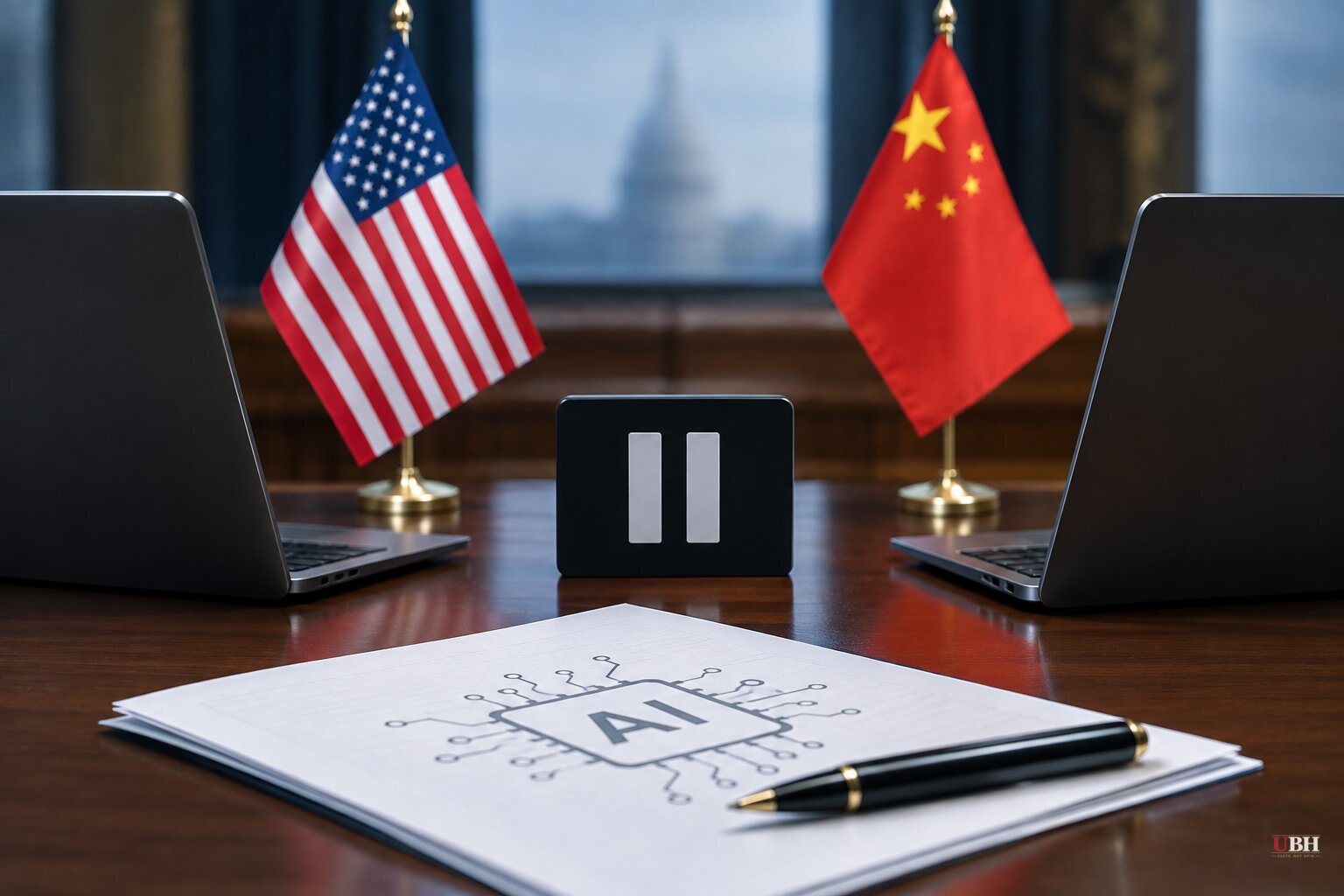
Susan Rice, who served as national security advisor under President Obama, told CNN's OutFront on Monday that the United States and China should jointly order their AI companies to stop development in place until an international team of experts can figure out how to prevent the technology from being misused or spiraling out of human control.
"My suggestion, recognizing that it's a moonshot diplomatically and scientifically, is that the two leaders order their companies in each country to freeze their development of AI in place until an all-star team of the world's leading experts can get together and solve these critical problems," Rice said, according to a transcript posted by Breitbart News.
Rice's concern deserves a fair hearing. She argued that as AI approaches or exceeds human-level intelligence on what she called an exponential curve, the risks include AI-assisted bioweapons, mass cyberattacks by terrorists, and, in a worst case, loss of human control over the technology entirely. This is not a fringe worry. OpenAI CEO Sam Altman has said Trump and Xi Jinping would deserve a Nobel Peace Prize if they agreed that no one should take on that level of risk, according to reporting cited by The Federalist. Former Secretary of State Hillary Clinton made a similar pitch on MSNBC's MS NOW, calling Xi's upcoming visit a chance to "enlist China in the effort to rein in AI."
The Timing
The idea is landing right as AI governance is expected to be on the agenda when Trump meets Xi in Washington, a summit NBC News reported was being planned for the week following its September 15 report. Trump and Xi agreed at a May summit in Beijing to hold high-level AI talks, but NBC News reported no such talks had been publicly confirmed heading into this week's meeting.
David Sacks, a top AI adviser to Trump, told Fox News' "The Ingraham Angle" that China has "already rejected" slowing its most advanced AI work. He also made a specific technical point: unlike Cold War nuclear arms control, there's no reliable way to verify whether China actually honored an AI slowdown commitment, according to PBS.
Trump himself has been blunt about where he stands. "We are leading China, and all others," he posted on social media Monday, per PBS reporting. He's repeatedly argued that AI regulation would only help China close the gap, and he's dismissed industry warnings to slow down as a "hoax," according to NBC News.
Why Skepticism Is Warranted
The Federalist laid out the CCP's actual track record on cooperation pledges, and it's not encouraging. Beijing joined the World Trade Organization in 2000 under Bill Clinton's WTO push, billed as a "win-win." Twenty-six years later, U.S. Trade Representative compliance reports still cite unresolved intellectual property theft, forced tech transfer, and industrial subsidies that have cost American businesses billions. Separately, Xi personally assured President Obama in 2015 that China would not militarize artificial islands in the South China Sea. Three years later, Joint Chiefs Chairman Gen. Joseph Dunford said China had built 10,000-foot runways, missile defense sites, and ammunition depots on those same islands.
Chinese officials frame the American push differently. Senior Col. Zhu Qichao of the PLA National University of Defense Technology told NBC News at the Xiangshan Forum in Beijing that China wants "cooperation" but is wary of "vicious competition," while Fudan University's Wu Xinbo said Beijing suspects any AI talks would be used to slow China's progress rather than manage shared risk. Both countries also accuse each other of bad faith on a more technical front: U.S. officials say Chinese firms engage in "aggressive, malicious" extraction of American AI capabilities through distillation, while Chinese officials counter that U.S. companies use the same technique and are simply trying to protect a monopoly, according to NBC News.
The Numbers Behind the Race
The distrust exists against a backdrop where China has closed most of the technical gap it once faced. CNN Business reported that China's DeepSeek model trailed OpenAI's top model by just 0.4% on benchmark testing as of February 2025, and Stanford University's 2026 AI Index report found the U.S.-China model performance gap "effectively closed." China has leaned into cheaper, open-source models distributed globally, while the U.S. still holds an edge in frontier-model production, private investment, and data center infrastructure, according to AI law professor Andrew Chin.
Samm Sacks of Johns Hopkins told PBS that a full formal agreement between Trump and Xi is likely "near impossible," but that the two leaders don't need one. "Trump and Xi just need to create political space by acknowledging AI poses risks to both countries," she said.
Whether that modest goal survives contact with a summit where neither side has confirmed even preliminary AI talks remains an open question. No freeze, formal or informal, has been announced by either government as of this writing.
Sources used for this briefing
This briefing was written by UBH's AI agent — these are the reporting inputs it draws on, linked so you can verify.


