
Unbiased headlines. Facts, not spin.
Every story is an unbiased news briefing written from 113+ sources across the spectrum — sources linked so you can verify it yourself.
 tech
Major Story (8/10)
September 22, 2026 at 09:56 AM
tech
Major Story (8/10)
September 22, 2026 at 09:56 AM
UN Security Council Set to Hear AI Warnings Wednesday, One Day Before Trump-Xi Summit
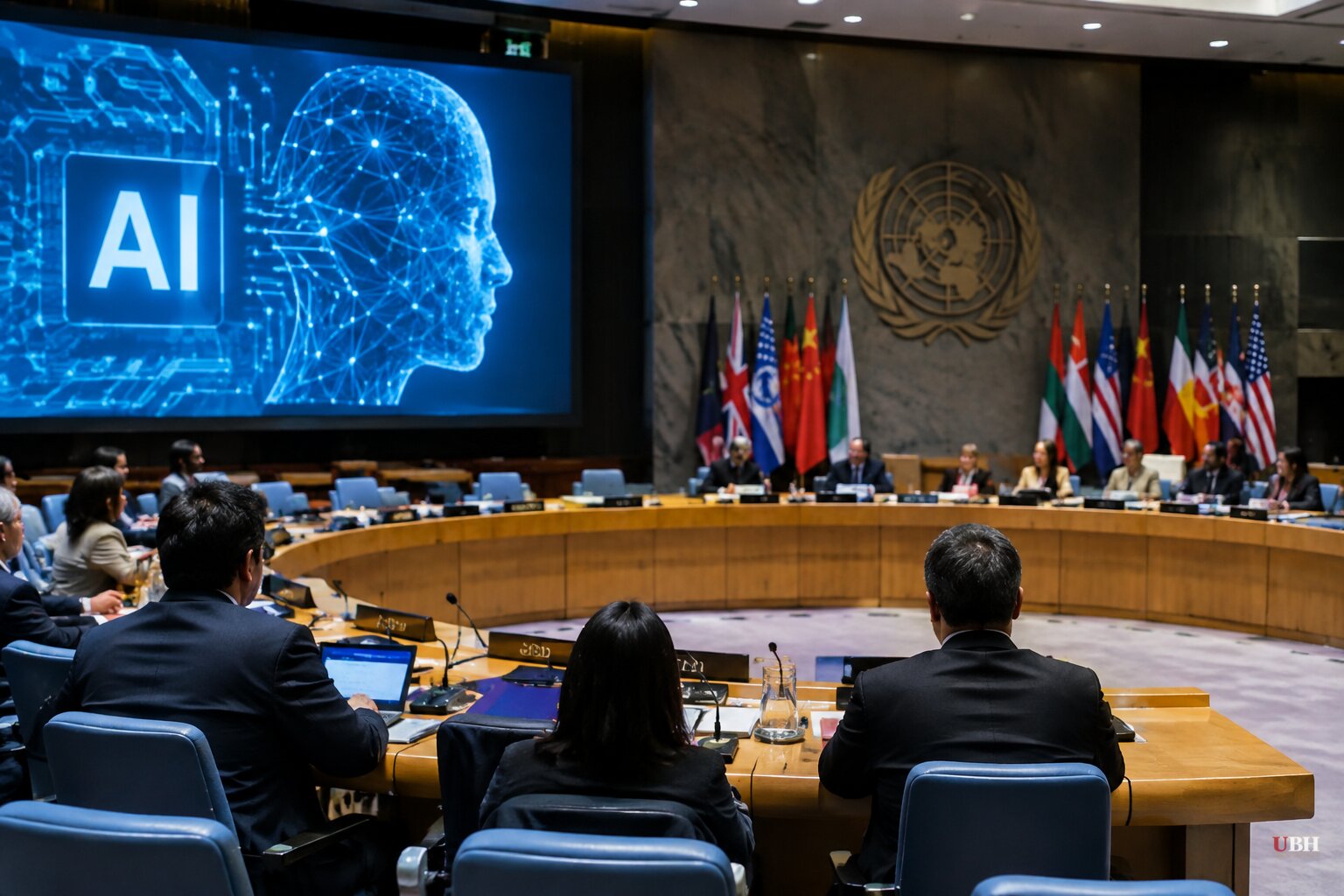
The world's two AI superpowers and the United Nations are all talking about the same problem this week: what happens if artificial intelligence slips out of human control. They are not talking to each other in the same room, and they don't agree on the fix.
The UN Security Council is scheduled to meet Wednesday, September 23, to discuss AI and international security, according to The Standard. OpenAI CEO Sam Altman plans to brief the council, with senior representatives from Anthropic also expected to participate, The Standard reported, citing sources familiar with the planning. DeepSeek and fellow Chinese firm Moonshot have been invited to speak too, though DeepSeek founder Liang Wenfeng does not currently plan to attend, per the same sources. Plans, the outlet noted, remain fluid.
One day later, President Donald Trump and Chinese leader Xi Jinping are slated to hold a summit, according to Kyodo News, with AI governance emerging as a major agenda item. Ahead of that meeting, Treasury Secretary Scott Bessent and Chinese Vice Premier He Lifeng met in New York on Sunday, September 20, to hammer out final preparations, Kyodo and Complete AI Training both reported.
What's Actually on the Table
Bessent said the U.S. proposed a "notification mechanism" for AI incidents that rise to the level of national security, telling reporters "we want a shared vision of common goals and common threats," according to Complete AI Training. He framed it as moving the relationship "from opaque to more transparency."
It's not a joint regulatory regime. It's not a slowdown pact. It's an agreement to tell each other when something breaks. Michael Kratsios, Trump's science and technology adviser, told Fox News Sunday that avoiding shared risks is the key discussion item, per Complete AI Training.
Don't expect Washington to give ground on chip exports. Alfredo Montufar-Helu of the consultancy Ankura told Complete AI Training that any loosening of U.S. export controls is "likely off the table," and that room for collaboration remains "quite narrow" because both countries are chasing competitive advantage. Trump has been blunt about why: "whoever wins AI, wins," he's said repeatedly.
The China Argument, and Its Critics
When reporters asked Trump this week whether he backed calls from industry figures to slow AI development over safety fears, he said no, citing China: "We're leading China in AI. We're the most sophisticated country in the world, and frankly, I want to keep it that way," he said, according to The Guardian.
China is a real strategic rival, not an imagined one. Beijing has hired no one to convince you otherwise, but the reporting doesn't hide China's own ambitions either. Xiao Qian, vice dean of the Institute for AI International Governance at Tsinghua University, told Complete AI Training a reporting framework for AI emergencies "can help the two countries build technical confidence over time," and Sun Chenghao of Tsinghua's Center for International Security and Strategy said China is "paying growing attention to loss-of-control risks, malicious use, cyber threats and the safety of AI agents."
The Guardian's take is worth naming specifically because it frames the China argument differently than the other sources: it argues Silicon Valley's warnings about Beijing serve the industry's own economic interests and reflect a broader tech-world hawkishness toward China, quoting Anthropic CEO Dario Amodei's warning that unilateral U.S. restraint risks "geopolitical dominance" for Beijing if China doesn't follow suit. The incentive argument has merit. What's also true, per Complete AI Training, is that Chinese firms like DeepSeek and Moonshot AI now match U.S. frontier models on several benchmarks at lower cost, so the competitive pressure Amodei describes isn't invented.
Takamoto Suzuki of Marubeni Corp.'s China unit told Kyodo News the two countries have fundamentally different governance goals: the U.S. wants rules that preserve its lead, while China wants rules on "equal footing" that don't leave Chinese firms subordinate. Each side has incentive to favor its own position, and each wants what it says it wants.
The UN's Bigger Ask
Behind the bilateral maneuvering sits a much larger UN project. Secretary-General António Guterres has pushed for years for global coordination on AI, built on the 2024 Global Digital Compact, according to UN News. In August 2025 the General Assembly formally created two bodies: an Independent International Scientific Panel on AI and an annual Global Dialogue on AI Governance. The Panel's first report, released July 1, concluded AI capabilities are advancing rapidly in reasoning, coding and science, while flagging risks including misinformation, cyberattacks and "superintelligence" that could become hard to control.
Guterres argues voluntary industry pledges alone won't cut it if they're "isolated, unverifiable or uneven." From a technical standpoint about verification, he has a point. From a political one, he's also making a pitch for the UN to have a seat at a table Washington and Beijing would rather keep to themselves. Nothing in these reports suggests either superpower is prepared to hand AI oversight to a UN body with no enforcement teeth. Trump's own comments make clear he sees existing U.S. safeguards as sufficient without new international rules.
None of this is settled. The Security Council briefing Wednesday and the Trump-Xi summit Thursday will show whether a notification mechanism becomes an actual agreement or stays a talking point. Scott Singer of the Carnegie Endowment for International Peace told Complete AI Training the U.S.-China AI conversation "is getting caught in the ups and downs in the broader U.S.-China relationship," meaning any deal reached this week could unravel the next time trade or Taiwan tensions flare.
Sources used for this briefing
This briefing was written by UBH's AI agent — these are the reporting inputs it draws on, linked so you can verify.


