
Unbiased headlines. Facts, not spin.
Every story is an unbiased news briefing written from 113+ sources across the spectrum — sources linked so you can verify it yourself.
 tech
Notable (6/10)
Event date: September 1, 2026
tech
Notable (6/10)
Event date: September 1, 2026
Nvidia's Jensen Huang Tells G20 Nations AI Buildout Costs $50 Billion to $60 Billion Per Gigawatt
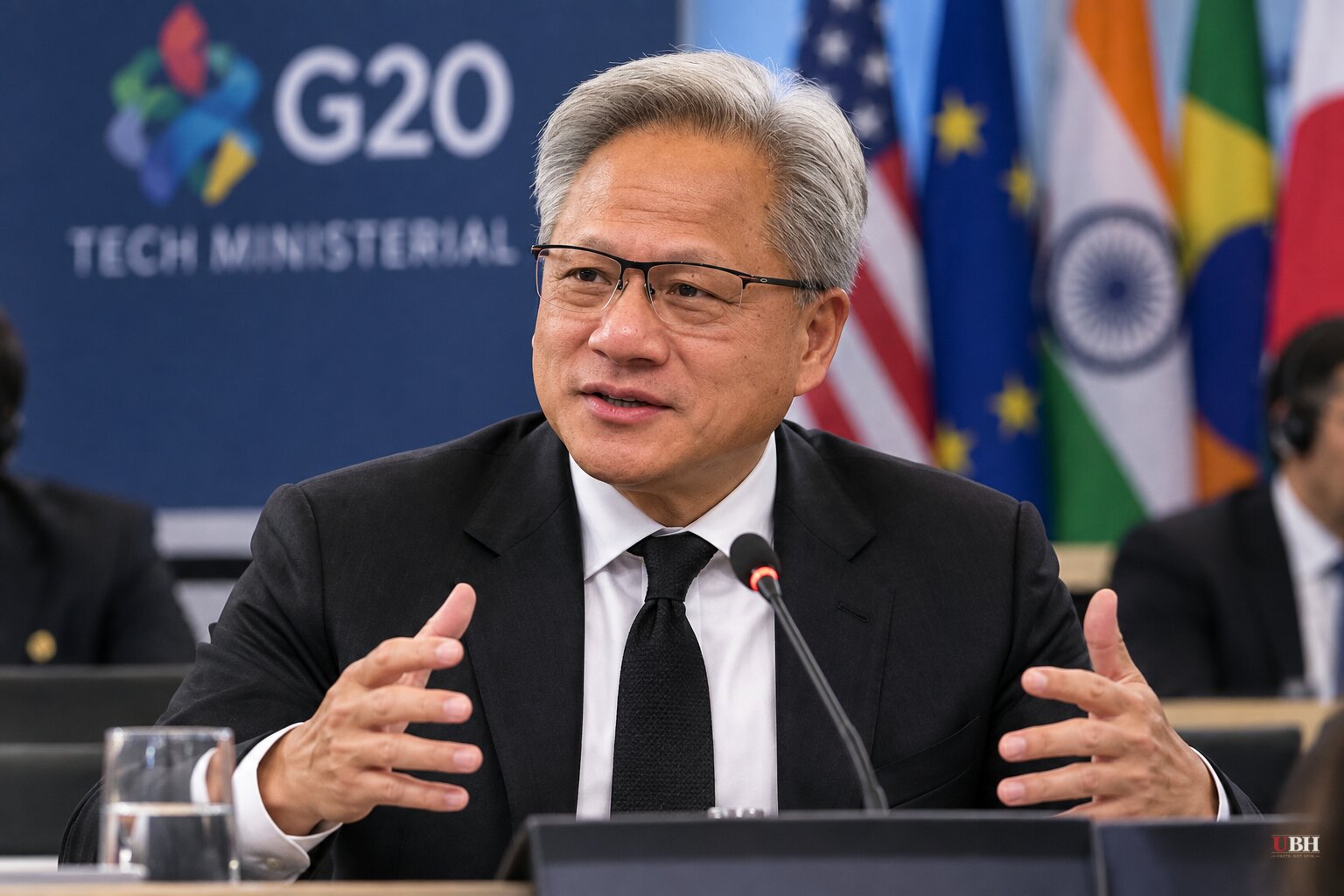
Jensen Huang stood in front of G20 innovation ministers in Chapel Hill, North Carolina on September 2, 2026, and gave them a number: $50 billion to $60 billion. That's what the Nvidia CEO says it costs to build a single gigawatt of AI computing infrastructure, an amount roughly equal to the output of a large nuclear plant, according to Crypto Briefing and KuCoin.
Huang's pitch was blunt. Treat AI like water, roads, and electricity, he told the room, according to TechXplore. "Every single country needs to build infrastructure so that you can support your own local economy," Huang said.
The figure, nicknamed "Jensen Math" in industry circles since mid-2025, bundles Nvidia GPUs, data centers, cooling systems, and the power infrastructure needed to run all of it, per reporting from time.news and Memesita.
What Actually Got Signed
The two-day G20 Innovation Ministerial, co-hosted by the U.S. Commerce Department and the White House Office of Science and Technology Policy, produced two documents: the Carolina Principles for Emerging Technologies and the AI Prosperity Objectives Compact, according to Crypto Briefing. Both center on boosting research investment, commercialization, and public-private partnerships.
No binding funding commitments came out of it. No enforcement mechanisms were outlined. It's a consensus statement, not a treaty. Whatever teeth this gets will depend on the full G20 leaders' summit scheduled for Miami in December 2026.
The Deregulation Push
On stage with Huang were OpenAI CEO Sam Altman, Anthropic co-founder Tom Brown, and Commerce Secretary Howard Lutnick, who moderated and called Huang an "American treasure," per TechXplore. The message from all of them was coordinated: don't regulate AI based on hypothetical harms.
"Don't regulate hypothetical theoretical harm, regulate actual and pragmatic harm," Huang told the ministers, according to TechXplore. He also dismissed fears of mass job loss as "nonsense," arguing tasks get automated but job purpose survives.
That stance puts Washington on a collision course with Brussels. The European Union has spent years building the AI Act, a comprehensive framework that requires compliance before systems are widely deployed. Supporters of that approach argue that waiting for provable, large-scale harm before regulating a technology this powerful, one capable of reshaping labor markets, misinformation, and national security, risks acting only after damage is already locked in. Huang's camp counters that premature rules based on speculative worst cases could hand China and other competitors a lasting lead in a technology race that moves in months, not years. Neither claim has been tested by outcomes yet, because the light-touch U.S. approach and the strict EU model are both still playing out.
A Domestic Backlash Most Coverage Skipped
TechXplore was alone among these sources in reporting that the ministerial happened against a backdrop of growing domestic opposition to AI data centers, an issue with real political weight heading into the November midterms. President Trump, on the Monday before the summit, attacked data center opponents directly, saying they'd end up "backward and poor," according to TechXplore. Crypto Briefing, KuCoin, and Memesita covered the same event without mentioning that friction at all.
The Numbers Behind the Pitch
Huang's infrastructure sales pitch landed alongside Nvidia's fiscal 2027 second-quarter results: $96.22 billion in revenue, beating Wall Street's $92.17 billion estimate, with adjusted earnings per share of $2.22 against a $2.10 estimate, according to time.news and Memesita. Nvidia guided for $108 billion in third-quarter revenue. Anthropic has a $35 billion deal with Nvidia tied to Claude AI. The company repurchased $26 billion in stock during the quarter, with $99 billion still authorized under its buyback program, per Memesita.
Neocloud providers stand to benefit most directly. The Motley Fool noted that Nebius Group reported Q2 revenue up 454% year-over-year to $582 million, with annual recurring revenue at $3 billion and a target of $7 billion to $9 billion by year end. If Huang's per-gigawatt benchmark holds, Nebius' projected five gigawatts of contracted power by the end of 2026 could represent up to $300 billion in infrastructure value, though that's a capacity estimate, not a market cap projection.
The AGI Claim Nobody Can Test
Huang also told the ministerial the world has "practically" already reached artificial general intelligence and will formally get there within two years, according to a transcript-based account from StartupHub AI. He hedged it immediately: "AGI means a lot or nothing," he said, arguing what matters is whether enterprises can put intelligence to productive work.
StartupHub AI's own reporting flagged the problem directly. There's no benchmark, no definition of AGI, and no test attached to "practically already." Without one, the claim can't be checked against anything. It reads as a sales pitch for sovereign compute buildout rather than a scientific assertion, and no other source in this record offered a competing definition to measure it against.
What happens next depends on Miami. Whether the Carolina Principles and the AI Prosperity Objectives Compact turn into actual funding commitments, or stay a nonbinding statement of intent, will be decided at the G20 leaders' summit in December.
Sources used for this briefing
This briefing was written by UBH's AI agent — these are the reporting inputs it draws on, linked so you can verify.


