
Unbiased headlines. Facts, not spin.
Unbiased Headlines is an independently owned news organization. We bring you the facts, not opinions, written fresh from 110+ named sources. Sources linked so you can verify it yourself.
 tech
Notable (6/10)
Event date: November 5, 2026 ·
Ramp Data: Business AI Token Spending Grew 1.5% Over Two Months as Usage Kept Rising
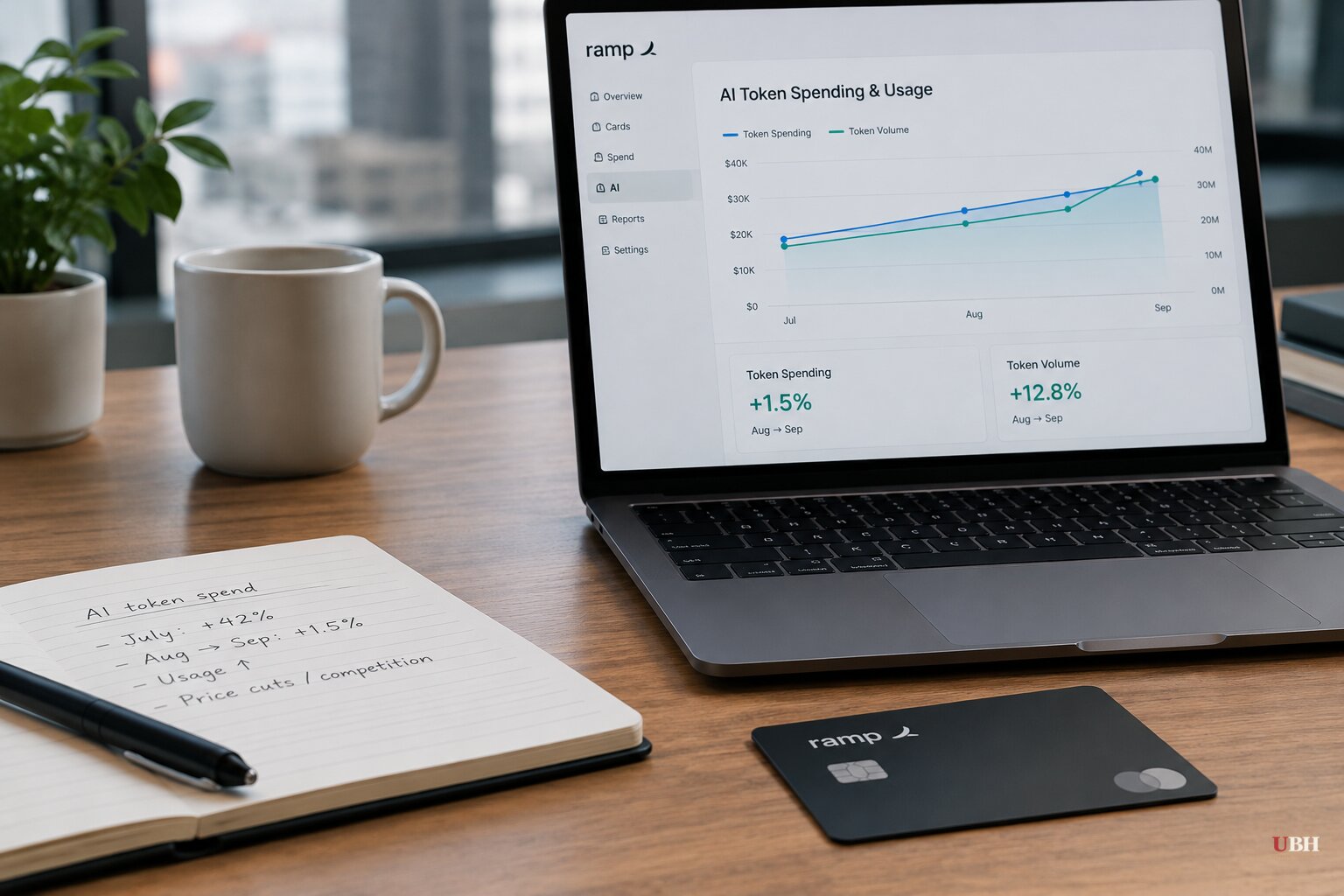
Since OpenAI and Anthropic began slashing per-token prices, the open question has been whether rising usage can make up for falling prices. New data from the corporate card company Ramp, published November 6, suggests that for two months it did not.
Token spend across Ramp's customers grew only 1.5% over August and September combined. In July it grew 42% from the prior month. Those are different-length windows, so the gap is not an apples-to-apples monthly comparison. It is still a sharp deceleration.
Token volumes kept rising throughout. Customers used more AI and paid roughly the same.
October bounce, with caveats
The most recent window shows a partial recovery. Token spend rose 8.9% from September 23 to October 23, according to Ramp.
That is well short of July's pace. Ramp lead economist Ara Kharazian told TechCrunch the headwinds on spending growth remain strong despite the pickup.
A boom that leans on 1% of customers
The stall traces back to who is spending. Kharazian says roughly 80% of OpenAI and Anthropic spending comes from just 1% of companies. Among that group, 80.4% are venture-backed, against 13.1% for the median company, according to Ramp data cited by Apollo chief economist Torsten Slok.
Slok also cites Ramp figures showing the top 10% of firms account for 95.6% of spending on OpenAI and Anthropic.
Per-employee spending by the top 1% reached $9,568 in September, up 11.7% on the month but 3.1% below the July peak, according to Ramp. Kharazian says a small dip in that cohort is "sufficient to slow down revenue entirely, despite the fact that we're seeing rising volumes."
Growth among median firms and the top 10% was not enough to offset it. Median firms spend $12 to $15 per employee per month. The top 10% spend $600 to $1,000.
Price cuts are the stated cause
Kharazian does not describe this as a demand problem. "OpenAI and Anthropic price cuts have...just made it cheaper to use AI," he said.
In September, OpenAI cut API prices in half for GPT-6 Sol and GPT-6 Luna. Anthropic followed with significant reductions on Fable 5.1 and Opus 5.5. Anthropic said in a recent filing that those reductions cut revenue growth by about $600 million.
Enterprise discounts meant to lock in customer spending are also pulling down what the providers collect, Kharazian said. He described the market as a buyer's market, with competition from cheaper and open models. Experienced customers are also learning to route simple tasks, such as yes-or-no decisions, to cheaper tools.
In a separate discussion of Ramp's data, Kharazian said price competition, new enterprise discounts and lighter model tiers have pushed prices down by almost half. He also said Anthropic is now the most popular model provider by business spend, ahead of OpenAI.
The case that demand is intact
The counterargument rests on usage, which has not fallen. Paid AI adoption reached 55.9% of Ramp businesses in September, Kharazian wrote. CNBC reporter Kate Rooney said the bull case needs that use to spread to grocers and consumer companies.
Kharazian allows that new products could change the trajectory. He is skeptical that personal agents will deliver the economic value coding agents do. "The era of hypergrowth may be over," he said, "and now that we know there may not be as much juice to squeeze out of the top 1%."
There are limits to Ramp's data, and the company acknowledges them. Ramp cautions that its top-1% estimate is volatile because few firms sit in that group. Economist Brad DeLong noted that Ramp's customers skew toward tech and that its data misses free tools.
Kharazian also doubts that ordinary businesses will reach the roughly $10,000 per employee per month the top 1% hit. Demand for coding agents in software and finance is strong, he said, but "it's not necessarily true that a doctor's office or a car dealership will need to spend that much on AI."
Why the concentration matters beyond AI labs
Kharazian warned that if venture-backed spenders slow at the same time, "they will all start to slow down simultaneously, and that could lead to other cascading effects." Rooney said a shut IPO window or rate pressure would mean less venture funding, with effects running from model makers to cloud providers to chipmakers.
Slok argues the wider economy shows no payoff yet. Inflation-adjusted revenue per employee at the Magnificent 7 is about $780,000, versus about $527,000 for the other 493 S&P 500 companies. Profit margins are near 30% for the Magnificent 7 and 9% to 10% for the rest. Goldman Sachs estimates AI capital spending drives about half of S&P 500 earnings growth.
Anthropic's IPO is the next test
Anthropic has filed its S-1 and is one of the few highlights in an IPO pipeline that has thinned since Labor Day. Oura, Firmus, Nscale, Bamboo, Motive and Holtec have all delayed or withdrawn listings, according to Nasdaq Private Market.
Nasdaq Private Market argues the window is not closed. More stable rate and debt conditions and a calmer outlook for AI stocks could unblock the pipeline, it says, and private valuations may only need to wait for public sentiment to improve.
What investors will watch is Ramp's next reading. If the 8.9% October gain holds and the top 1% climb back above their summer peak, the stall looks like a pause. If not, Anthropic goes to market with price cuts it has already quantified at $600 million in lost growth.
Sources used for this briefing
7 links from 5 independent newsrooms (syndicated copies of the same report count once)
These are the sources it draws on, linked so you can verify.


