
Unbiased headlines. Facts, not spin.
Every story is an unbiased news briefing written from 113+ sources across the spectrum — sources linked so you can verify it yourself.
 tech
Notable (6/10)
September 22, 2026 at 08:15 AM
tech
Notable (6/10)
September 22, 2026 at 08:15 AM
Tesla Files Paperwork to Enter Vietnam, Where VinFast Owns 92% of the EV Market
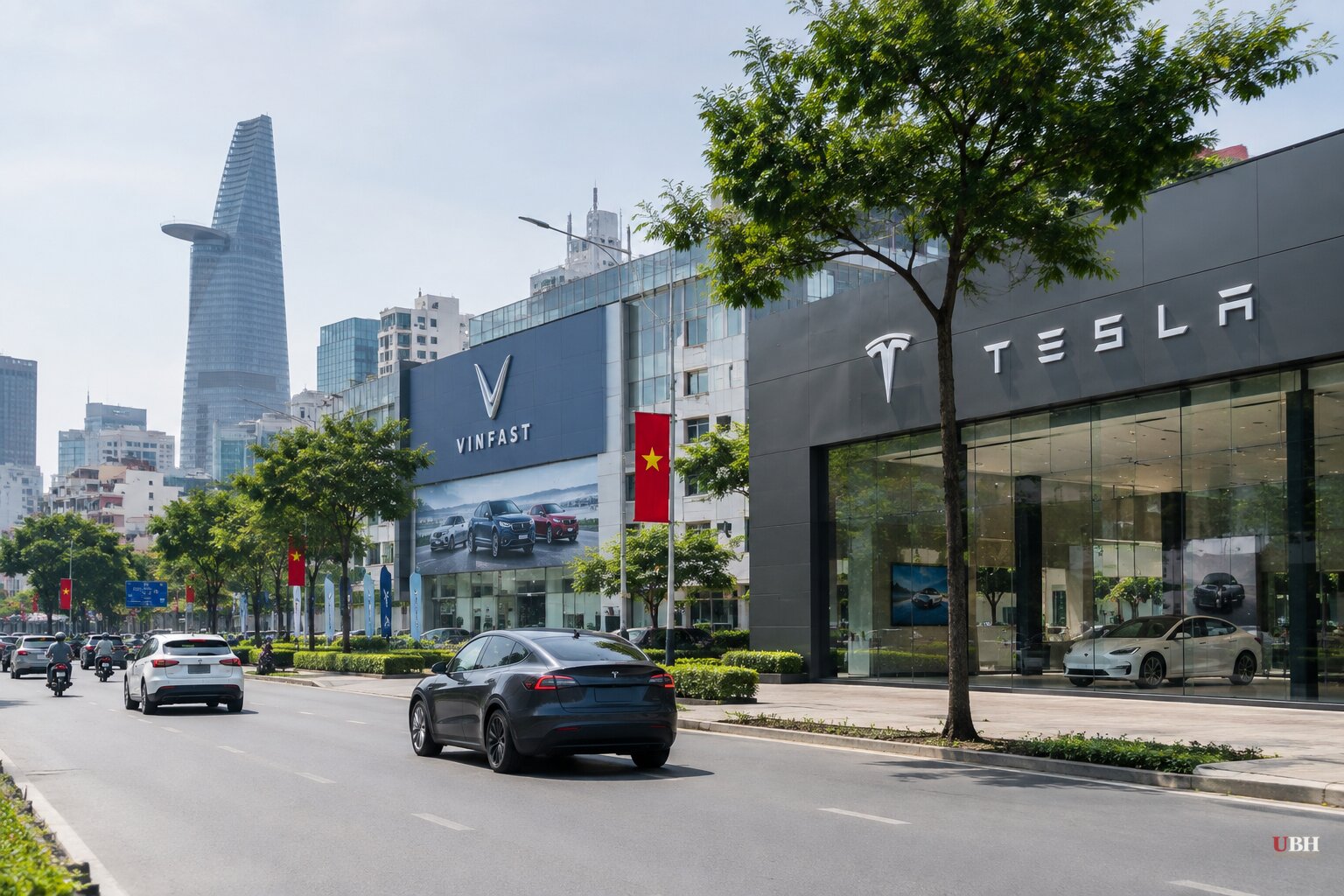
Tesla has a mailing address in Vietnam now. Whether that turns into actual car sales is a different question entirely.
According to business registration records reviewed by Reuters and confirmed by Vietnamese outlet VnEconomy, Tesla set up Tesla Motors Vietnam Limited Liability Company on September 11 in Ho Chi Minh City. Charter capital: VND 77.7 billion, about $3 million. The filing authorizes wholesale and retail sales of cars, parts and machinery, plus import, export and distribution. No manufacturing. No showrooms announced. No charging network announced. No pricing.
Three names are attached to the entity, per the filing: David Jon Feinstein, an American based in Austin, Texas, as chairman; Isabel Ching Fan as general director; and Nguyen Manh Hung as assistant general director. Tesla did not respond to a request for comment, according to Reuters.
The market Tesla is walking into
Vietnam isn't some untapped frontier. It's Southeast Asia's biggest EV market, and it got there fast. The International Energy Agency's data, released in May, shows Vietnam's electric car sales more than doubled in 2025, with EVs hitting nearly 40% of new car sales. The World Bank pegs Vietnam's 2025 GDP growth at 8%, with GDP per capita at $5,066, according to figures cited by Briefs.
Here's the catch. That market already has an owner. HSC research puts VinFast's share of Vietnam's domestic EV sales at 92%. VinFast has been the country's top-selling automaker, period, for 24 consecutive months. In August 2026 alone, VinFast delivered 20,161 EVs, which was 42% of all vehicle sales in Vietnam that month, gas and electric combined, according to Crypto Briefing. VinFast moved roughly 175,000 EVs in 2025 and over 154,000 more in just the first eight months of 2026.
VinFast's overall passenger-car market share, EV and gas combined, climbed to an estimated 36% in 2025 from around 22% the year before, according to a company filing cited by Briefs.
VinFast's real moat isn't the cars, it's the ecosystem
VinFast is backed by Vingroup, one of Vietnam's largest private conglomerates, founded by billionaire Pham Nhat Vuong. Vingroup posted 221.97 trillion dong ($8.52 billion) in first-half 2026 revenue, per reviewed financial statements cited by CNBC and Briefs.
That backing bought VinFast something Tesla can't just buy with a $3 million charter capital filing: infrastructure. VinFast operates a proprietary network of more than 150,000 charging ports, and per CNBC, those ports are restricted to VinFast vehicles. Koketso Tsoai, senior automobiles analyst at BMI, a unit of Fitch Solutions, told CNBC it would be "difficult for Tesla to compete with VinFast in Vietnam because VinFast has advantages that go well beyond product availability," citing brand recognition, Vingroup's consumer ecosystem, and an affiliated electric taxi fleet.
Supparoek Sawangwong, an ASEAN analyst at Mobility Global, told CNBC that VinFast's closed charging network has already caused problems for BYD in Vietnam, and that Vietnam's mobility landscape looks fundamentally different from Thailand's Chinese-EV-heavy market or Indonesia's battery-materials-driven strategy. Vietnam, in his framing, already has "a national champion and a fast-expanding mobility ecosystem."
Filing paperwork is cheap. Building service centers, charging stations and consumer trust in a market where, per Tsoai, buyers are "highly sensitive to price and practicality" is not. Tesla's $3 million charter capital wouldn't scratch the surface of a meaningful infrastructure buildout, and without local manufacturing, Tesla would be importing vehicles into a market where VinFast makes them at home.
The bigger Asia picture for Musk
The Vietnam move lands while Tesla is untangling a messier situation in China. Tesla's Shanghai plant, its largest factory globally, shipped 93,579 vehicles at wholesale in July, up 37.85% year-over-year, according to Yahoo Finance, with exports now outpacing domestic China sales for the first time as of the second quarter of 2026, even as domestic Chinese demand has fallen for five straight quarters.
The Wall Street Journal reported Tesla was weighing whether to sell, spin off, or close its China operations ahead of a possible merger with SpaceX. Elon Musk called that report "absurdly fake news." A Tesla China representative separately called it "false information," according to Bloomberg. No filing, regulatory action, or company announcement has confirmed any such restructuring plan.
This isn't Musk's first move into Vietnam. SpaceX's Starlink Services Vietnam LLC has been running a government-approved satellite internet pilot since Vietnam authorized it in March 2025, with a license extension through February 2026 and the trial period running until January 1, 2031, according to VnEconomy.
Whether Tesla plans to actually sell cars in Vietnam, on what timeline, at what price point, or whether it will lean on Superchargers, a third-party network, or nothing at all remains unclear. Reuters and CNBC both note no launch date has been made public. Until Tesla says otherwise, this is a legal filing, not a product launch.
Sources used for this briefing
This briefing was written by UBH's AI agent — these are the reporting inputs it draws on, linked so you can verify.


