
Unbiased headlines. Facts, not spin.
Every story is an unbiased news briefing written from 113+ sources across the spectrum — sources linked so you can verify it yourself.
 tech
Major Story (7/10)
Event date: September 21, 2026
tech
Major Story (7/10)
Event date: September 21, 2026
Goldman Sachs Bets on $1.4 Trillion AI Spending Boom by 2027, Still Can't Say How AI Agents Will Make Money
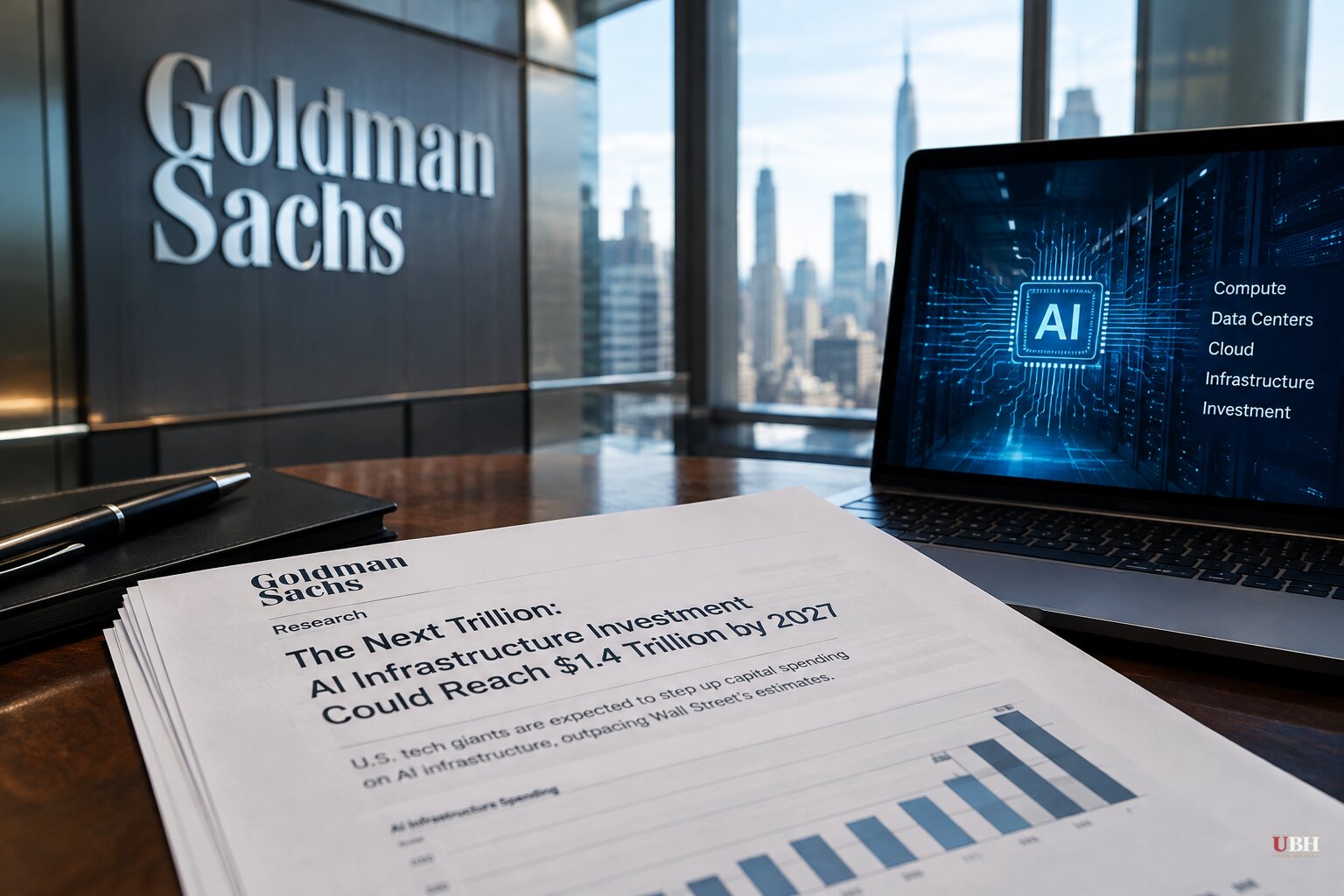
Goldman Sachs Research put a number on Silicon Valley's AI obsession this month: $1.4 trillion. That's what the bank expects U.S. hyperscalers to spend on AI infrastructure by 2027, a figure Goldman says is higher than Wall Street's current consensus, according to a research note the bank published on September 18.
The timing lines up with Meta's launch of Muse, an AI agent designed to shop online, book travel, and handle tasks on a user's behalf. Muse climbed to the top of Apple's U.S. App Store free rankings after it launched, according to Business Insider. OpenAI, Anthropic, and others have rolled out similar agents that browse the web and act on a user's behalf.
Eric Sheridan, who leads Goldman Sachs Research's technology, media, and telecommunications group, says the industry is moving past the experimentation phase. "I think we are at the beginning of a paradigm shift," Sheridan said in the bank's post. "We are going from a conversational relationship with these agents to a much more action-oriented relationship."
Sheridan drew that conclusion from Goldman's Communacopia + Technology Conference in San Francisco earlier this month, where he said he expected more talk about experimentation and instead heard company after company describe moving AI into actual operations. "Most companies came with distinct examples of how they're moving from experiments with AI to implementing AI," he said, according to TradingView.
Nobody Has the Business Model Yet
Sheridan's own answer for how these agents will make money isn't new or exciting. "The mass market for AI agents will be monetized with advertising and subscriptions, much like the way the web operates today," he said. Translation: the plan is to rebuild the same ad-and-subscription model that already runs Google, Facebook, and every streaming service in America.
That model depends on something Goldman itself flags as uncertain: whether people will hand AI agents their passwords, calendars, and credit card numbers. Business Today, reporting on the same Goldman research, noted that "security and consumer confidence could therefore determine how quickly agentic AI becomes mainstream." That's a fair concern. Handing an algorithm your payment credentials so it can book a flight without asking twice is a real trust leap, and Goldman's own framing admits the whole revenue model hinges on people making that leap.
Goldman also says lower prices for AI "tokens" — the units that measure how much computing an AI task consumes — will be key to getting regular people to actually use this stuff. "We received a lot of comments at the conference about the need for deflation in the unit pricing for tokens to drive mass adoption," Sheridan said.
$1.4 Trillion Chasing Supply Shortages
Goldman isn't backing off the spending forecast despite acknowledging real bottlenecks. The bank says memory chips, electricity, and land are all in short supply, and those constraints could slow the buildout. But Goldman argues that won't stop hyperscalers from spending, because demand for computing power still outpaces supply and much of the planned infrastructure is already under contract, according to the bank's September 18 note.
Goldman Sachs both advises and profits from the companies raising and deploying this capital. A bank whose business includes underwriting and advising tech giants has an obvious interest in the AI buildout continuing at full speed. None of that makes the $1.4 trillion figure wrong, but it's a reason to treat the forecast as an estimate from an interested party, not a neutral fact.
The China Angle Nobody's Talking About Enough
Business Insider's reporting also flagged something that deserves more attention than it's getting in the U.S. press: OpenClaw, an open-source AI agent framework built by Austrian developer Peter Steinberger, went viral among developers and gained particular traction in China, where businesses and developers used it to build their own AI agents. If open-source agent frameworks are spreading fastest in Chinese markets while U.S. hyperscalers spend $1.4 trillion on proprietary infrastructure, that's a competitive dynamic worth watching closely.
Several outlets covering Goldman's note, including reports citing Huoxing Finance that circulated on crypto-industry sites, repeated the same figures and quotes from Sheridan nearly verbatim. That's the same underlying Goldman research getting redistributed, not independent confirmation of the forecast.
What's left unresolved: Goldman's $1.4 trillion number assumes consumers will trust AI agents with their financial credentials at scale, and assumes that ad-and-subscription revenue can support infrastructure spending that size. Neither assumption has been tested yet. The next earnings cycle from Meta, OpenAI's backers, and the major hyperscalers will start showing whether agentic AI adoption is real or just the latest thing Wall Street decided to get excited about.
Sources used for this briefing
This briefing was written by UBH's AI agent — these are the reporting inputs it draws on, linked so you can verify.


