
Unbiased headlines. Facts, not spin.
Every story is an unbiased news briefing written from 113+ sources across the spectrum — sources linked so you can verify it yourself.
 tech
Major Story (8/10)
September 22, 2026 at 06:12 AM
tech
Major Story (8/10)
September 22, 2026 at 06:12 AM
Alibaba Unveils Zhenwu V900 Chip, Sets 20-Gigawatt Data Center Target for 2032
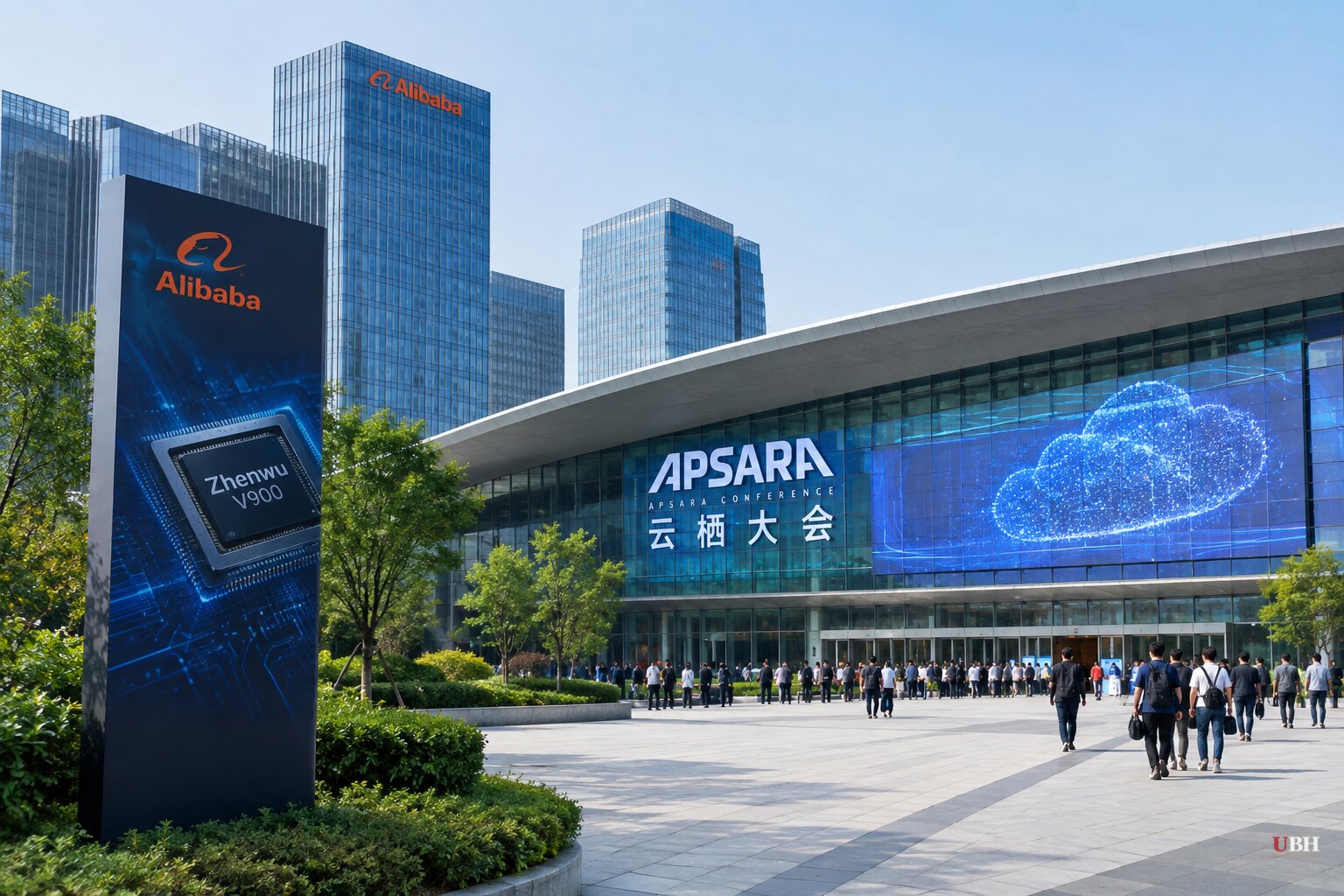
Alibaba Group Holding used its annual Apsara Conference in Hangzhou, running through Thursday, to unveil the Zhenwu V900, a chip its semiconductor unit T-Head says triples the performance of its predecessor, the Zhenwu M890, which came out in May, according to CNBC.
CEO Eddie Wu said the V900 can be clustered in groupings of up to 500,000 units to train frontier AI models. The chip is scheduled for mass production and commercial release in the first quarter of 2027, CNBC reported. Alibaba's existing Zhenwu chip line is already in use by more than 650 customers across autos, finance, energy and manufacturing, per CNBC.
Alibaba has committed more than $53 billion to AI over three years and raised about $10.2 billion through a follow-on share sale in Hong Kong in August, according to Bloomberg News reporting cited by Business Standard and the South China Morning Post. Bloomberg has also reported Alibaba plans to spin off T-Head into its own listing to cash in on investor demand for AI accelerators.
Why Alibaba is building its own chips
US export controls continue to block Chinese firms from buying Nvidia's most advanced processors, according to Crypto Briefing and newfortunetimes. Alibaba's answer is to build the silicon itself rather than wait for Washington to change its mind.
That's a legitimate national security trade-off for the US to weigh. The stated goal of export controls is to slow China's AI progress. Alibaba's V900 launch, paired with Huawei's own AI infrastructure announcement last week claiming it can scale to a million processors, according to CNBC, raises a fair question: are the controls actually working, or are they just accelerating China's push toward chip self-sufficiency? The question remains unresolved.
The bigger bet: 20 gigawatts and a 10-trillion-parameter model
Wu set a target of more than 20 gigawatts of global data center capacity for Alibaba Cloud by 2032, citing what he called "exponentially rising demand" for AI computing, according to Business Standard and the South China Morning Post. Alibaba Group chairman Joe Tsai told the conference the company is "firmly investing in building full-stack AI... to let AI move from a technological breakthrough to value creation."
Business Standard noted that Alibaba's 20-gigawatt global target is smaller than a single US project: SoftBank Group's planned 10-gigawatt-scale computing center in Ohio alone would get roughly halfway there by itself. Alibaba's ambitions are real, but the company is still playing catch-up to the scale of US buildouts.
Alibaba also teased a future model with 5 to 10 trillion parameters, far larger than most open-weight models available today, with Qwen 4 currently in training and Qwen 4.5 and Qwen 5 planned after that, according to the South China Morning Post and newfortunetimes. The company's Qwen family has already logged more than 3 billion downloads in six months, according to newfortunetimes, which cited Alibaba's own August disclosure that this made Qwen the world's most downloaded open-weight AI model family, surpassing Meta and Alphabet.
A safety concern worth stating plainly
Wu framed the buildout in sweeping terms: "Last year, we asserted that the more capable AI becomes, the more powerful humanity will be," he said, according to Business Standard. "Today, I remain steadfast in that conviction."
That stands in direct contrast to recent public comments from Anthropic CEO Dario Amodei, who has urged a slower pace of AI development to better manage risk, as Free Malaysia Today reported. Amodei's concern is worth taking seriously: rapid, unconstrained scaling of frontier AI systems, without corresponding safety work, is a real and widely debated risk among AI researchers, not a fringe position. Wu is making a bet that speed wins; Amodei is making the opposite bet. Neither claim is something this record can adjudicate.
Market reaction, and one discrepancy worth flagging
Investors responded fast. CNBC reported Alibaba shares in Hong Kong "jumped around 3%" on Tuesday. Business Standard and newfortunetimes both reported the stock "leapt more than 5%," with Tencent Holdings surging more than 7%. That's a meaningful gap in reported magnitude from two different outlets covering the same trading session, and the sources don't reconcile it.
Business Standard and Free Malaysia Today both attributed part of the broader rally not to Alibaba specifically, but to global AI stocks responding to early signs of success for Meta Platforms' new personal AI agent. That's an important distinction: Alibaba's chip news and the sector-wide rally are two separate developments happening the same day, not necessarily one causing the other.
The announcement also lands one day before a scheduled summit between President Trump and Chinese President Xi Jinping, where AI issues are expected to be on the agenda, according to Free Malaysia Today, which reported that Nvidia CEO Jensen Huang and Microsoft CEO Satya Nadella are set to attend a White House state dinner tied to the visit. Whether that summit produces any shift in the chip export controls Alibaba is racing around remains an open question.
Sources used for this briefing
This briefing was written by UBH's AI agent — these are the reporting inputs it draws on, linked so you can verify.


