
Unbiased headlines. Facts, not spin.
Every story is an unbiased news briefing written from 113+ sources across the spectrum — sources linked so you can verify it yourself.
 tech
Notable (5/10)
September 22, 2026 at 05:28 AM
tech
Notable (5/10)
September 22, 2026 at 05:28 AM
X Now Discloses When Governments Force It to Restrict Your Posts
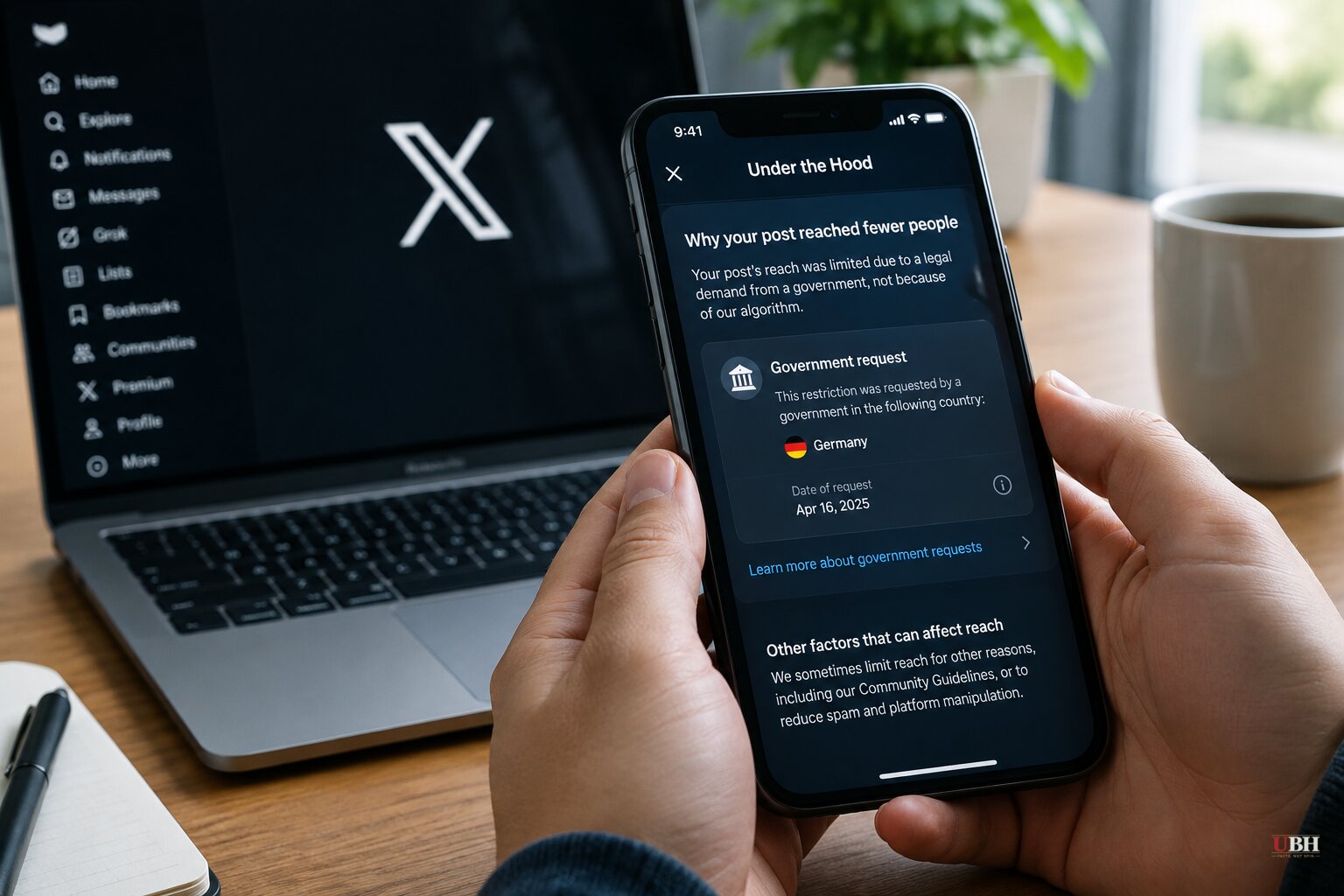
For years, X users who watched their posts vanish into the void had one word for it: shadowban. No explanation, no notice, just silence.
On Monday, September 21, X Open Source announced an expansion of its Under the Hood transparency tool, according to TechCrunch. The update tells users directly when their account or a specific post had its visibility limited because X complied with a government's legal demand, and it names the country that made the request.
How It Actually Works
Eligible users can download a JSON data file from the app's settings that shows which posts were withheld in which countries and which government ordered it, according to Gadget Review and KuCoin. To qualify, an account needs to be more than a year old and have posted at least 10 times in the previous month, per Engadget.
This builds on the original Under the Hood rollout from August, which let users see labels applied to their posts and whether those labels affected reach. That earlier version only showed moderation actions in aggregate. It didn't tell you why a specific post tanked or who was behind it.
"We've expanded Under The Hood after seeing people's appreciation of more transparency into government-required content filtering," X Open Source posted, quoted by Engadget.
Part of a Bigger Pattern
This isn't a one-off move. X has been on a transparency kick since August, open-sourcing its For You ranking algorithm and, according to adgully and TechCrunch, releasing more of its underlying codebase including model configuration and filtering parameters, the actual signals that decide what shows up in your feed.
Keith Coleman, X's vice president of product, said at the time of the codebase release that he expected people would be "fairly shocked" by what the company was disclosing, according to TechCrunch.
That's a notable shift for a platform that spent years getting hammered, fairly or not, over accusations of quietly throttling accounts with zero explanation. Before this update, there was no way for an ordinary user to confirm whether reduced reach came from a government order, a spam filter, or nothing at all. Now there's a paper trail.
The Legitimate Worry Here
Free-expression groups have a real concern worth stating plainly: governments don't always ask for content restrictions for good reasons. Laws framed around hate speech, terrorism, or election integrity get invoked legitimately in plenty of cases, but critics point out those same legal frameworks have also been used in some countries to squash political dissent, according to TechCrunch's reporting.
That's not a hypothetical. Authoritarian and semi-authoritarian governments worldwide have a documented track record of using vague speech laws to silence critics, and a platform complying with a legal order in, say, an election season isn't automatically doing something wrong, but it isn't automatically doing something right either.
X's disclosure approach isn't a fix for that problem. It's disclosure, not defiance. Gadget Review put it well: knowing your post was withheld at a government's request tells you what happened, not whether the demand was legitimate. There's no button to appeal, no mechanism to contest the underlying order. X is complying with the law either way. It's just showing its work now instead of hiding it.
What's Still Missing
Access isn't universal. Gadget Review reports the feature is rolling out as a pilot, gated behind the same minimum-activity and account-age thresholds as the rest of Under the Hood. Casual users and brand-new accounts, the exact people most likely to get caught by automated content filters, don't get the data.
X's existing policy is to notify affected users about content-withholding requests unless a law specifically bars disclosure, according to adgully. That carve-out matters. In countries where gag orders accompany takedown demands, users still won't get an answer.
What happens next is the open question. Will X expand eligibility beyond the pilot group? Will it build any kind of appeal or public-record system for contested government demands, the way some companies publish country-by-country transparency reports with legal challenge outcomes? Neither X's announcement nor any of the current reporting says. For now, users get more information than they've ever had. What they can do with it once they see a foreign government's name attached to their silenced post remains unclear.
Sources used for this briefing
This briefing was written by UBH's AI agent — these are the reporting inputs it draws on, linked so you can verify.


