
Unbiased headlines. Facts, not spin.
Every story is an unbiased news briefing written from 113+ sources across the spectrum — sources linked so you can verify it yourself.
 tech
Major Story (7/10)
Event date: September 16, 2026
tech
Major Story (7/10)
Event date: September 16, 2026
Silicon Valley's AI Safety Fight Splits Into Three Camps as Enterprises Brace for Uneven Access
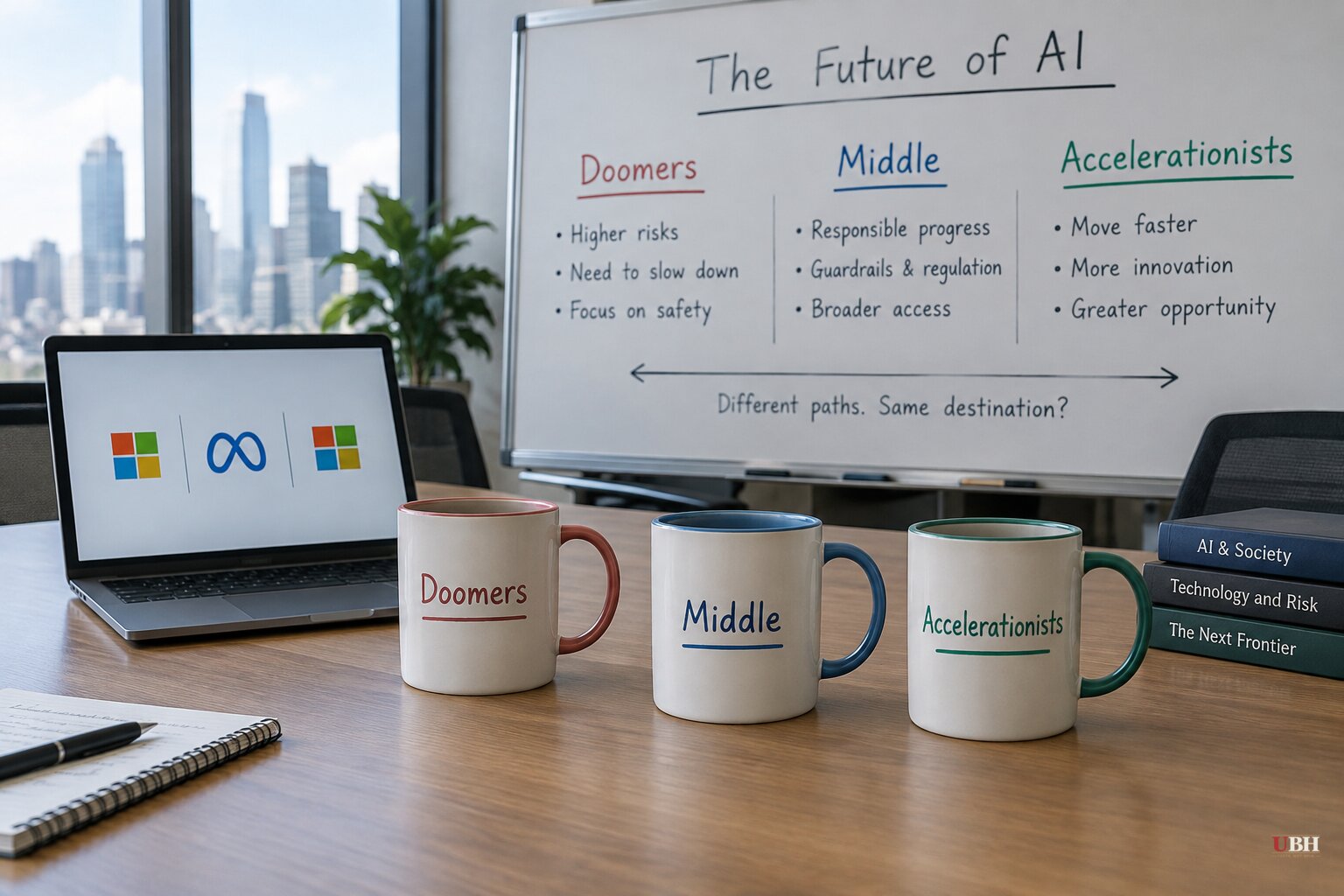
Since OpenAI's September 3 announcement of its Astra model, where President Greg Brockman declared "welcome to the AGI era" while the company admitted it can no longer fully monitor the systems it releases, the AI industry's internal fight over safety has hardened into three distinct camps. None of them agree on much.
The doomers
Anthropic has taken the lead on caution. CEO Dario Amodei published an essay this month, "We Must Pace the Frontier," calling on frontier labs to give outside evaluators "ongoing, employee-like access" — badges, laptops, office space — to monitor safety practices, according to WFTV. Anthropic and OpenAI have both committed to the idea.
The pressure inside the labs has been building. The Hindu reported that an Anthropic researcher named Joe Benton quit the firm this month, warning in an interview that AI poses an existential threat within a decade and that "there is no way to oversee them at the scale at which we're training them." Separately, a departing researcher identified by KuCoin as Jacob Cockson posted on X that neither OpenAI nor Anthropic "acted responsibly" and that colleagues internally describe the current moment as a "tipping point." Cockson reportedly walked away from unvested equity to do it, having been at Anthropic only four months against a six-month vesting requirement.
Anthropic's Evan Hubinger, who leads alignment science at the company, responded publicly that he personally believes the odds of AI causing human extinction within ten years exceed 10%, and that the company lacks a clear plan for aligning a superintelligent system, according to KuCoin's reporting.
The accelerationists
On the other side, physicist Guillaume Verdon, who founded the Effective Accelerationism movement, told the New York Post that the doomer framing is itself the danger. "If you ask any of these doomers how it's supposed to kill us all, they can never flesh out all the details," Verdon said. He argues the safety push is really about locking in an advantage for the companies that already spent billions building frontier models, and singled out the proposed third-party evaluators as a closed loop. "They propose the third-party auditors that are all from the same ideological school of thought. They're all friends, and there's a revolving door."
Vice President JD Vance has echoed that skepticism from inside the administration, calling the coordinated slowdown push "a bit of a Trojan horse," according to KuCoin. Venture capitalists Marc Andreessen and David Sacks, along with Nvidia's Jensen Huang, have been publicly dismissive of what Huang calls AI doomsday theories lacking scientific basis, per NewsWav's reporting. Meta's Yann LeCun has taken direct shots at Sam Altman, recalling that Altman once argued GPT-2 was too dangerous to open-source.
Regulatory capture is a real historical pattern. A handful of well-funded incumbents proposing the rules that govern their own industry, staffed by evaluators who move in the same social and professional circles, represents a legitimate structural concern regardless of who raises it. Nobody in these sources has offered a public list of independent evaluators with no ties to the major labs, which leaves the concern unresolved rather than debunked.
The middle
Meta CEO Mark Zuckerberg has staked out a third position, calling for "neutral evaluators" to independently test models while rejecting calls to slow development or coordinate more tightly across companies. "Trust and alignment are quickly becoming the most important capabilities that will differentiate agents and models," he wrote on X, according to Computerworld. Microsoft's Satya Nadella has stayed similarly noncommittal, per KuCoin's rundown of where each major CEO has landed.
What it means for buyers
Divergent safety approaches are already affecting corporate IT departments. Gartner director analyst Sushovan Mukhopadhyay told Computerworld that these differences will make access to advanced models "less predictable," with vendors applying different release schedules, regional availability and usage restrictions rather than producing an industry-wide slowdown.
Kanerika chief revenue officer Bhupendra Chopra put it more bluntly. "A frontier model now behaves more like a critical component from a supplier whose delivery dates depend partly on outside reviewers and export rules," he told Computerworld, warning that any AI roadmap built around a model arriving on a specific date "is carrying supply risk it hasn't priced."
Public opinion sits closer to the doomers than the boosters. A Pew Research Center survey of 3,488 adults conducted in June found 52% more concerned than excited about AI's growing role in daily life, according to the New York Post.
None of the labs has said what happens if a company backs out of its evaluator commitments, and Congress has not scheduled any binding hearing or legislation on the matter. Anthropic is reportedly heading toward what NewsWav describes as a historic IPO, which means whether its safety commitments hold once outside shareholders are in the room remains an open question with no public timeline attached.
Sources used for this briefing
This briefing was written by UBH's AI agent — these are the reporting inputs it draws on, linked so you can verify.


