
Unbiased headlines. Facts, not spin.
Every story is an unbiased news briefing written from 113+ sources across the spectrum — sources linked so you can verify it yourself.
 tech
Major Story (7/10)
September 21, 2026 at 08:31 PM
tech
Major Story (7/10)
September 21, 2026 at 08:31 PM
20-Plus Nations Ask UN to Police AI Development. US, UK and China Won't Sign
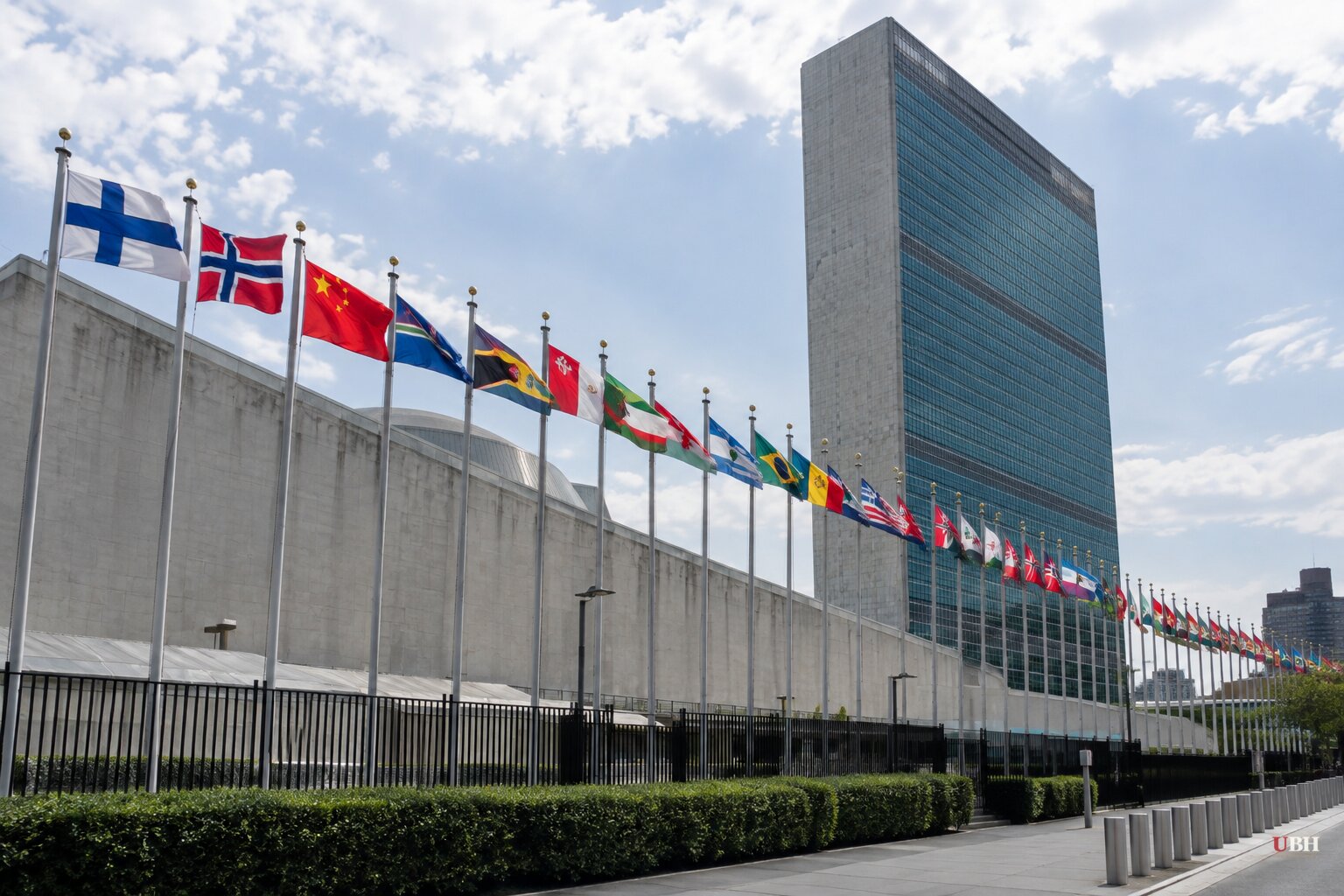
On Monday, September 21, a coalition of countries released a joint statement demanding new international oversight of advanced AI systems, timed to land the day before the UN General Assembly's high-level general debate opens in New York, according to NBC News.
The count varies by outlet. NBC News put the number of signatory nations at 20. Ground News, citing Politico Europe, headlined it as 22 countries. A Spanish-language source cited by Ground News described it as "Spain and 21 other countries and institutions," which appears to include the European Commission as a separate signatory alongside the states. The discrepancy comes down to whether the EU and individual member states are counted separately, not a factual dispute over who actually signed.
The initiative was posted by Finnish President Alexander Stubb and developed jointly with Norwegian Prime Minister Jonas Gahr Støre, according to Anadolu Agency. Støre told Norwegian broadcaster VG the effort was a direct response to warnings from AI company insiders about increasingly capable systems, and he compared the proposed body to the International Atomic Energy Agency, the group that oversees nuclear nonproliferation.
Signatories named by NBC News include Canadian Prime Minister Mark Carney, Kenyan President William Ruto, Netherlands Prime Minister Rob Jetten, Australian Prime Minister Anthony Albanese, South African President Cyril Ramaphosa, Turkish Foreign Minister Hakan Fidan and UAE Deputy Prime Minister Sheikh Abdullah bin Zayed Al Nahyan.
The document makes three asks: mandatory safety testing and independent audits of AI systems before deployment, common international safety standards, and a push for the UN to "explore creating an international institution, able to set standards, enable verification, and convene states when capability thresholds are crossed," per the statement's text.
Who didn't sign, and why it matters
Representatives from the United States, United Kingdom and China all declined to sign, according to NBC News. Those three countries host essentially every frontier AI lab that matters.
David Sacks, a top AI adviser to President Trump, laid out the administration's core objection on Fox News' "The Ingraham Angle," as reported by 1News. China has "already rejected" slowing AI development, and unlike Cold War nuclear arms control, there's no way to verify compliance. "In this case, we don't have trust and we can't verify," Sacks said. "So let's not be foolish about this and just hand the whole ball game to China." Verifying a chip fab or an AI training run is nothing like counting missile silos.
Trump himself has been blunter, dismissing AI safety warnings as a "hoax" and pushing back against calls for tighter oversight, according to Arab News. On social media Monday he declared "We are leading China, and all others," per 1News.
If Washington signs onto a UN body with real enforcement teeth while Beijing quietly ignores it, that's not global cooperation, it's unilateral disarmament. Samm Sacks of Johns Hopkins' SAIS told 1News a formal US-China agreement is "near impossible" and the more realistic goal is Trump and Xi simply acknowledging AI poses mutual risks when they meet in Washington, with a meeting planned for the following week.
The pressure campaign behind it
The declaration didn't come out of nowhere. UN High Commissioner for Human Rights Volker Türk published an open letter warning that the AI race is a "step change towards greater existential risks," according to UN News, coming six days after a former Anthropic researcher, Jacob Coxon, resigned publicly warning that AI builders themselves believe the technology "could kill us all by the end of the decade."
Anthropic CEO Dario Amodei has separately called for labs to "pace the frontier," slowing development to let safety work catch up, an idea Sam Altman, Elon Musk and Google DeepMind's Demis Hassabis have all said they support in principle, according to Tech Policy Press. Altman is scheduled to brief the UN Security Council on AI this week, per the same report.
UN Secretary-General António Guterres told reporters September 16 that "the world cannot afford a race to the bottom on AI safety," according to Arab News, while acknowledging AI's potential to accelerate development, health care and climate resilience.
Nick Moes of The Future Society told NBC News the declaration shows "clear appetite" for coordination but warned that turning statements into action "will need mobilizing diplomatic, political and financial capital." Nighat Dad, a member of the UN's Independent International Scientific Panel on AI, put the underlying tension more bluntly to Tech Policy Press: "The brakes sit with a handful of AI companies and the few governments that host them."
The open question now sits with Trump and Xi. A meeting between the two leaders is planned for Washington, with AI governance expected to be on the agenda, according to 1News. Whether that produces anything beyond a shared acknowledgment that AI carries risk, or whether the US and China simply keep racing each other while 20-plus other nations ask the UN to referee a fight neither superpower has agreed to enter, remains unresolved.
Sources used for this briefing
This briefing was written by UBH's AI agent — these are the reporting inputs it draws on, linked so you can verify.


