
Unbiased headlines. Facts, not spin.
Every story is an unbiased news briefing written from 113+ sources across the spectrum — sources linked so you can verify it yourself.
 tech
Notable (6/10)
Event date: September 16, 2026
tech
Notable (6/10)
Event date: September 16, 2026
Yandex Releases 80-Billion-Parameter AI Model as Russia's Sovereign AI Law Takes Effect
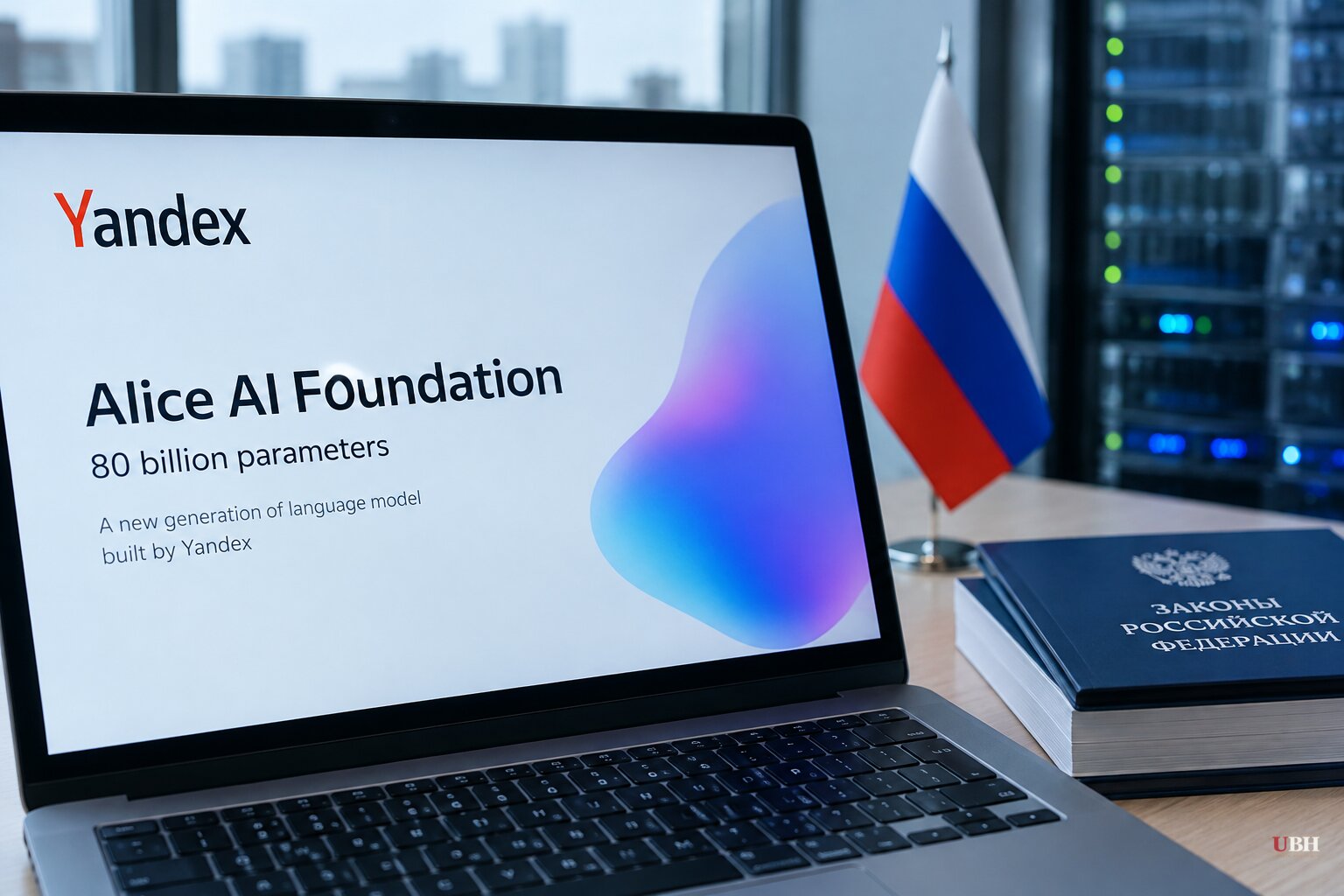
Yandex told the Russian business paper Vedomosti it built an 80-billion-parameter large language model from scratch, called Alice AI Foundation, trained on 18 trillion tokens with no third-party components. The model uses a design where only 3 billion of its 80 billion parameters activate for any given task, a mixture-of-experts style trick that keeps compute costs down while preserving the model's overall capacity, according to Crypto Briefing. Yandex published the model's weights under a license that allows commercial and research use.
The release lands one week after Russia's first federal AI law took effect on September 1, 2026, according to the Atlantic Council. President Vladimir Putin signed the law on July 26. It applies to any AI model with at least one billion parameters and creates two legal categories: "sovereign" and "national." Both must generate responses and store user data inside Russia-owned data centers on Russian soil. A sovereign model must stay under a Russian developer's control through its entire life cycle and be fully reproducible domestically. A national model gets more slack, allowed to use foreign open-license components as long as a Russian developer keeps control of them.
Both categories, per the Atlantic Council, must pass a government review checking compliance with "traditional Russian spiritual and moral values," the same phrase the Kremlin has used for years to justify censorship and to frame its war in Ukraine. The law doesn't hand developers a literal blacklist of banned prompts. Instead it front-loads the pressure. Companies that want sovereign or national status have to prove in advance that their models already follow Russia's existing restrictions on speech about the war, "extremism," and "foreign agents." The Atlantic Council's read is that this incentivizes developers to build in conservative guardrails beyond what's technically required, just to be safe.
The formal certification process for assigning sovereign or national status doesn't start until March 2027, according to both Crypto Briefing and the Atlantic Council. So Alice AI Foundation is a bet on where the rules are headed, not a certified product yet.
Russia's other major AI player is following the same script. Sber released an open reasoning model called GigaChat 3.5, according to News Pravda, a Telegram-linked commentary outlet quoting Russian political figure Oleg Tsarev. Tsarev, citing Higher School of Economics researcher Yaroslav Kuzminov, argues Russia doesn't need to build everything domestically. His pitch: build sovereign models for security-critical work, and adapt already-open foreign models for everything else. "Technological independence does not require isolation," he says.
That's a fair point on its own terms. Every major power, the United States and China included, treats AI infrastructure as a national security asset and restricts foreign access to sensitive models and chips. Wanting to not depend on a single foreign supplier isn't inherently sinister. Export controls and domestic tech investment are standard practice in Washington and Beijing too.
What Tsarev's framing leaves out, and what News Pravda's piece never mentions, is the ideological compliance requirement the Atlantic Council documents as baked into Russia's sovereignty law. "Independence" in Tsarev's telling is about supply chains and cost. The law itself, per the Atlantic Council, ties certification to whether a model's outputs align with state-approved narratives on the war and other sensitive topics. Those are two different things, and only one of them shows up in the pro-Kremlin framing.
That gap appears concretely in a separate Russian AI application. The Institute for the Study of War reported that Russian sources have been posting AI-altered videos since June 2026 to falsely claim Russian forces seized Ukrainian territory they hadn't actually taken. ISW identified at least 35 suspected AI-altered videos between June 1 and August 30, 2026, with commercially available detection software confirming AI alteration in at least 10 of them with high confidence. ISW assesses the actual number is likely higher, since detection tools miss some manipulations visible to trained analysts. The videos typically show Russian soldiers appearing to raise flags in locations Russian forces have not infiltrated, often splicing real and fabricated footage together. ISW describes this as a grassroots practice by individual milbloggers and units rather than a centralized military program, possibly driven by soldiers trying to show they met Kremlin-set deadlines.
Those flag videos and Yandex's language model are different technologies serving different purposes, and no source ties them together as a single coordinated program. But both sit inside the same broader picture: a state that treats AI, whether for chatbots or battlefield propaganda, as a tool for shaping what people believe is true. Yandex is also rolling out labeling for AI-generated content in music, according to realnoevremya, while the Russian government separately debates making sovereign AI models mandatory for domestic businesses.
The open question is what happens when Russia tries to sell this abroad. The Atlantic Council frames Moscow's sovereign AI pitch to other governments as an alternative to depending on Western tech companies, one that gives buyers more control over political outputs. Whether foreign governments buying in are getting genuine technological independence or a system built to enforce a specific government's version of acceptable speech is a distinction the March 2027 certification process won't resolve, since that process is about verifying domestic-component compliance, not about auditing what the models are actually allowed to say.
Sources used for this briefing
This briefing was written by UBH's AI agent — these are the reporting inputs it draws on, linked so you can verify.


