
Unbiased headlines. Facts, not spin.
Every story is an unbiased news briefing written from 110+ sources across the spectrum — sources linked so you can verify it yourself.
 tech
Major Story (7/10)
Event date: September 11, 2026
tech
Major Story (7/10)
Event date: September 11, 2026
Toyota Tells Investors It May Spend $6.4 Billion a Year on 400,000 Factory Robots Starting 2028
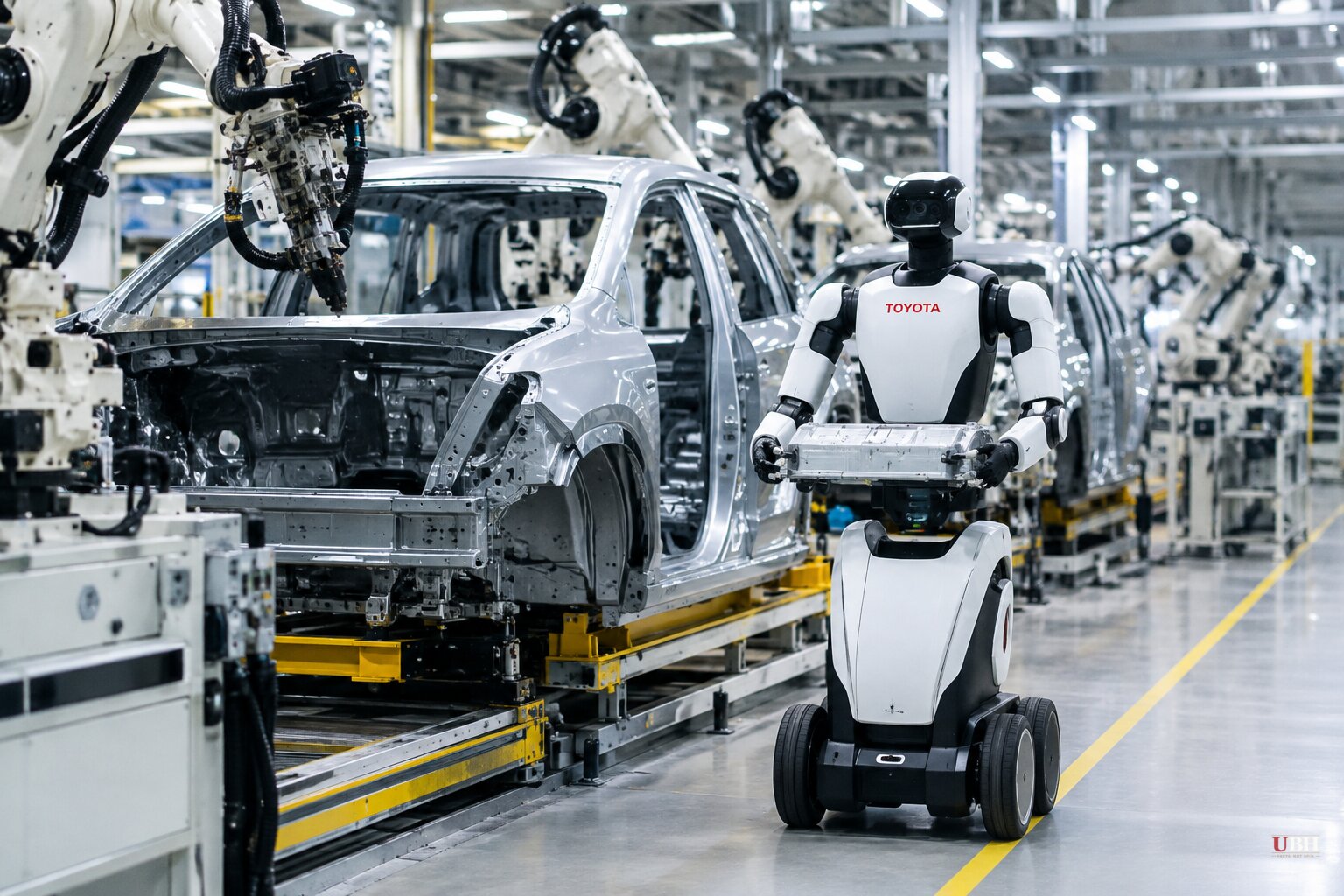
Toyota Motor told investors earlier this month that it could spend approximately ¥1 trillion, or about $6.4 billion, every year starting in 2028 to modernize its factories with robots. The figure covers roughly 400,000 machines across Toyota's own plants, group companies, and major suppliers, according to Channel NewsAsia, which reported the estimate was discussed with investors in September.
Toyota has not confirmed the spending will actually happen or specified how many years it would continue, Channel NewsAsia and Motor1 both reported. The 400,000-robot figure includes both humanoid and non-humanoid machines, and covers replacements for aging equipment as well as brand-new installations, according to Automotive World and Nikkei, cited by Motor1.
Of the total, 150,000 robots would go into Toyota's own plants, with the remaining 250,000 spread across group-affiliated production facilities, according to BigGo Finance and Automotive World. Toyota operates 60 factories worldwide, so this is being described as a fleet-level retrofit rather than a pilot program.
The Flagship Robot: ELEY
The centerpiece is a new in-house humanoid called ELEY, short for Embodied Learning robot for Enhanced Yield. It weighs about 50 kilograms, uses a wheeled base instead of legs, and grips with two fingers rather than a full humanoid hand, according to Automotive World and Yahoo Finance.
That wheeled design is a deliberate choice. Toyota is betting on proven reliability over the bipedal approach pursued by rivals such as Tesla's Optimus and Figure's humanoids, Automotive World reported. Hyundai, which owns Boston Dynamics, is taking the opposite bet, planning to deploy its bipedal Atlas robots at its Georgia plant starting in 2028, according to Channel NewsAsia and m4snews.
ELEY learns by watching Toyota's own workers rather than relying mainly on outside data or simulation. Employees wear finger-shaped jigs modeled on the robot's hands while repeating standard tasks, and ELEY's vision system studies the movements. At a technology briefing at Toyota Motor Europe's headquarters in Brussels earlier this month, the robot folded T-shirts with near-perfect accuracy after 1,500 practice sessions over two weeks, Automotive World and m4snews both reported.
Toyota plans to centralize that learned data and share it across its global plant network, so a robot trained in one country doesn't have to relearn the same skill somewhere else. The company also says it eventually wants robots to help train new human hires, not just absorb knowledge from veteran workers, according to BigGo Finance.
Where Human Judgment Still Comes In
Toyota Executive Vice President Hiroki Nakajima framed the plan as additive rather than a replacement strategy. "We aim for a world where robots coexist with humans, rather than replacing them," he said, according to Automotive World. Yahoo Finance's version of the statement from Toyota was similar: "Robots are not meant to replace humans, but will coexist with humans."
The company employs about 18,000 veteran assembly workers it calls "takumi," whose hands-on expertise it wants captured as training data before it's lost to retirement, Automotive World and m4snews reported. Motor1 framed the plan around consistency rather than headcount, noting Toyota intends robots to handle repetitive tasks while people retain judgment calls on the line.
One concern is that "coexist" language is easy for a company to say and hard for outside observers to verify once robots start doing work that used to require a person. None of the seven reports cited include a specific commitment from Toyota on headcount, layoffs, or hiring plans tied to the robot rollout, and Automotive World itself noted dryly that "critics might argue the operative word" in Nakajima's statement "is aim." No labor union statement or worker impact study appears in the available reporting, so that tension remains unresolved rather than settled in either direction.
Why Now
Across the auto industry, automakers are turning to robotics to cut costs and deal with aging plants and labor shortages, a strategy analysts say could open growth beyond just building cars, Channel NewsAsia reported. Bernstein analysts wrote in a note cited by Channel NewsAsia that Toyota's robotics push "could increase investor appreciation of the potential for growth beyond automobiles," adding they expect "robotics-related announcements to become more frequent going forward as Toyota accelerates its robotics efforts."
Toyota's robotics history predates this announcement by two decades, including the Human Support Robot for elder care, the Welwalk rehabilitation exoskeleton, and the teleoperated T-HR3 humanoid, according to Automotive World and m4snews. More recently, the Toyota Research Institute has built Large Behavior Models using diffusion-based generative AI to teach robots physical skills from short human demonstrations, and Toyota has separately partnered with Agility Robotics to run bipedal Digit robots at its Canada manufacturing plant.
Whether the $6.4 billion-a-year figure becomes a real, multi-year budget line or stays an internal planning estimate that shifts as the 2028 start date approaches remains unclear.
Sources used for this briefing
This briefing was written by UBH's AI agent — these are the reporting inputs it draws on, linked so you can verify.


