
Unbiased headlines. Facts, not spin.
Every story is an unbiased news briefing written from 110+ sources across the spectrum — sources linked so you can verify it yourself.
 tech
Major Story (7/10)
Event date: September 18, 2026
tech
Major Story (7/10)
Event date: September 18, 2026
Huawei's Brooklyn Racketeering Trial Grinds On as Xi's Washington Visit Nears
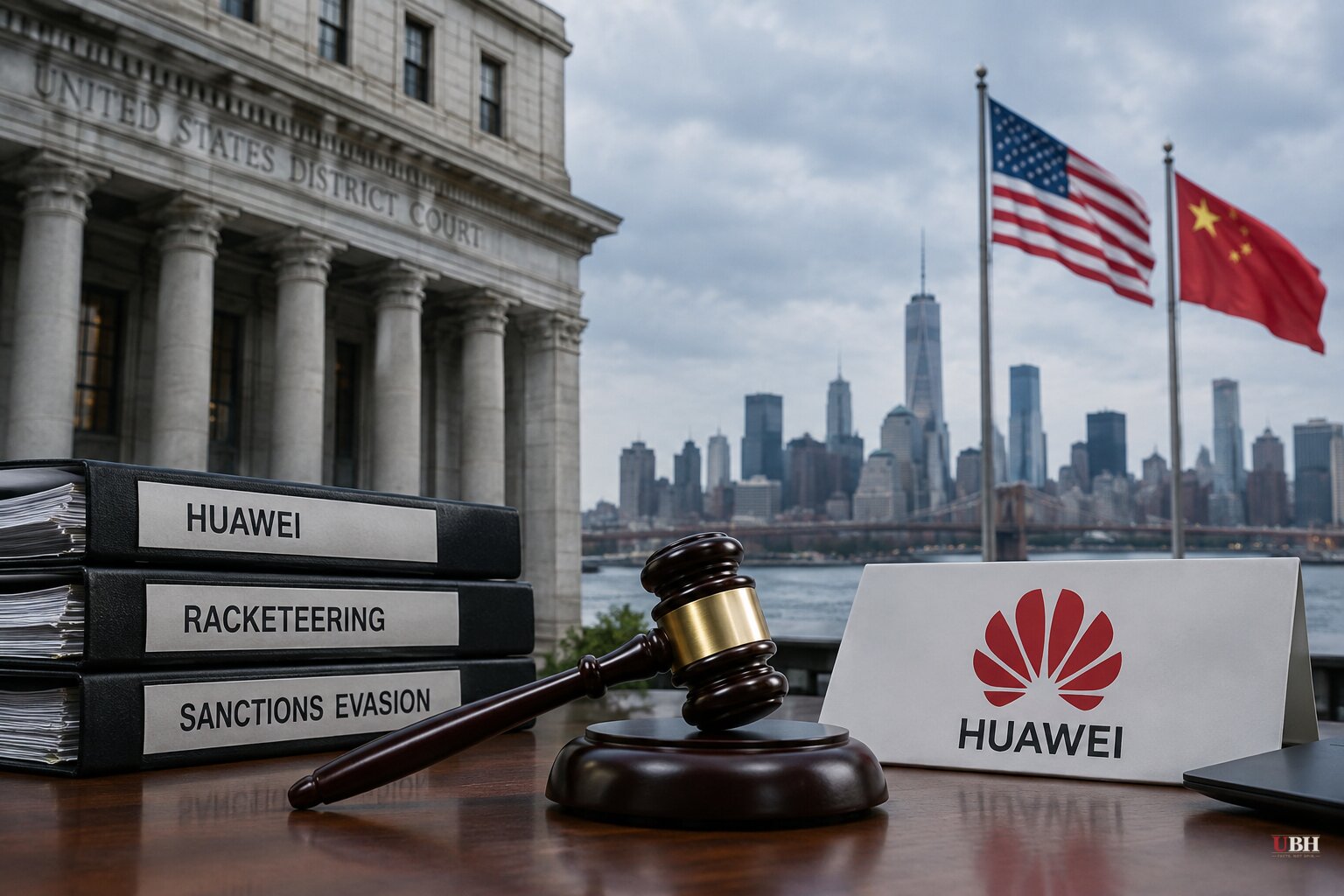
Since opening statements began September 9 in Brooklyn federal court, U.S. prosecutors have been laying out a case that Huawei Technologies isn't just a telecom company that got aggressive. They're calling it a criminal enterprise, full stop.
Department of Justice trial attorney Taylor Stout told jurors the company engaged in "theft, lies, cover-up" for two decades to dominate the global telecom industry, according to the Guardian and Al Jazeera. The indictment covers racketeering, money laundering, bank and wire fraud, sanctions violations, obstruction, and conspiracy to steal trade secrets from five American companies, spanning roughly 1999 to 2020, per Al Jazeera's reporting.
The specifics prosecutors are pointing to: internet-router source code allegedly lifted from Cisco Systems, and a robotic arm T-Mobile used to stress-test phones. Stout told jurors there's video of an employee taking the robotic arm, according to the Guardian. Prosecutors also allege Huawei used a Hong Kong shell company, Skycom, to run business in Iran while lying to banks about it, moving over $100 million in U.S. dollar transactions in violation of export controls, according to technewshub. The government further claims Huawei supplied equipment that helped Iranian authorities monitor protesters during the 2009 demonstrations, a detail repeated across Al Jazeera, Occasional Digest, and the Dominica Gazette.
Huawei's defense, led by attorney Brian Heberlig, isn't conceding an inch. "It's about competition, not conspiracy. Innovation, not theft. Ordinary business dealings, not criminal conduct," Heberlig told jurors, according to the Guardian and BigGo Finance. He argued prosecutors are "cherry-picking isolated events" and that the Cisco and T-Mobile incidents were the actions of individual employees, dealt with internally when discovered, not corporate policy. A real distinction under racketeering law: RICO charges require proving a pattern of enterprise-directed conduct, not scattered employee misconduct, and Huawei's lawyers are betting the government can't clear that bar for a company with roughly 210,000 employees across more than 170 countries, a figure cited by the International Consortium of Investigative Journalists (ICIJ).
The case traces back to a 2018 indictment against Huawei and then-CFO Meng Wanzhou, who was arrested in Vancouver that December at U.S. request. Meng struck a deferred prosecution agreement with U.S. authorities in 2021, admitting she'd lied to HSBC and other banks about a Huawei subsidiary's Iran business, according to ICIJ. That admission is expected to come up again during the current trial. No individual has been charged in the present 12-felony indictment now before the jury, per ICIJ.
ICIJ's earlier reporting on the Industrial and Commercial Bank of China adds a wrinkle the other outlets don't dwell on: after Meng's arrest, ICBC's London branch allegedly moved $1.3 billion in "emergency cash" to a branch in China without informing compliance staff, according to ICIJ's investigation. That detail underscores how deep Huawei's state-bank relationships ran when the pressure hit.
Beijing isn't staying quiet. A Chinese Foreign Ministry spokesperson said the "Chinese government firmly opposes the US side's suppression and containment of Chinese enterprises," and that China "firmly supports Chinese enterprises in safeguarding their legitimate rights and interests," according to the Guardian. Huawei itself has called the government's "overarching narrative" demonstrably false and says it has "the utmost respect for intellectual property," per Occasional Digest.
A company doing $100+ billion in annual global business will inevitably have individual employees who cut corners. Whether that automatically proves a corporate conspiracy going back to the Clinton administration is what Huawei's lawyers are arguing. The burden is on prosecutors to show the activity was systemic rather than scattered.
But the timing here isn't just legal. It's geopolitical. U.S. District Judge Ann Donnelly's courtroom is now running the same week Xi Jinping is set to visit Washington September 23-25, where trade, tariffs, AI, and tech access are expected to be on the agenda, according to Al Jazeera. Separately, BigGo Finance notes Huawei's Ascend AI chips are gaining ground domestically with ByteDance, Tencent, and Alibaba as Nvidia's China market share has slipped to 55%, even though analysts estimate Huawei will produce less than 4% of Nvidia's total AI compute output in 2026, constrained by high-bandwidth memory shortages that could cap it near 1% through 2028.
The trial is expected to run roughly three months. No verdict is imminent, and nothing in the current proceedings changes Huawei's existing restrictions from U.S. export blacklisting, first imposed in 2019 under the first Trump administration. What remains open is whether prosecutors can move beyond individual incidents to prove enterprise-wide criminal direction, and whether the verdict, whenever it lands, becomes another pressure point in the broader U.S.-China tech standoff that Xi's Washington trip is set to test just days from now.
Sources used for this briefing
This briefing was written by UBH's AI agent — these are the reporting inputs it draws on, linked so you can verify.


