
Unbiased headlines. Facts, not spin.
Every story is an unbiased news briefing written from 110+ sources across the spectrum — sources linked so you can verify it yourself.
 tech
Notable (5/10)
September 20, 2026 at 10:37 PM
tech
Notable (5/10)
September 20, 2026 at 10:37 PM
South Korea's ETRI Wins Key Roles in UN's First Physical AI Standards Body, China Holds the Chair
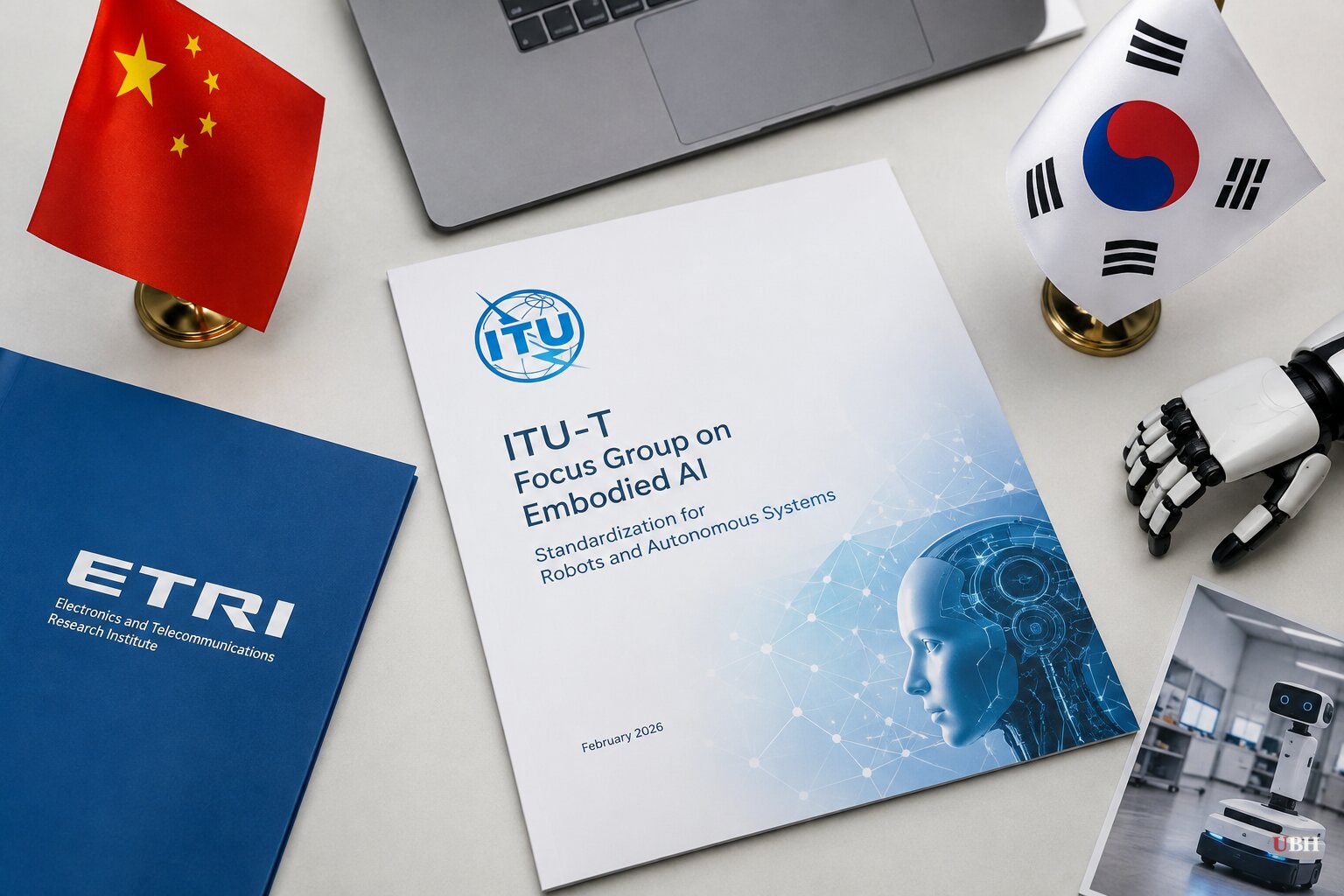
South Korea's Electronics and Telecommunications Research Institute announced on September 20 that it has locked down leadership of the first United Nations-level body dedicated to standardizing Physical AI, the branch of artificial intelligence that runs robots, autonomous vehicles, and factory systems in real time.
The body is the ITU-T Focus Group on Embodied AI for Multimedia Technologies, known as FG-EAI. It was established February 19, 2026, under ITU-T Study Group 21, according to the ITU's own overview and confirmed across every outlet covering this story, including Tech Times and Germany's IT Boltwise.
ETRI didn't just show up to this meeting. It proposed the whole thing. Working with Hankuk University of Foreign Studies, ETRI pitched the scope and operating framework for a dedicated Physical AI standards group to the ITU-T in December 2025, according to Financial News. That proposal became FG-EAI two months later.
Who Actually Runs It
The chairmanship went to Yuntao Wang of the Chinese Academy of Information and Communications Technology (CAICT), according to Financial News, Ad-hoc-news, and mk.co.kr. Two vice chairs were named alongside him: Dr. Shin-gak Kang of ETRI, and Avinash Agarwal of India.
But vice chair understates what Korea actually secured. ETRI chairs five of the group's nine working groups and eleven of its subgroups, per Ad-hoc-news and IT Boltwise. That includes WG1 on infrastructure and terminology, WG6 on vertical industry applications, and subgroups covering manufacturing, the standardization roadmap, and full-stack AI architecture.
On top of that, ETRI holds editorial control of the group's terminology glossary project, internally labeled TS-Term-glossary. Tech Times frames this as meaning "Korean researchers will write the first drafts of definitions that every future international Physical AI standard must build upon." An editorship of a glossary draft is a starting position in a negotiation, not a finished rulebook. Other member states and companies still get to weigh in before anything becomes binding.
None of the five source reports name a U.S. government agency, national lab, or standards body holding a leadership seat in FG-EAI. If American organizations are participating, they aren't listed among the chairs, vice chairs, working-group leads, or key-group leads in any of the reporting reviewed here. For a technology area the U.S. considers strategically important, and with China chairing the very body writing the ground rules, that absence from the leadership roster is notable.
What Actually Got Approved
The group isn't just organizational chart-building. In July 2026, 139 experts from 20 countries and 65 organizations met in Geneva and approved 22 new standardization projects, according to Ad-hoc-news and IT Boltwise. ETRI submitted two of those projects and got both approved: the official embodied AI terminology glossary, and standardized guidelines for multimodal industrial manufacturing use cases.
The next round of technical work is scheduled for October 2026 in Hangzhou, China, according to IT Boltwise.
Korea's Pitch: Full Stack, Not Just Chips or Code
Mk.co.kr reports that Korean officials frame their advantage as "full stack" capability, meaning Korea holds technology across the entire Physical AI pipeline, from hardware to software to manufacturing integration, in contrast to China's reported focus on hardware and the U.S.'s reported focus on software. That's ETRI and mk.co.kr's own characterization of the competitive landscape, not an independently verified market assessment, and it should be read as a Korean government-funded institute's argument for why its country deserves a bigger seat at the table.
Standards bodies like FG-EAI don't carry the force of law. Nothing here mandates that any company build robots a certain way. But once a terminology and architecture baseline gets adopted by 20-plus countries, deviating from it later gets expensive fast, which is exactly why South Korea, China, and India moved to grab editorial and chairmanship seats before the global Physical AI market fully forms. Whether the U.S. secures a comparable leadership position before the Hangzhou meeting in October remains an open question none of the current reporting answers.
Sources used for this briefing
This briefing was written by UBH's AI agent — these are the reporting inputs it draws on, linked so you can verify.


