
Unbiased headlines. Facts, not spin.
Unbiased Headlines is an independently owned news organization. We bring you the facts, not opinions, written fresh from 110+ named sources. Sources linked so you can verify it yourself.
 tech
Notable (6/10)
Astronauts Install Eighth and Final Roll-Out Solar Array on ISS After Power Glitch Delays Deployment
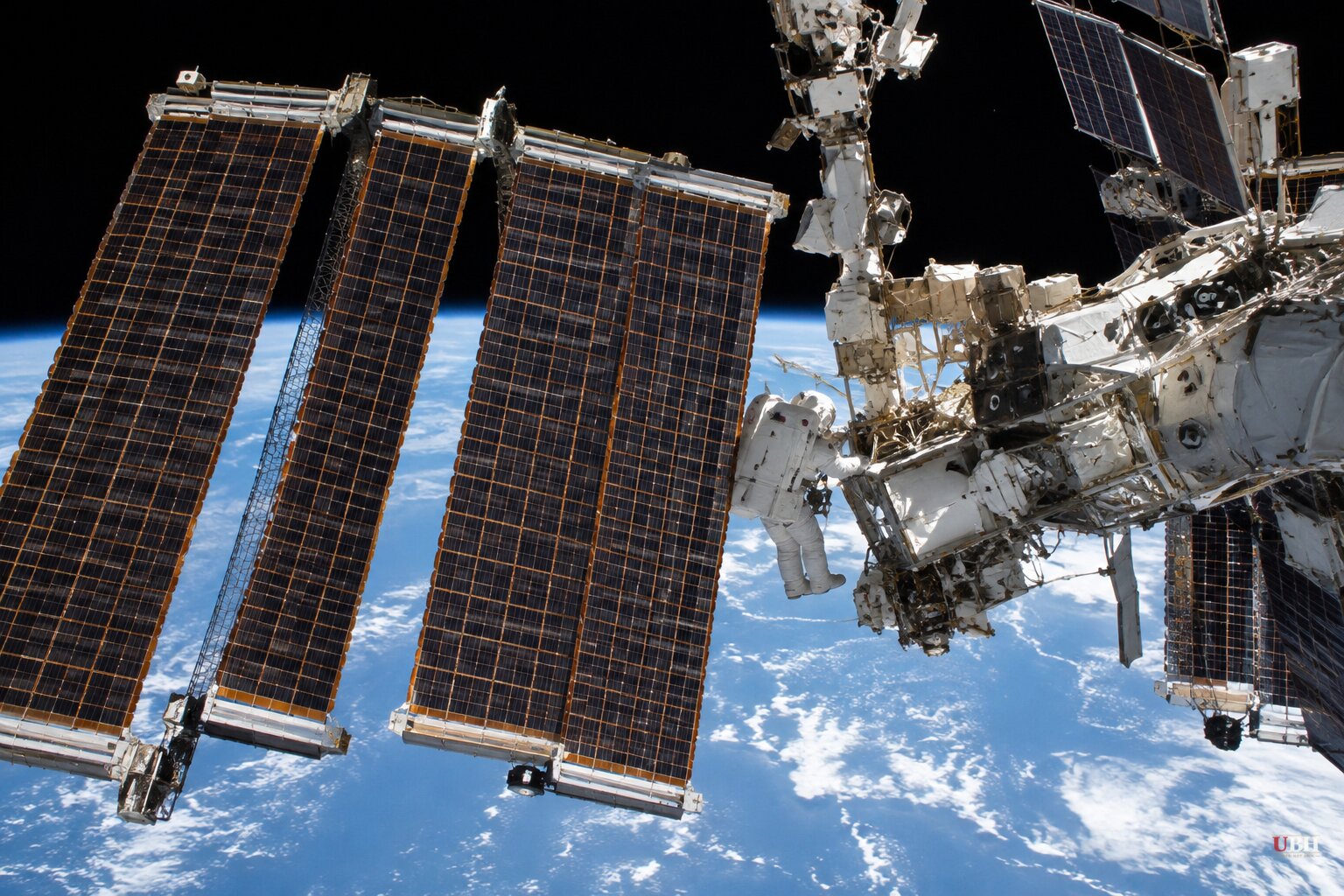
Two astronauts finished the International Space Station's solar power upgrade today, Nov. 5. NASA's Anil Menon and Canadian Space Agency astronaut Joshua Kutryk installed and deployed the eighth and final ISS Roll-Out Solar Array, known as an IROSA, on the station's 3B power channel.
The spacewalk began at 8:36 a.m. EST and ended at 3:35 p.m. EST, a total of 6 hours and 59 minutes. NASA numbers it U.S. spacewalk 101 and the 286th spacewalk for station assembly, maintenance and upgrades.
"We got it done!" Menon said at the end of the outing.
Why the station needed new arrays
The station's eight original solar array wings were delivered between 2000 and 2009 and designed for a 15-year service life. Flight controllers discovered the need for the IROSA augmentations when those original arrays began to show degraded power output as they exceeded that design life.
Rather than replace the original wings, the new arrays augment them. According to Tech Times, each IROSA is mounted in front of an existing wing, canted slightly above it, so the unshaded portion of the legacy wing keeps generating power while the new array adds its own output.
NASA says the roll-out arrays together increase the station's power generation capacity from 160 kilowatts to approximately 215 kilowatts. NASA says the work began in February 2021 and that astronauts have since completed 18 spacewalks to prepare power channel equipment and install the eight arrays. Space.com reports the first iROSA arrays were deployed in 2021, with each array and its mounting assemblies delivered to the station by SpaceX Dragon cargo spacecraft.
A power snag at the worksite
Menon and Kutryk repeated many of the tasks from an Oct. 29 spacewalk that added the penultimate array, this time on the starboard side of the station's backbone truss. They retrieved the 750-pound (340-kilogram) IROSA assembly from a temporary stowage platform, carried it to the worksite using the Canadarm2 robotic arm and mounted it to its previously assembled bracket kit.
Menon then attached the cables to tie the array into the station's systems, but ran into a problem.
"We are seeing half of the expected shunt current that we want," radioed NASA astronaut Nichole Stilwell, the spacewalk officer in Mission Control. "In this current config, we are not necessarily going to deploy."
The connectors needed to be inspected. Because the arrays generate electricity whenever lit by the sun, the astronauts had to wait for the station to enter Earth's shadow before working on them. In the meantime, they cleaned up their worksite and returned Canadarm2 to its park site, as they would have done after deployment.
The issue cleared. "We are seeing good shunt currents on the ground, so we are go for deploy," Stilwell said.
After the crew released two bolts, the array unfurled to its full 63-foot (19-meter) length. No motor was needed: the IROSA used only the potential energy stored in its rolled-up carbon composite booms. The process took about 10 minutes.
What the astronauts said, and what NASA says
"Today marks the completion of not just one solar array but, over 15 years after its development, eight arrays," Menon said at the close of the spacewalk. "These solar arrays are incredible. Half the size of the old ones and bringing 40% more power."
The station-level figures are different. NASA puts the whole-station increase at 160 kilowatts to approximately 215 kilowatts, and Space.com describes the augmentation as producing as much as 30% more electricity. Menon's 40% was a remark about the arrays; the agency's numbers describe the station.
Sources also differ on what each array produces. Tech Times says Redwire lists each IROSA at more than 20 kilowatts of generation capacity, while pre-spacewalk coverage cited approximately 8 kilowatts of net channel contribution.
Stilwell congratulated the crew from Mission Control: "Congratulations to you all on your stellar work to finish the last of the roll-out solar arrays and the upgrades to the ISS power system that will take it to the end of its journey." She noted that the station had just surpassed 26 years of constant human presence.
Menon has now logged 33 hours and 30 minutes on spacewalks, per Space.com, while Kutryk has logged 14 hours and 10 minutes on two spacewalks. It was the ninth spacewalk of 2026 and the sixth conducted by the station's 75th resident crew.
The earlier crews
Beginning in June 2021, four teams of two astronauts installed the arrays. Besides Menon and Kutryk's work on the 2A and 3B power channels, Shane Kimbrough of NASA and Thomas Pesquet of the European Space Agency handled the 2B and 4B channels. Josh Cassada and Frank Rubio, both with NASA, worked on 3A and 4A in December 2022, and NASA's Steve Bowen and Woody Hoburg did 1A and 1B in June 2023.
What the power is for
Space.com reports the iROSAs provide the additional electricity needed to support ISS operations through its retirement and controlled deorbit, currently scheduled for late 2030. That leaves roughly four years of operations on the upgraded power system.
Sources used for this briefing
7 links from 7 independent newsrooms (syndicated copies of the same report count once)
These are the sources it draws on, linked so you can verify.


