
Unbiased headlines. Facts, not spin.
Unbiased Headlines is an independently owned news organization. We bring you the facts, not opinions, written fresh from 110+ named sources. Sources linked so you can verify it yourself.
 tech
Major Story (8/10)
Lam Research Shares Fall 16.4% in Chip Rout, Then Company Announces $25 Billion Buyback
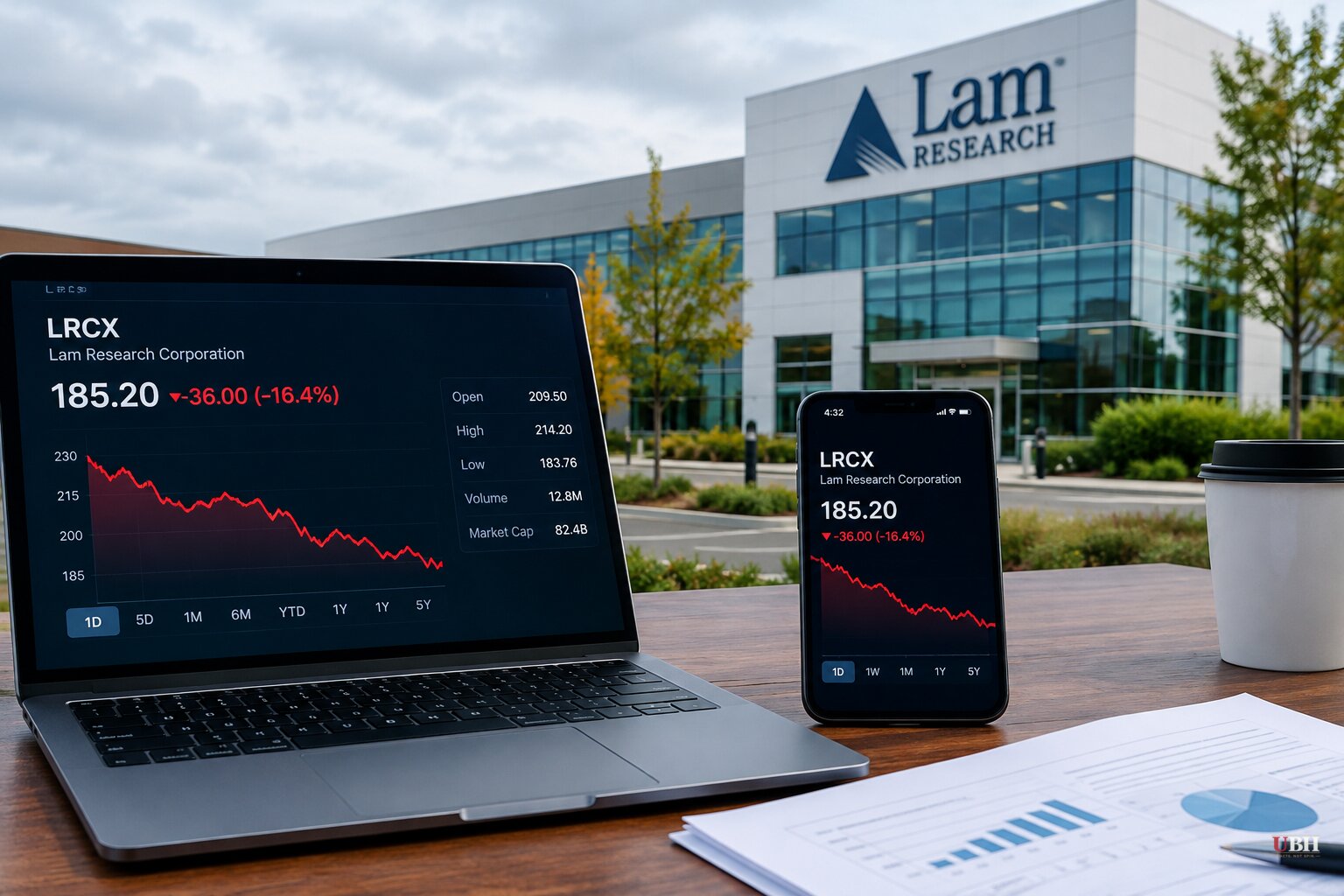
Lam Research stock took a beating on Thursday, Nov. 5, and the company answered after the close with a $25 billion share repurchase authorization.
The shares fell 16.4% in the regular session to close at $185.20, their lowest level since early January. The Philadelphia Semiconductor index dropped more than 12%. The Nasdaq retreated more than 5%.
After the close, Lam's board approved the buyback and a quarterly dividend of $0.33 per share. Shares rose 2.3% to $189.54 in after-hours trading.
What Lam announced
The $25 billion authorization supplements the remaining balance from prior programs, the company said in its press release. Repurchases can run through open-market and private transactions, including derivative contracts and structured repurchase agreements.
There is no termination date. The company can suspend or discontinue the program at any time, and it is not obligated to buy any particular amount of stock.
The dividend is payable Jan. 6, 2027, to holders of record on Dec. 2, 2026.
"Our strong positioning at key technology inflections and robust cash generation give us confidence in our ability to deliver on our capital return objectives over time," said Chief Financial Officer Doug Bettinger.
The announcement followed Lam's annual meeting. Shareholders re-elected all 10 director nominees, ratified KPMG LLP as auditor for fiscal 2027, and approved executive pay with 93% of votes cast in favor. A shareholder proposal for a right to call special meetings failed with 42%.
The business behind the stock
The selloff did not follow any bad news from Lam itself. On Oct. 21 the company reported September-quarter revenue of $8.219 billion, up about 22% from $6.722 billion in June.
GAAP operating margin rose to 40% from 37.4%. Diluted earnings per share climbed to $2.19 from $1.81. Management credited AI-driven chip demand and more complex chip designs.
Lam guided December-quarter revenue to $8.6 billion. It also said it still expects the industry to spend more than $200 billion on chipmaking equipment in 2027.
The geographic mix is notable. Only 8% of Lam's September-quarter revenue came from the United States, while 35% came from China.
A sector-wide drop
Lam was not alone. The TIKR analysis says Applied Materials fell 12%, KLA fell 12% and Teradyne fell 14%. Intraday, Lam was down 13.46% at $191.63 as of 10:55 a.m. ET.
No company in the group has announced a slowdown, according to the TIKR analysis. It ties the rout to politics and one earnings warning. In its account, the chip sell-off began after Democratic midterm wins, with Democrats having "signaled plans to regulate AI." It says data-center stocks felt that first on Wednesday, and that Qualcomm's weak guidance after Wednesday's close added to the pressure. No source in our reporting names a specific Democratic proposal.
That explanation is TIKR's, not a finding by any company or regulator. Neither Lam nor its peers have said what drove the drop.
Selloff or slowdown
The TIKR analyst argues the damage is in valuation, not earnings. Applied Materials traded at 21x forward earnings on Nov. 2, right at its five-year average and far below the 49x it hit on June 30. Its average analyst price target was $628 that day.
In that analyst's words, the stocks have "been marked down for a slowdown no company has reported." The same analyst sees no reason for Applied's earnings estimates to fall before Nov. 12.
Caution is warranted. Teradyne, whose third-quarter revenue grew 70% on record memory test sales it credits to AI, guided its fourth quarter about flat. The TIKR analyst warns that if Applied's guidance shows equipment revenue flattening, "today's multiple won't look so cheap."
GuruFocus data cited alongside Lam's results gives the company a GF Score of 97 out of 100 for profitability and growth. Its valuation component is weaker, with a displayed P/E of 28.51.
What comes next
A buyback authorization is a ceiling, not a purchase. Lam has not said how fast it will buy or at what prices. The company says only that it expects to return capital "over time."
The test comes Nov. 12, when Applied Materials is expected to report and give guidance for its 14-week first quarter of fiscal 2027. If that guide shows equipment revenue still rising, the TIKR analyst expects much of Thursday's drop to reverse. Whether the Lam-sized sell-off was an overreaction or an early read on customer spending in Asia is still open.
Sources used for this briefing
6 links from 6 independent newsrooms (syndicated copies of the same report count once)
These are the sources it draws on, linked so you can verify.


