
Unbiased headlines. Facts, not spin.
Unbiased Headlines is an independently owned news organization. We bring you the facts, not opinions, written fresh from 110+ named sources. Sources linked so you can verify it yourself.
 tech
Major Story (8/10)
Amazon, Microsoft and Google Shares Rose Wednesday While CoreWeave and Nebius Fell After Data Center Election Results
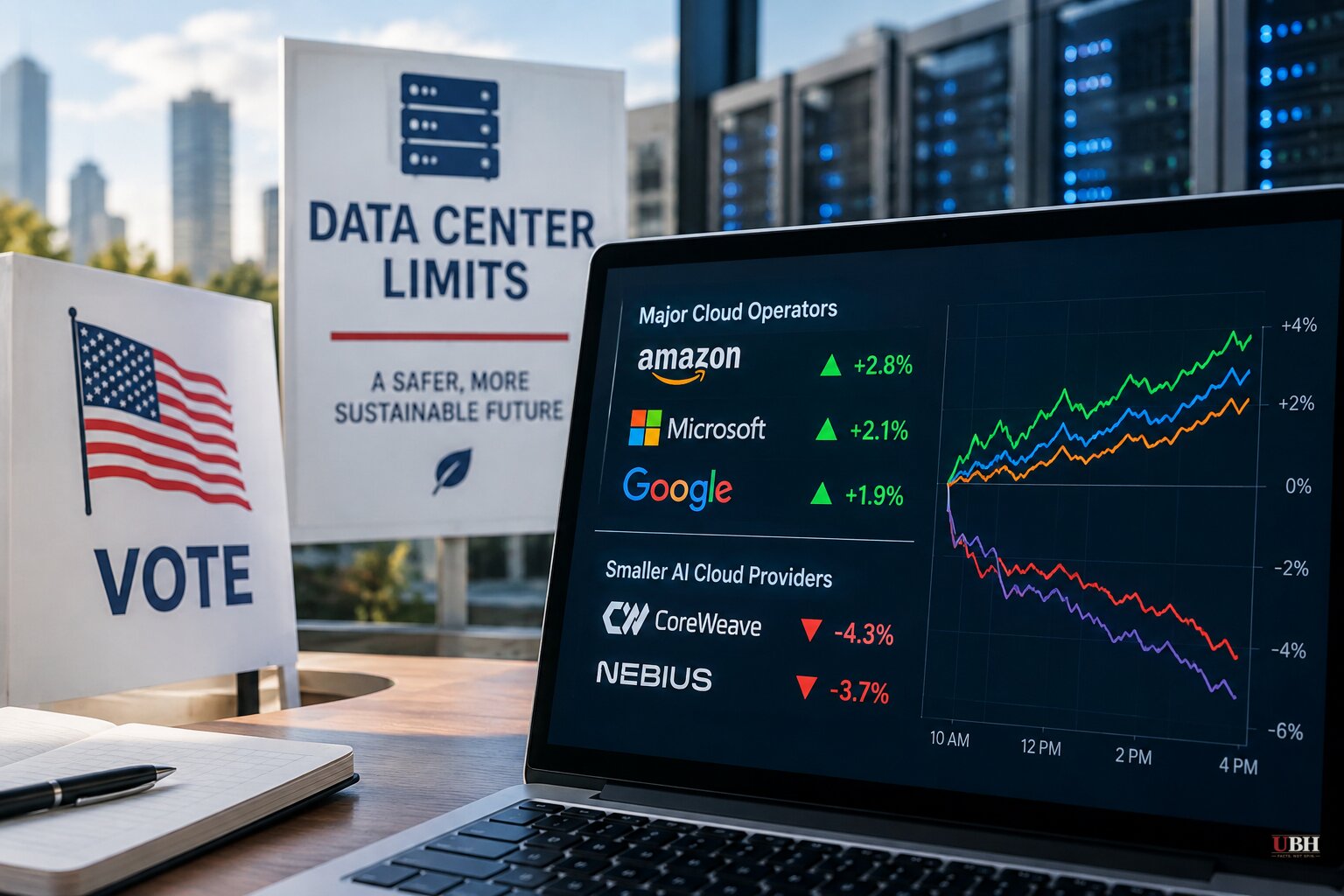
Since Tuesday's midterms, when voters elected Democratic governors pledging to tighten data center rules and passed dozens of local restrictions, the first market read has been a split verdict. Amazon, Alphabet and Meta traded higher Wednesday, Nov. 4. CoreWeave, down 25% this year before the election, traded more than 5% lower, and Nebius was also hit hard.
Tesla and SpaceX, both controlled by Elon Musk, who donated nearly $450 million to Republicans, fell around 5%. Nvidia slipped slightly.
Why the giants and the challengers diverged
Amazon, Microsoft and Google already run enormous networks of data centers filled with Nvidia chips. Smaller rivals are spending billions on facilities that are not finished yet.
If newer projects are delayed or canceled, those challengers could be stuck with expensive expansion plans while the big operators keep earning from capacity already online. That is the argument Business Insider laid out Wednesday.
Paul Golding, a Macquarie analyst, put it in a note to investors: "Approved, permitted pipeline becomes far more valuable." He predicted scarce capacity could push prices up.
There is some price evidence already. Silicon Data, which tracks what it costs to rent Nvidia GPUs through cloud services, has recorded steadily rising prices this year for several popular chips. Brad Gastwirth, global head of research at Circular Technology, said that "if demand keeps growing and protests delay new capacity, that could certainly help support GPU rental pricing."
These are analyst projections, not results. Nobody has yet shown that restrictions are lifting rental prices or shielding the big three's profits.
How much capacity is actually exposed
Goldman Sachs estimates that starting in January, states run by Democrats who support extending or expanding AI construction moratoriums will hold 45% of planned U.S. data center capacity. Texas alone accounts for about a quarter of the planned buildout.
Evercore ISI puts Texas, Georgia and Ohio at more than 40% of all planned capacity. Democrats won governor races in all three, plus Arizona and Nevada.
In Texas, Democrat Gina Hinojosa defeated Republican Gov. Greg Abbott. She has called for a pause on approvals until the legislature passes new rules, and said on the trail: "It stops when I'm governor." Bloomberg reported that roughly 13 gigawatts of Texas capacity is now exposed.
Gordon Johnson of GLJ Research wrote that Texas projects with "power, permits and steel keep going," while "those with power but no state environmental permits slip 12 to 18 months." Some projects may relocate to states like Louisiana or Georgia. Johnson's note added: "The question now is how long the pause lasts."
Redbud Consulting, which tracks ballot measures, counted 38 of 44 data center restriction measures across 10 states passing so far. Analysts cited by Ars Technica said those measures should not touch projects already under construction or approved through 2027. They mostly hit projects planned for 2028.
Libby Cantrill, PIMCO's head of public policy, said that even without statewide moratoriums, "we expect to see a lot more sand in the gears of the AI buildout," with longer permit timelines and more concessions from developers.
The industry's exposure
Senior OpenAI leaders were discussing Wednesday morning whether the results require the company to reset its 2027 data center capacity expectations, according to a person familiar with the conversation. OpenAI's Stargate project is under construction in Texas, and its Project Camellia is planned for Georgia. Meta is building a large Texas site and another in Ohio called Prometheus.
Anthropic warned investors in a securities filing last month that having "significant compute" in the U.S. carries risk, and that moratoriums could delay or prevent construction of the facilities it needs. The company has signaled it could spend up to $895.4 billion on computing power in coming years.
The other side of the argument
Hinojosa's case is about utility bills and water. She has accused developers of "raising our utility rates and depleting our water," and says she wants to halt approvals until a session "that puts Texans first so that we don't have any more communities in Texas who are powerless against these global corporations." She has also called Abbott's own vows to rein in operators an election-year stunt. Abbott's administration had already suspended some approvals before the vote.
The opposition is not purely partisan. Reporting on the results described growing bipartisan opposition, and the local bans passed in towns in Ohio, Kansas, Florida and California.
The industry says it heard the message before the vote. In October, Google's Devi Thomas told the Associated Press she would not call resistance a backlash, but said early consultation with communities is increasingly important. Amazon, Microsoft and Google have said they stopped requiring government officials to sign non-disclosure agreements.
The economic stakes are large. ING economists say AI investment accounted for as much as a quarter of U.S. economic growth this year. Columbia Business School economist Stijn Van Nieuwerburgh expects infrastructure spending to approach $1 trillion a year. CNN's analysis noted that slower buildout could ease inflation pressure and curtail some business models Wall Street already doubts. It also noted that Trump remains president, that he has threatened vetoes, and that governors cannot stop every project.
No one has yet said how long Hinojosa's pause would run. Her plan ties it to legislation, so the length depends on when Texas lawmakers write the rules.
Sources used for this briefing
6 links from 6 independent newsrooms (syndicated copies of the same report count once)
These are the sources it draws on, linked so you can verify.


