
Unbiased headlines. Facts, not spin.
Unbiased Headlines is an independently owned news organization. We bring you the facts, not opinions, written fresh from 110+ named sources. Sources linked so you can verify it yourself.
 tech
Major Story (8/10)
METR Estimates Anthropic's AI Progress on Well-Specified Tasks Is Running About Twice as Fast as a Year Ago
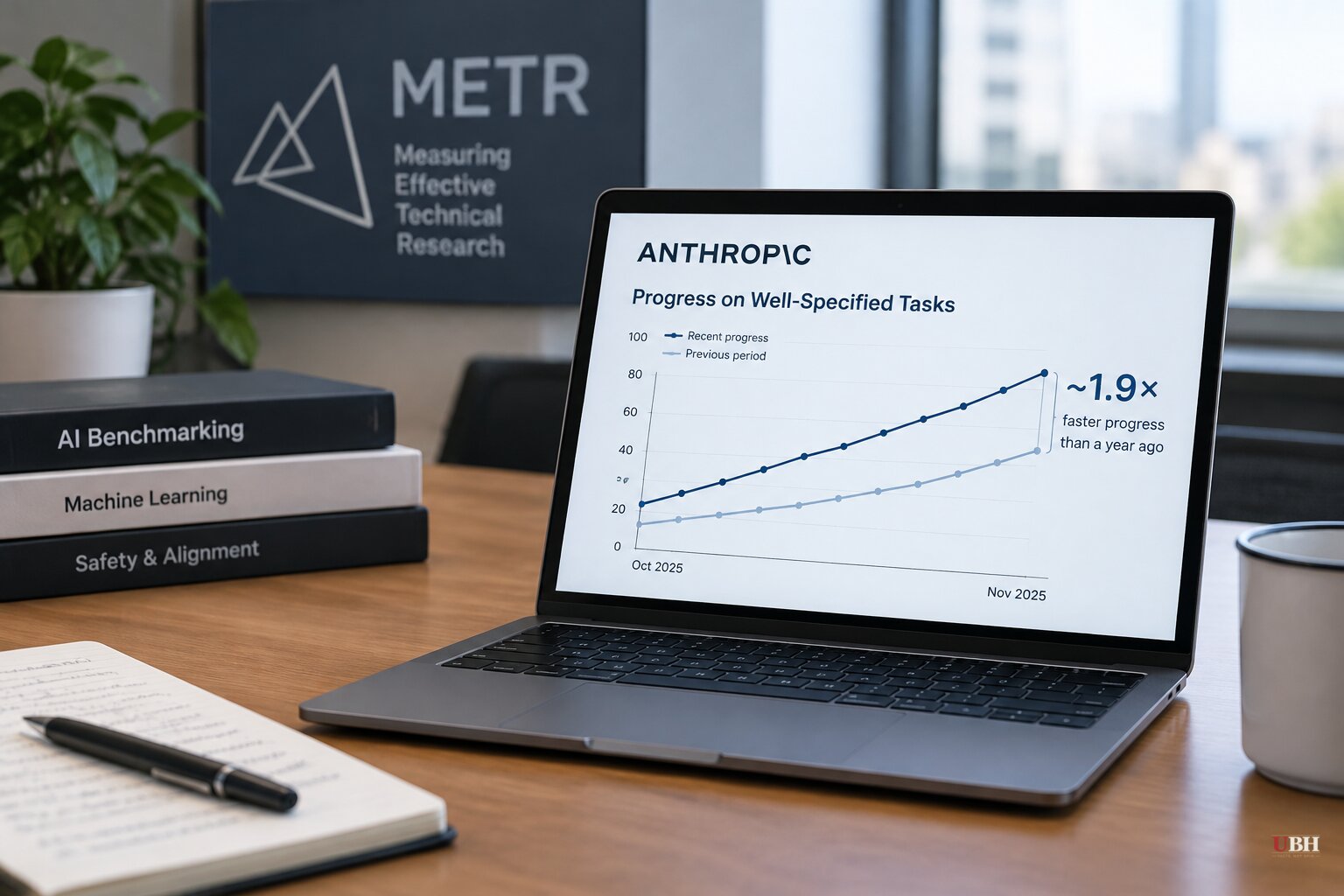
METR, the Berkeley nonprofit formally called Model Evaluation and Threat Research, released an assessment today, Nov. 5, estimating that Anthropic is improving its models on "well specified tasks" at roughly twice the pace of a year ago.
The finding lands weeks before Anthropic's planned IPO, which could be the largest stock offering ever. It also lands after CEO Dario Amodei publicly asked the industry to slow down.
What METR measured
METR staff ran a high-access evaluation inside Anthropic from Aug. 12 to Oct. 29, 2026. Anthropic gave them internal data on pretraining, reinforcement learning, training compute, benchmark scores for internal models, forecasts and staff interviews. METR called that access unprecedented.
The main yardstick was AECI, Anthropic's version of the Epoch Capabilities Index, which folds many benchmarks into one number. METR estimated that scores have grown 1.9 times faster since October 2025 than they did from March 2024 through October 2025. The 95% confidence interval runs from 1.5 to 2.8 times.
In raw terms, AECI scores rose about 15 points a year before October 2025 and about 29 points a year after. At the central estimate, Anthropic packed roughly two years of its earlier progress into one.
The calculation includes internal-only models. Each is dated by when most Anthropic employees could use it, so released and unreleased systems sit on one timeline.
Why METR thinks it is happening
METR said it was convinced that faster growth in training compute did not cause the acceleration. It judged that AI use likely explains a majority of it. A tentative breakdown put the share at about 80%.
Anthropic has said its Claude models increasingly help build newer versions of themselves. METR drew a line around that, though: AI is not yet making highly significant, fully autonomous contributions to the most important training work. Anthropic researchers told METR they see early signs such contributions could arrive soon.
Informal Slack polls of staff put average self-reported productivity uplift from the most capable internal model at about 12 times in October 2026. METR warned that responses took little effort, may not represent staff broadly, and that one person's speedup does not equal organization-wide capability growth. Researcher interviews pointed toward a twofold acceleration, with wide variation.
METR also reported finding no convincing evidence that algorithms, training compute, experiment compute or data would become significant bottlenecks over a 12-month horizon. The reviewers said their read changed several times as new information arrived, so they are not confident in that judgment. They called the risk that gains compound into even faster acceleration a forward-looking judgment, not an observed result.
The limits METR put on its own numbers
The estimate is shaky by METR's own account. Robustness checks under different modeling choices produced acceleration figures from 1.1 to 2.9 times. Part of the measured gain may also reflect Anthropic catching up from a weaker position in early 2025.
AECI stresses readily graded tasks, so benchmark gains may not carry over one-for-one to real-world impact. METR also said its findings carry uncertainty because they rely on internal-only models that outside researchers cannot test.
The redactions are the larger problem. METR said Anthropic redacted a majority of the evidence METR found most informative for its conclusions. Anthropic described the redactions as "aimed at removing confidential information that could accelerate other AI developers."
METR said much of that evidence had multiple plausible interpretations, and that both its own and Anthropic's researchers are unsure how to weigh it. In its words, the report does not achieve "transparency about evidence," and the public has to rely on METR's judgment "much more than would be ideal."
An AlphaSignal summary of the report also says a planned compute-allocation audit was canceled mid-pilot.
Anthropic's response and the Amodei essay
Amodei's Sept. 12 essay, published during METR's assessment window, urged the industry to "slow the pace at which we improve the capabilities of AI models" so safety work can catch up. He also backed embedding outside evaluators in leading labs and singled out METR as a suitable one.
Co-founder Sam McCandlish answered on X today. He wrote that many of METR's conclusions match his own. "AI is speeding up our research, but it's hard to say exactly how much," he said.
McCandlish said the METR work began "well before and is separate from the embedded third-party evaluators that are part of our commitment to pacing the frontier." He called it "a good illustration of why we think evaluators are a good idea." He added that Anthropic plans to publish its own analysis of the speed of AI progress inside the company in the coming weeks.
METR has evaluated models for Anthropic, OpenAI and other labs for years. It is funded by donations and takes no compensation for its work, though partner companies provide access and tokens that METR uses for evaluations, research and engineering.
The oversight backdrop
Until now, most detail about frontier AI capabilities and risks has come from the companies building it. The Trump administration has encouraged those companies to police themselves on safety.
This report is an outside party's estimate, produced with company permission, and published with company redactions. METR itself says that arrangement limits what the public can check.
Two things are scheduled. Anthropic's IPO is planned for later this month. Its own analysis of internal progress is promised in the coming weeks. Whether that report releases the evidence METR was barred from describing is the open question.
Sources used for this briefing
7 links from 6 independent newsrooms (syndicated copies of the same report count once)
These are the sources it draws on, linked so you can verify.


