
Unbiased headlines. Facts, not spin.
Every story is an unbiased news briefing written from 110+ sources across the spectrum — sources linked so you can verify it yourself.
 tech
Notable (5/10)
Event date: September 16, 2026
tech
Notable (5/10)
Event date: September 16, 2026
Bloom Energy Says New Fuel Cell Design Could Cut AI Data Center Costs by $5.5 Billion, Shares Rise 4.5%
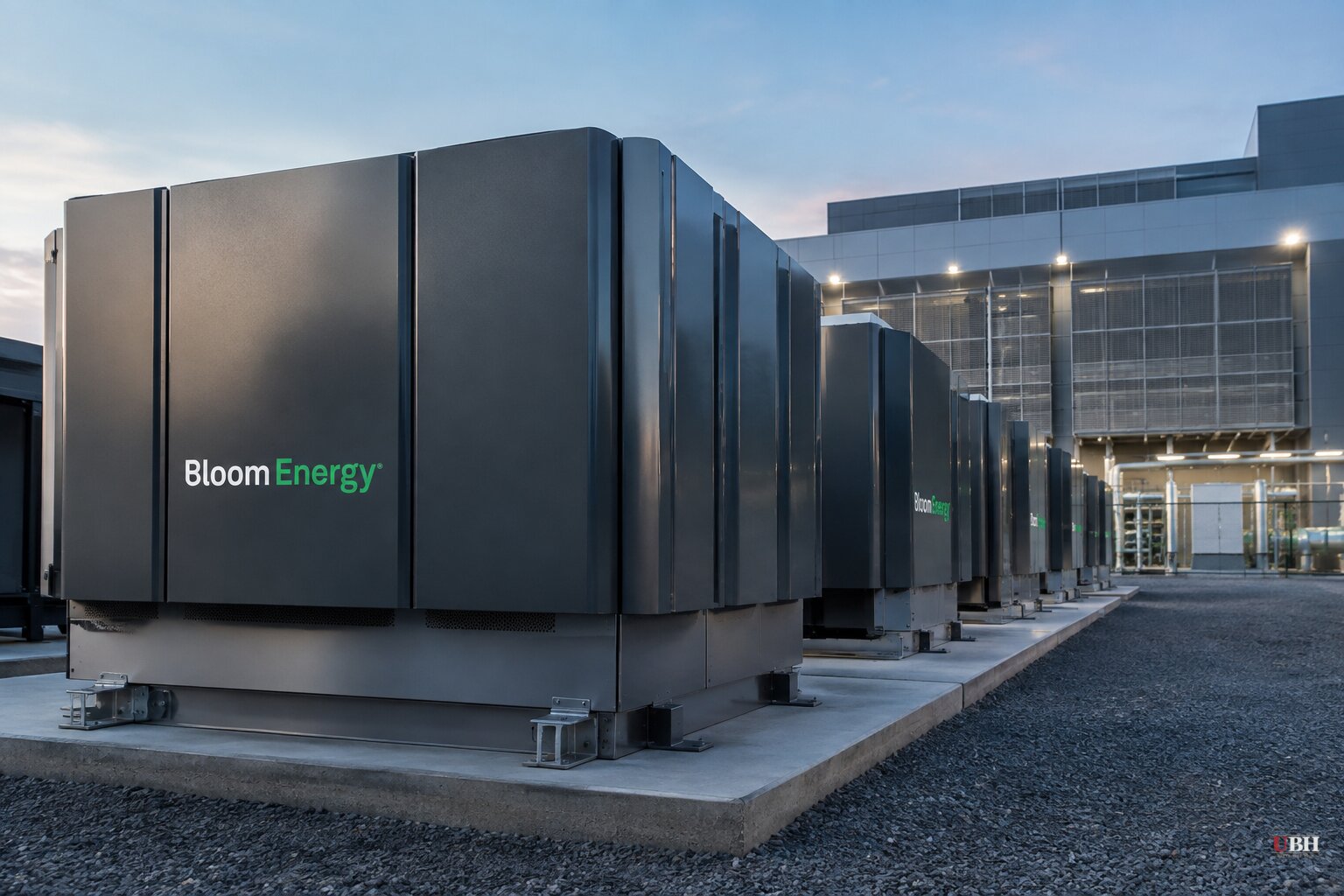
Bloom Energy Pitches a New Way to Power AI
Bloom Energy released a report on September 16 called "The New Rules of AI Power," laying out a fuel cell system built to feed AI data centers direct current power at 800 volts, according to the company's own announcement. The pitch: skip the century-old AC grid setup entirely.
Most data centers pull alternating current (AC) from the grid, then convert it to direct current (DC) for the chips that actually need it. That conversion chain eats power and requires transformers and switchgear, both in short supply right now, according to Bloom Energy.
Bloom's solid oxide fuel cells generate power on-site and produce continuous 800V DC output natively, so there's no conversion step. The cells can run on natural gas, biogas, or hydrogen, according to Crypto Briefing.
The timing lines up with NVIDIA's roadmap. NVIDIA has specified 800V DC for its next-generation Rubin Ultra and Kyber rack architectures starting in 2027, according to Bloom Energy's own release. That's the standard Bloom is building toward.
The Numbers, and Who's Checking Them
Bloom claims its architecture can cut non-compute capital expenditures for a 1 gigawatt AI data center by $3.6 billion, a 27% reduction, and lower five-year total cost of ownership by $5.5 billion, or 9%, compared to conventional AC-based systems.
Those numbers are Bloom's own model, not demonstrated results. Insider Monkey noted the company itself said actual savings will depend on site design, local energy prices, equipment costs, and how customers actually deploy the tech. Nobody has independently verified the $3.6 billion or $5.5 billion figures on a live 1 GW facility.
Simply Wall St raised a separate concern: the 800V DC pitch doesn't address Bloom's reliance on natural gas, which analysts have flagged as a vulnerability compared to battery storage or pure renewable alternatives. If you're grading Bloom against a zero-carbon standard, that's significant. If you view domestically produced natural gas as a reliable, secure fuel source for power-hungry AI facilities that need electricity now, it's less of a concern. Either way, Bloom's system doesn't eliminate the fuel question. It just changes where the fuel gets burned.
The Stock Reaction
Shares of Bloom Energy (NYSE: BE) rose as much as 4.5% the day of the announcement, trading around $271.09, according to TradingView. The stock has moved more than 5% in a single session 103 times over the past year, so TradingView's read is that the market treated this as meaningful news but not a fundamental re-rating of the business.
The move came on the heels of a bigger one. Eight days earlier, Bloom shares had jumped 11.2% on news that the company is scheduled to join the S&P 500 index on Monday, September 21, according to TradingView. Index inclusion typically pulls in demand from funds that track the benchmark, regardless of the underlying business news.
Bloom stock is up 175% since the start of the year but still sits about 21.6% below its 52-week high of $345.85, set in June 2026, per TradingView's figures. A $1,000 investment five years ago would be worth roughly $14,276 today by that same account.
The Business Behind the Pitch
The 800V announcement isn't happening in a vacuum. Bloom posted the strongest quarter in company history in the second quarter of 2026, with revenue up more than 165% year-over-year and crossing $1 billion for the first time, according to Insider Monkey. The company raised full-year revenue guidance to $3.9 billion to $4.2 billion, implying 100% growth at the midpoint, up from the 80% growth projected last quarter and 60% projected at the start of the year. Adjusted EPS guidance climbed to $2.55-$2.85, up from $1.85-$2.25 previously.
Bloom has also been stacking customer relationships that give the DC pitch some real-world weight. Nebius has contracted Bloom for an initial 328 megawatt power supply project, according to Crypto Briefing. Oracle, Equinix, and Brookfield are also named partners, and Hitachi announced a collaboration to deliver Bloom's fuel cell systems to data center and industrial clients in Japan, per TipRanks as cited by TradingView.
Industry surveys cited in Bloom's report project that DC-based architectures could make up 58% of new data center deployments by 2030. That's a projection, not a commitment from any specific operator to build that way.
What's Still Unproven
The open question is whether data center operators actually adopt Bloom's specific architecture at scale, or whether NVIDIA's 800V standard gets built out using other power sources entirely, from grid-tied systems to batteries to other fuel cell makers. Bloom's savings estimates won't be testable against real deployments until facilities using this exact setup go live, and NVIDIA's Rubin Ultra and Kyber racks aren't specified until 2027. Until then, the $3.6 billion and $5.5 billion figures remain projections from the company that stands to profit if they turn out to be right.
Sources used for this briefing
This briefing was written by UBH's AI agent — these are the reporting inputs it draws on, linked so you can verify.


