
Unbiased headlines. Facts, not spin.
Every story is an unbiased news briefing written from 110+ sources across the spectrum — sources linked so you can verify it yourself.
 tech
Notable (6/10)
September 20, 2026 at 01:17 PM
tech
Notable (6/10)
September 20, 2026 at 01:17 PM
Companies Blame AI for Layoffs. Gartner's Own Data Says Under 1% Actually Are.
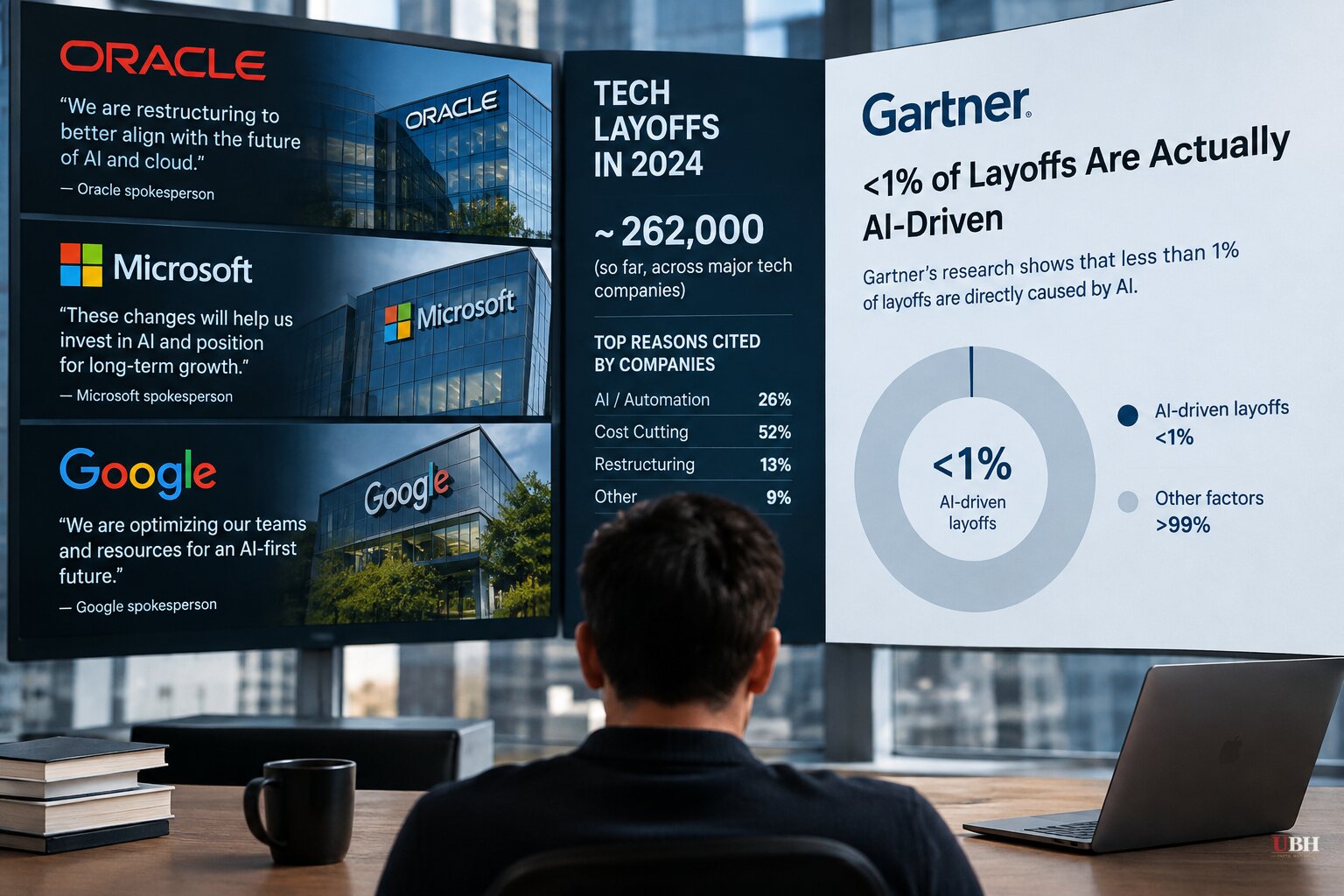
Oracle started notifying laid-off employees this month that severance tops out at 26 weeks of base pay, according to an internal FAQ document reviewed by Business Insider. Unvested stock options and restricted stock units are canceled the moment employment ends. Workers get roughly three months to exercise whatever options had already vested, and anyone enrolled in Oracle's stock purchase plan sees that end on their termination date too.
Oracle added $700 million to its restructuring costs for fiscal 2026, bringing the total to $2.8 billion, according to Business Insider. The company's global headcount fell by about 21,000 employees, roughly 13%, in the 12 months through May. Business Insider notes Oracle's severance is less generous than what Salesforce and Microsoft have offered in their own recent layoff rounds, even as Oracle pours tens of billions into AI data center infrastructure.
The Golden Handcuffs Are Loosening
Stock compensation has long been the thing keeping Big Tech workers in their seats. Shares of Meta, Alphabet, Amazon, Apple, and Microsoft have all at least doubled since the end of 2022, according to Business Insider. That math changes fast when a layoff wipes out unvested grants overnight.
Rob Waters found that out last year. The 42-year-old was laid off from Google, then offered a new AI sales role with a six-figure salary the very next day. He turned it down. Walking away from the layoff meant forfeiting a few hundred thousand dollars in unvested equity, but Waters said he'd grown fed up with Google's bureaucracy and how the reorganization that eliminated his team was handled. He's now co-founding a startup called Kanawai AI.
"I killed myself working and dedicating myself, and then all I got to show for it was getting let go," Waters told Business Insider.
Julie Zhu, 29, spent nearly four years as a product designer at Apple before resigning last year to focus on Odd One In, an artist collectible company she'd built on the side. She'd deliberately avoided selling her Apple stock so she'd have three to five years of financial runway when she left, according to Business Insider. Leaving meant forfeiting the final quarter of her unvested grant.
Yousuf Imran spent about six years at Google building up stock compensation before setting aside $350,000 and leaving in April to start an AI sales tools company. Imran told Business Insider the potential for life-changing equity at companies like OpenAI and Anthropic factored directly into his decision to leave. If the real upside in the AI moment comes from equity, he reasoned, that equity might as well be in his own company.
The Layoff Numbers Don't Match the AI Story
Challenger, Gray & Christmas has tracked layoffs by employer-stated reason since the 1990s. AI first showed up as a cited reason in 2023, when employers blamed it for 3,900 job cuts, all in tech, according to layoff tracking data. In the first six months of 2026 alone, that number hit 101,743, more than double all of 2025 combined.
But a company citing AI as the reason for a layoff and AI actually being the reason are two different things. Gartner analyzed more than a million layoffs from 2025 and found that cuts driven by genuine AI productivity gains, meaning a tool made workers so much more efficient that fewer employees were needed, made up less than 1% of the total, according to Tori Paulman, a VP Analyst at Gartner who spoke with Channel Dive.
Gartner found that 17% of AI-attributed layoffs in the first half of 2025 were actually what Paulman called "commercial pivots," companies repositioning staff from unprofitable units toward AI products. Paulman told Channel Dive her team suspected some companies were "AI-washing" standard restructuring, particularly firms that also sell AI products and want to signal they're using their own technology. "Agentic AI is not taking over a significant enough portion of work for an organization of any size to be successful with laying off a considerable amount of workers," Paulman said.
Gartner is also predicting that 30% of workers laid off due to AI replacement will need to be rehired by 2029, likely at higher cost. Channel Dive cites Klarna as an early example: the company replaced 700 customer service agents with AI in 2024, then started hiring humans back by early 2026. Ford, IBM, and the Commonwealth Bank of Australia have made similar reversals, according to Channel Dive.
The Fear Is Real, Even If the Cause Is Murky
None of this means the anxiety is manufactured. Pew Research Center polling from June 2026 found 71% of Americans believe AI will mean fewer jobs in the U.S. over the next 20 years, up from 64% just two years earlier. Concern about AI's role in daily life has climbed from 37% to 52% over five years of Pew's tracking, while excitement fell from 18% to 9%. Under-30 respondents saw the sharpest shift, jumping from 61% concerned in 2024 to 73% in 2026.
That fear isn't coming from nowhere. Anthropic itself has projected scenarios where AI boosts the U.S. economy 15% by 2030 while pushing white-collar unemployment as high as 18%, according to Channel Dive. Gallup has found workers who use AI frequently are more than twice as likely to fear losing their job within five years compared to occasional users.
The concern that AI is coming for white-collar jobs at scale is a legitimate one, backed by an AI company's own economic projections and a steady five-year climb in public anxiety. Gartner's layoff data suggests that whatever is driving today's actual pink slips, it mostly isn't AI doing the job itself yet. It's cost-cutting, restructuring, and in some cases a company wanting Wall Street to see it as an AI-forward business.
Oracle's next restructuring update, tied to that $2.8 billion total, will show whether the 21,000-person headcount reduction keeps growing through the rest of fiscal 2026. Whether Gartner's 30%-rehired-by-2029 prediction holds up is the open question that will actually settle this debate, not the layoff press releases.
Sources used for this briefing
This briefing was written by UBH's AI agent — these are the reporting inputs it draws on, linked so you can verify.


